

Planning for unexpected health issues can feel like a heavy burden, especially when you think about who will handle your affairs if you can’t.
It’s easy to get caught up in worries about losing control too early or dealing with challenges that slow everything down right when speed matters most.
These kinds of uncertainties often create stress for families and lead to avoidable headaches.
A springing power of attorney offers a thoughtful approach to ease those concerns by stepping in only when necessary.
In this blog, I will explain the mechanics of springing power of attorney, along with its advantages and disadvantages, and its potential risks.
You will also learn how it stacks up against alternatives, the legal aspects, and some frequently asked questions to help you make an informed decision.
What is a Springing Power of Attorney?
A springing power of attorney is a legal document that grants someone, known as your agent, the authority to make financial or medical decisions on your behalf, but only after a specific event occurs.
This typically occurs when someone becomes mentally or physically incapacitated to make decisions for themselves.
The instrument has statutory roots in late-20th-century state legislation. California’s adoption of the Uniform Durable Power of Attorney Act was among the earliest frameworks to codify conditional activation.
Today, most states recognize springing POAs under their own versions of the Uniform Power of Attorney Act (UPOAA), though the requirements for triggering and certification vary by jurisdiction.
A springing POA becomes effective only when the person who created it is declared legally incapacitated by a written certification from a licensed physician or a court order.
Because activation depends on a clearly defined triggering event, the document must include precise language describing what qualifies as incapacity.
Clear definitions and certification requirements help prevent delays, disputes, or confusion when the authority is finally needed.
How a Springing Power of Attorney Works?
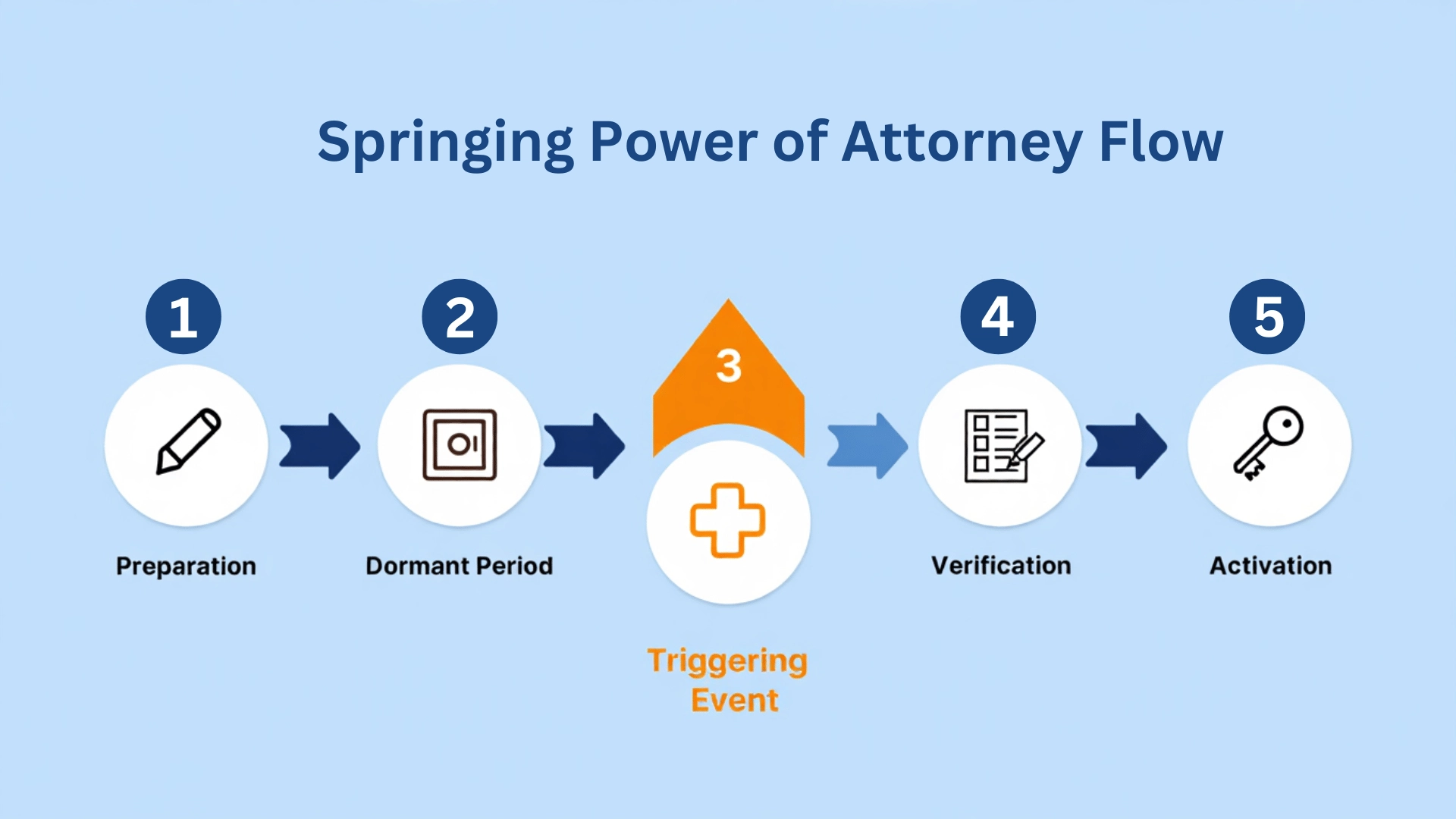
Knowing the inner workings of a springing power of attorney lets you grasp when and how it kicks in to protect your decisions during incapacity.
1. Creation and Legal Drafting Process
When preparing a springing power of attorney, you begin by outlining the specific powers you want to grant, such as managing finances or healthcare choices.
A trusted agent must be selected, understanding that authority begins only after the triggering event occurs, and the document must comply with state law requirements.
The American Bar Association(ABA) POA guidelines mention that signing before a notary and witnesses strengthens validity and reduces future disputes.
Working with an attorney helps prevent drafting errors that could invalidate the document later. State-specific rules matter more than most people realize.
In New York, for example, a POA that does not comply with the state’s statutory short-form requirements can be outright refused by financial institutions, a practical hurdle that has nothing to do with the document’s legal validity and everything to do with institutional compliance standards.
In my years reviewing estate documents for probate-adjacent cases, the gap between “legally valid” and “operationally accepted” is one of the most common surprises families encounter.
2. Defining the Triggering Event Clearly
To make a springing power of attorney effective, you need to specify the triggering event with precise terms right from the start.
This usually means defining incapacity as the “inability to make informed decisions” due to mental or physical impairment.
Broad phrases such as “when needed” can create confusion, disputes, or even court involvement.
If those disputes do escalate into formal legal proceedings, understanding what litigation involves gives families a realistic picture of the cost and timeline they are facing.
It is recommended to obtain certification from two licensed physicians to expedite activation and avoid ambiguity. Consider including details on qualifying conditions or the duration of incapacity.
Well-defined terms create a clear process for family members and professionals, reducing delays during critical situations.
The single most common failure point I have seen in springing POA documents is vague triggering language.
A document held up for weeks because the phrase “mentally incapacitated” appeared without specifying who certifies it or how many physicians must agree is not a drafting edge case; it is a recurring pattern.
Getting that precision right at the drafting stage costs nothing and prevents enormous friction later.
3. What Happens Once It Becomes Effective?
Once the springing power of attorney activates, authority shifts to your agent, allowing them to handle tasks such as paying bills or making medical calls, as outlined.
Financial institutions verify the document and proof of incapacity, such as physician letters or affidavits, before granting access.
The agent must act in your best interest, keeping detailed records to avoid legal issues. Banks sometimes request additional verification, so early communication is helpful.
The agent is bound to act in the principal’s best interest and maintain accurate records. Understanding this transition helps families anticipate practical steps and avoid complications.
Springing vs Durable Power of Attorney
Springing and durable powers of attorney differ in activation and reliability, guiding estate planning choices.
| Feature | Springing POA | Durable POA |
|---|---|---|
| Activation | Triggers on proven incapacity | Effective immediately upon signing |
| Use Cases | Healthy individuals wanting autonomy | Chronic illness or urgent needs |
| Reliability | Vulnerable to challenges | Stronger legal enforceability |
| Medical proof | Required | Not Required |
| Pros | Retains control while capable; protects privacy | Immediate access; no disputes over capacity |
| Cons | Delay in proof; court fights possible | Risk of early agent abuse |
| Risk of Misuse | Lower but powers delayed | Higher, immediate access |
| Bank Acceptance | May face additional verification hurdles | Generally accepted with less friction |
| Best Paired With | Living trust, advance healthcare directive | Standalone or with simple will |
Advantages of Springing Power of Attorney
A springing power of attorney can be a smart option because it activates only upon a specific condition, like incapacity, which supports careful estate planning.
It allows the principal to keep full control over personal and financial matters until the triggering event occurs.
You can tweak or revoke it at any time before activation, giving you flexibility for life’s changes.
There is also an option to customize triggers to ensure the document fits your needs, limiting powers to defined circumstances.
This setup protects your privacy, as your agent can’t peek or act prematurely, thereby avoiding any risk of misuse while you’re able to make your own decisions.
It is also a useful instrument for individuals who have had prior difficult experiences in financial relationships where granting immediate authority to another person carries real personal risk.
The conditional structure provides a built-in layer of protection that a durable POA simply does not offer, and for many clients, that peace of mind is the deciding factor.
Disadvantages of Springing Power of Attorney
While a springing power of attorney sounds practical, it comes with drawbacks that could complicate things when you need it most.
A common drawback of the springing POA is the delay in activation, which might leave bills unpaid or decisions stalled, as proving incapacity takes time.
The HIPAA privacy rules for professionals can hinder doctors’ ability to share information regarding the medical inability, further delaying the process.
Family fights can erupt over “incapacity” proof, leading to legal battles and stress. Revocation before springing is possible but tricky if doubts linger.
Sometimes, banks may require additional verification, creating administrative obstacles. If triggers aren’t clearly defined, it can lead to a higher risk of litigation and costly battles.
These risks make springing less reliable for urgent health scenarios. Many experts favor immediate options for smoother protection.
When Should You Choose a Springing POA Over a Durable POA?
The right instrument depends on your health outlook, your relationship with your chosen agent, and how much access you are comfortable granting before incapacity occurs.
A springing POA is generally the stronger choice when you are currently healthy and do not anticipate near term incapacity.
It also works well if you have concerns about an agent acting prematurely on financial accounts.
A durable POA is typically better suited for individuals managing a progressive condition, planning for imminent surgery, or in situations where immediate agent access may be required.
If joint property ownership is part of your planning, it is also worth understanding what happens legally when two names are on a deed and one person dies, since POA authority does not transfer property title on its own and the two instruments need to work in coordination.
Legal Implications of Springing POA

Understanding the legal aspects of a springing power of attorney helps you see how it fits into your overall plans and what responsibilities it entails.
Your agent has fiduciary duties, meaning they must act in your best interest, avoid conflicts, and keep accurate records.
Courts have increasingly scrutinized agent misconduct in this context.
In In re Ferrara, 7 N.Y.3d 244 (2006), the New York Court of Appeals reinforced the principle that an agent under a power of attorney holds a position of trust equivalent to a fiduciary, and that self-dealing or unauthorized transfers can expose an agent to both civil liability and criminal prosecution.
While that case involved a different POA structure, the fiduciary standard it affirmed applies equally to springing instruments once they activate.
Courts might get involved if disputes arise over activation or agent actions, potentially leading to oversight or removal.
In cases where an agent’s misconduct causes financial or reputational harm, injured parties have also pursued claims that overlap with fraud-adjacent and defamation-based causes of action, though these are distinct legal tracks that require separate counsel.
Always consult a licensed estate planning attorney to ensure the document aligns with your needs and the laws of your specific state.
How to Revoke a Springing Power of Attorney?
Revocation is straightforward while you are still legally competent. The process typically involves five steps:
- Draft a clear revocation document: State your full intent to revoke the existing springing POA, including the original execution date, your name, and the agent’s name.
- Sign and notarize properly: Execute the revocation following your state’s exact requirements (matching the original POA’s formalities, typically witnesses + notary).
- Deliver to agents: Send certified copies to the named agent and any successor agents listed in the original document.
- Notify third parties: Contact all banks, medical providers, and others holding the original POA with written notice and revocation copy.
- Destroy originals you control: Shred or indelibly mark “REVOKED” all copies in your possession to avoid misuse.
Key Factors to Consider Before Creating a Springing POA
Before setting up a springing power of attorney, planning for some factors in advance can help ensure the document functions smoothly and protects your interests when it becomes necessary.
- Check Acceptance Policies of Financial Institutions: Some banks hesitate to accept springing POAs due to verification requirements
- Decide how Incapacity Will Be Evaluated: Consider whether one doctor, two physicians, or a specialist should confirm incapacity to make the process clearer and faster.
- Plan how The Document Will Be Accessed: Store the original in a secure but reachable location so your agent can obtain it quickly when activation is required.
- Consider Timing for Financial Responsibilities: Ongoing obligations such as mortgage payments, taxes, or insurance may require immediate action.
- Coordinate with Other Estate Planning Documents: Ensure the springing POA aligns with your will, trust, and healthcare directives to avoid conflicting authority.
- Include a companion HIPAA authorization: A pre-signed HIPAA release naming the certifying physician eliminates one of the most common activation delays and costs nothing to add at the drafting stage.
- Review the reservation of rights language in any insurance policies: If your financial plan includes insurance products, understand how a reservation of rights by an insurer might interact with your agent’s authority to act on your behalf once the POA is active.
Conclusion
A springing power of attorney can provide a balanced way to safeguard your affairs, stepping in precisely when incapacity strikes while preserving your independence beforehand.
Yet, its value hinges on clear drafting, trusted agents, and awareness of state-specific complications that might cause delays or disputes.
Weighing these against options like a durable POA ensures your plan aligns with your health outlook and family dynamics, minimizing risks during vulnerable times.
Ultimately, this tool empowers proactive estate planning, but it’s no substitute for professional guidance tailored to your situation.
If you’re considering getting one, consult an estate attorney today to review your options and secure peace of mind.
If you still have any queries or concerns, drop them in the comments below. I’d be happy to help you out further!
Frequently Asked Questions
How Much Does a Springing Power of Attorney Cost?
The cost ranges from $150 to $500, depending on state laws and document complexity, with an attorney, while online templates may cost $20 to $100.
Can I Name Multiple Agents to Act Together Under a Springing POA?
Yes, you can name co-agents, but specify whether they must act jointly or independently to avoid decision-making conflicts.
Does a Springing Power of Attorney Expire After a Certain Time?
No, it remains valid until revoked or the principal passes away, but regular reviews keep it up to date with life changes.
Is a Springing Power of Attorney Valid Across All States?
Not automatically. While most states recognize springing POAs, the requirements for execution, triggering, and certification vary significantly.
A document drafted under California law may face acceptance challenges in Florida or New York if it does not meet those states’ specific statutory requirements.
If you own property in more than one state or spend significant time across state lines, ask your attorney whether a single document covers all jurisdictions or whether state-specific instruments are advisable.