
When a loved one can no longer make decisions for themselves, whether due to age, illness, or injury, the legal system offers tools to step in and help. But going through those tools is rarely straightforward.
Families often find themselves in unfamiliar legal territory, facing paperwork, court hearings, and terminology that seems designed to confuse rather than clarify.
The process moves quickly when urgency strikes, and a single misstep, filing the wrong petition, misunderstanding a state-specific term, or missing a court deadline, can delay protection for someone who needs it now.
Before you make any decisions, it’s worth taking a moment to slow down. Understanding the legal framework available to you is not just helpful.
The most common point of confusion is the terms themselves. Conservatorship typically handles financial and legal matters, while guardianship focuses on personal care and daily decisions.
But in some states, those definitions are reversed, combined, or replaced entirely with different language. It’s the difference between acting with confidence and acting in the dark.
What is Conservatorship?
Conservatorship is a court-ordered legal arrangement in which a designated individual is given the authority to manage the financial and legal affairs of an adult who is unable to do so independently.
This situation often arises in cases involving elderly individuals with conditions such as dementia or Alzheimer’s, or adults with physical or mental disabilities that affect decision-making capacity.
The conservator is responsible for handling essential financial matters, including managing income, paying bills, overseeing property, and making important legal and financial decisions, all under the supervision of the court.
There are three primary types of conservatorship, each based on the level of control needed:
- General conservatorship: Grants broad authority over financial and legal affairs when an individual cannot manage their own matters
- Limited conservatorship: Restricts authority to specific areas while preserving independence in other aspects, especially for individuals with developmental disabilities
- Temporary conservatorship: Used in urgent situations and lasts until the court establishes a permanent arrangement
California courts have established that a conservatorship cannot be granted unless it is the least restrictive alternative available.
Under California Probate Code Section 1800.3, the court must make this finding expressly before appointing anyone.
This reflects a broader legal principle shared by many states, including Tennessee, that individual autonomy should be preserved wherever possible, and court-imposed authority should be used only to the extent genuinely necessary.
In every case, the conservator must act in the best interest of the individual and provide regular reports to ensure accountability and transparency.
What is Guardianship?
Guardianship is a legal arrangement in which a court appoints an individual to make personal, medical, and day-to-day decisions for someone who is unable to care for themselves.
Unlike conservatorship, which focuses mainly on finances, guardianship centers on the well-being and personal needs of the individual.
It is most commonly used for minors without parents or adults who are physically or mentally unable to manage their daily lives.
A guardian is responsible for decisions related to healthcare, living arrangements, education, and overall care. Depending on the situation, guardianship can be temporary or long-term.
Courts increasingly favor limited guardianship arrangements, which tailor the scope of the guardian’s authority to the individual’s specific areas of incapacity rather than removing all decision-making rights at once.
A guardianship may, for example, cover medical decisions while leaving financial matters intact if the individual retains that capacity.
Full guardianship, which removes substantially all decision-making authority, is generally reserved for situations where the individual cannot safely manage any aspect of their personal affairs independently.
In some states, guardianship may also include limited financial authority, but its primary purpose remains focused on personal care and protection.
Conservatorship vs Guardianship: Key Differences
Conservatorship and guardianship are often used interchangeably, but they serve different legal purposes. While both roles are designed to protect individuals, choosing between conservatorship and guardianship depends on financial or personal reasons.
| Feature | Conservatorship | Guardianship |
|---|---|---|
| Primary Focus | Financial and legal decisions | Personal care and well-being |
| Applies To | Adults (typically incapacitated) | Minors and incapacitated adults |
| Responsibilities | Managing money, property, and legal matters | Healthcare, living, and daily needs |
| Court Oversight | Required for financial reporting | Required for care-related decisions |
| Scope of Authority | General, limited, or temporary, determined by court order | Full or limited, depending on the court order |
| Duration | Can last for the conservatee’s lifetime; reviewed periodically by the court | For minors, it typically ends at age 18; for adults, it continues until capacity is restored or the ward dies |
| Typical cost range | $5,000–$50,000 depending on complexity, legal fees, and evaluations | $5,000–$50,000; same range; varies by state, court, and whether contested |
| Rights retained | The conservatee may retain voting rights, the right to marry, and personal decisions; limited conservatorship preserves all other rights by default | Ward may retain specific rights under limited guardianship orders; rights restoration can be petitioned if capacity improves |
What Happens When No Legal Planning Documents Exist?
When a person becomes incapacitated without prior planning in place, no durable power of attorney, no healthcare directive, or no living trust, the family has no legal authority to act, no matter how close they are.
Banks will not release funds, and hospitals may refuse to share medical information. Even basic financial tasks like paying rent or managing benefits require court approval.
In such cases, establishing a conservatorship or guardianship becomes the only option when guardianship and less restrictive alternatives are not available.
This process can take months, leaving affairs uncertain. If family members disagree on who should take responsibility, the case can become contested, leading to higher costs and longer timelines.
From experience, this situation is common but preventable.
Families who plan ahead with proper documents rarely need court intervention, saving both time and stress later.
When is Conservatorship or Guardianship Needed?
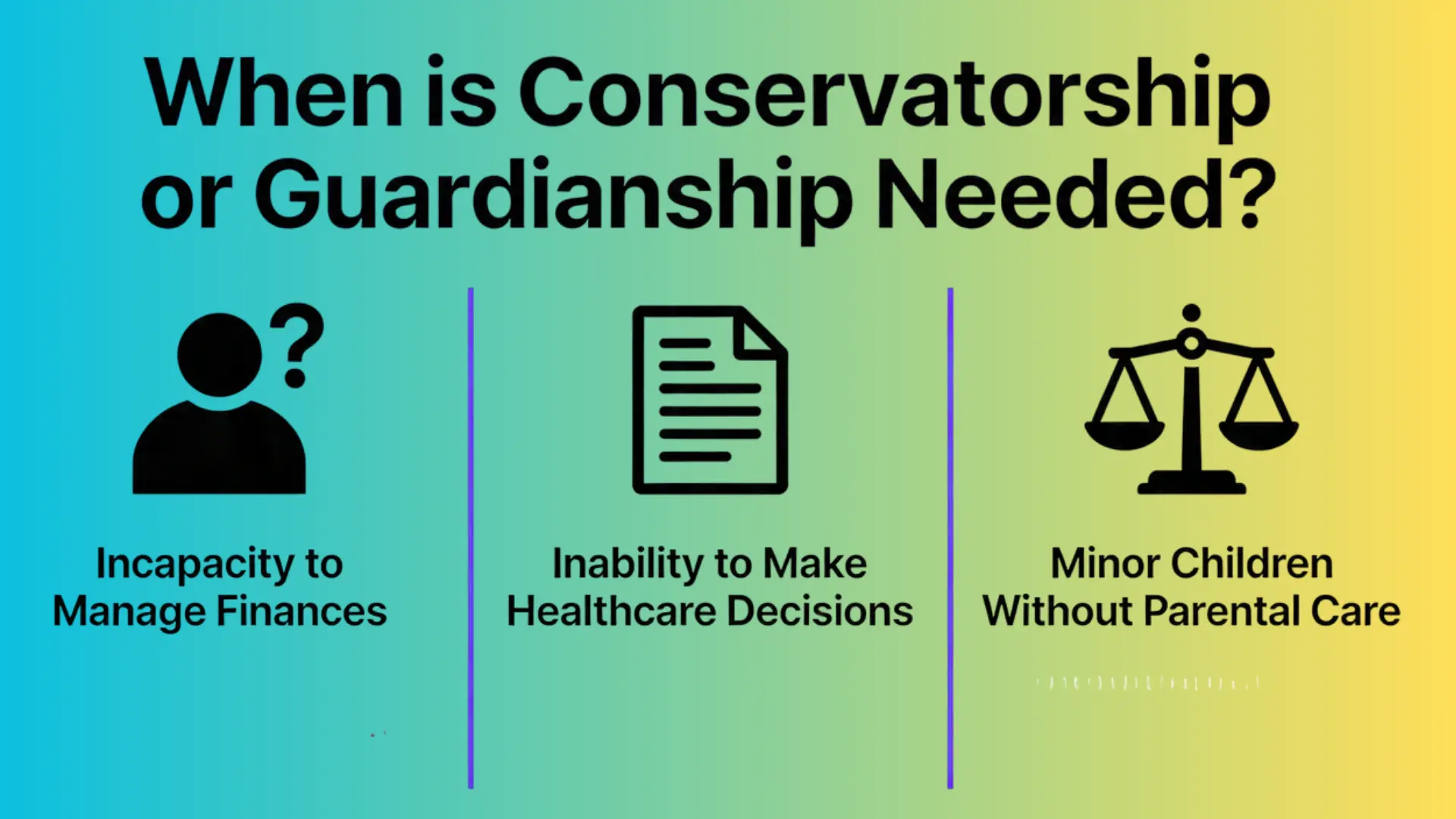
Most families don’t think about conservatorship or guardianship until a crisis forces the conversation.
When a child loses both parents due to death or abandonment, or when a parent is dealing with a serious infant health crisis, a legal guardian is required to make decisions about education, healthcare, and living arrangements.
According to the National Academy of Elder Law Attorneys (NAELA), unless someone has pre-existing legal authority to act, the court must be asked to appoint someone to assist, especially when a person can no longer make safe and informed decisions about their health.
Situations That Commonly Require Court-Appointed Authority:
- Cognitive Decline in Older Adults: Dementia, Alzheimer’s disease, and similar conditions affect memory and judgment. When a person cannot protect their own interests, a guardian or conservator may be appointed.
- Adults With Physical or Mental Disabilities: A disability alone is not enough. If someone cannot make informed decisions about health, finances, or safety, court involvement may be required.
- Minors Without a Legal Guardian: If a child loses parents due to death or abandonment, a legal guardian is needed to make decisions about education, healthcare, and living arrangements.
- Sudden Incapacity Due to Illness or Injury: Events like a stroke or a brain injury can remove decision-making ability. Without prior planning, families may lack legal authority to act.
- Risk of Financial Exploitation or Neglect: Vulnerable individuals may be targeted for financial abuse. A conservator can be appointed to protect assets and prevent misuse.
- No Prior Legal Planning Documents in Place: Without a power of attorney or healthcare directive, families must seek court approval for decisions that documented planning could have authorized immediately. These documents cannot be validly created after capacity is lost, which is why the absence of planning is itself a trigger for the court process.
Legal Process: How to Establish Conservatorship or Guardianship
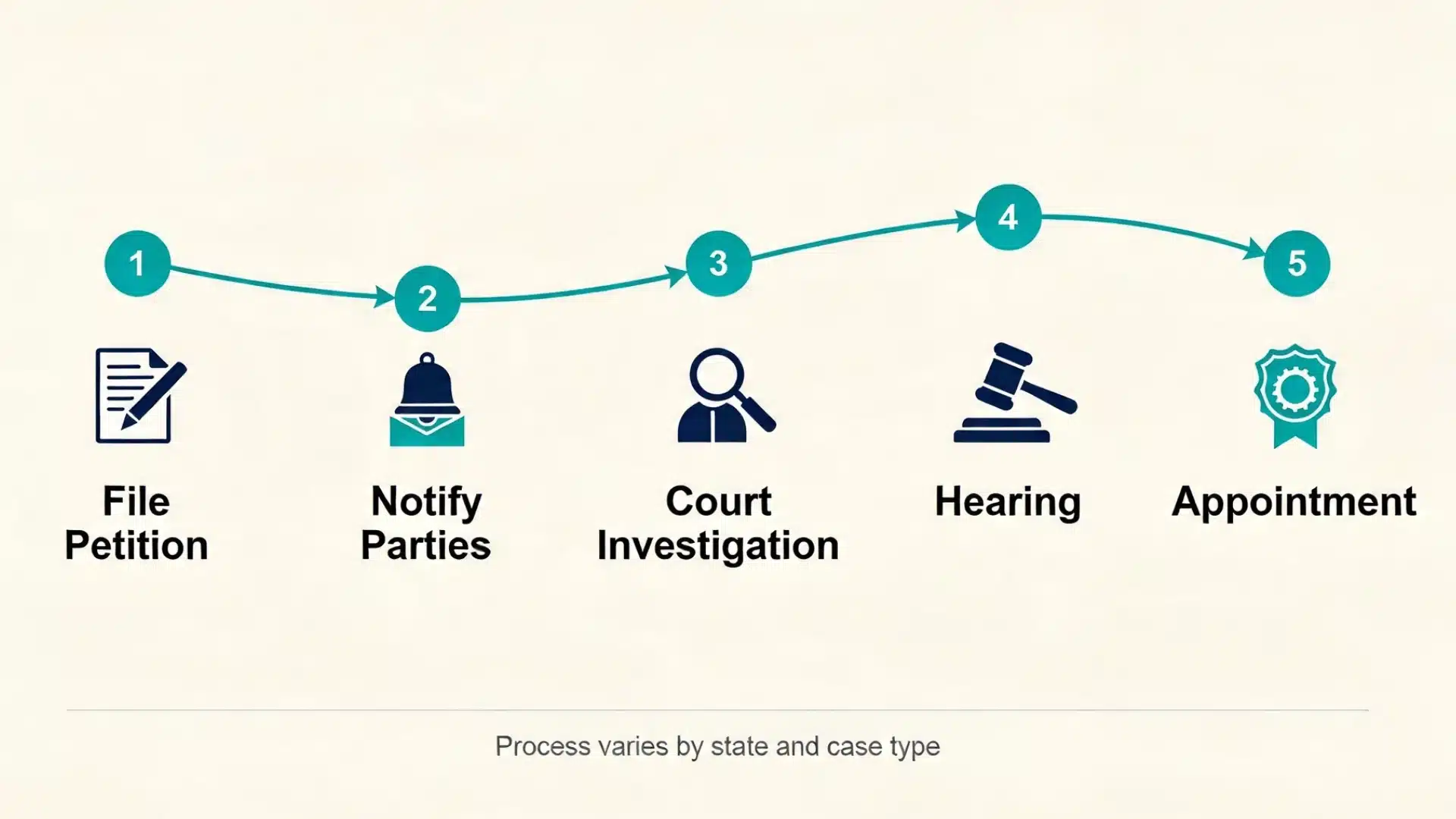
This process ensures that authority is granted only when appropriate and that the individual’s best interests remain the central focus.
Each step is intended to confirm that the arrangement is justified, that no less restrictive option is available.
Cases usually follow one of two paths. In an uncontested case, all parties agree on the need for the arrangement and who should be appointed, so the process moves faster.
In a contested case, where a family member, the individual, or another party objects, more hearings are required, costs increase, and the case takes longer to resolve.
Knowing which path a case may take is one of the most important steps before filing.
1. File a Petition
The process begins with filing a formal petition in the appropriate court. This document must clearly explain why the arrangement is needed, supported by specific facts rather than general concerns.
It often includes medical records, financial details, and examples of the individual’s inability to manage personal or financial matters.
The petitioner must also propose a suitable guardian or conservator, outlining their relationship, qualifications, and willingness to take on the responsibility.
2. Notify Interested Parties
Once the petition is filed, legal notice must be given to all relevant parties. This typically includes immediate family members, close relatives, and sometimes caregivers or other involved individuals.
The purpose is to ensure transparency and prevent decisions from being made without awareness.
Notified parties have the right to respond, raise objections, or present alternative suggestions for who should be appointed.
3. Court Visitor or Independent Investigator
The court appoints an independent court visitor, sometimes called a guardian ad litem or court investigator, depending on the jurisdiction, to meet personally with the individual, assess their functional capacities, and provide an independent recommendation to the judge.
Medical and psychological evaluations are frequently required at this stage.
The court visitor’s report carries significant weight in the judge’s final determination and is one of the primary safeguards against conservatorships or guardianships being granted without genuine need.
4. Court Hearing
During the hearing, all evidence is presented before a judge. The individual at the center of the case has the right to attend, speak, and be represented by legal counsel.
In California, following reforms enacted through AB 1194 in 2022, the appointed attorney’s role is explicitly that of a zealous independent advocate for the proposed conservatee, not simply a representative of the conservatee’s “interests” as others define them.
The judge evaluates whether the legal criteria for incapacity are met and whether the proposed guardian or conservator is appropriate.
5. Appointment and Ongoing Oversight
If the court approves the request, it formally appoints a guardian or conservator and defines the scope of their authority. This authority may be full or limited, depending on the individual’s needs.
After the appointment, ongoing court supervision is required. The appointed person must submit regular reports detailing financial transactions, healthcare decisions, and the individual’s overall well-being.
In many jurisdictions, the court also schedules periodic reviews to reassess whether the arrangement remains necessary or whether the scope of authority should be adjusted as the individual’s circumstances change.
Responsibilities and Limitations of Court-Appointed Roles
Court-appointed roles come with clear duties and strict limits. As outlined by the American Bar Association’s Commission on Law and Aging, guardians must follow both the court order appointing them and applicable state laws.
Misuse of authority, whether through financial mismanagement, neglect, or self-dealing, can result in removal from the role, personal financial liability, and in serious cases, criminal prosecution.
California’s AB 1194 introduced civil penalties of up to $10,000 per act of abuse by a professional fiduciary, reflecting a broader national trend toward stricter accountability.
| Aspect | Details |
|---|---|
| Primary Responsibility | Act in the best interest of the individual at all times |
| Financial / Personal Duties | Manage finances (conservator) or handle personal care (guardian) responsibly |
| Record Keeping | Maintain accurate records of decisions, expenses, and actions |
| Court Reporting | Submit regular reports and updates to the court |
| Follow Legal Orders | Comply with all court instructions and legal guidelines |
| Authority Limits | Cannot act beyond the powers granted by the court |
| Approval Requirements | Must seek court approval for major decisions in some cases |
| Accountability | Subject to court review and possible removal if duties are mismanaged |
| Ethical Boundaries | Cannot use authority or assets for personal benefit |
Guardianship vs Conservatorship in Different States
The definitions of conservatorship and guardianship vary. Each state applies its own terminology and legal standards, which means a filing that works in one state may be unrecognizable in another. Below are four states with notably distinct approaches.
1. California
California maintains one of the clearest separations between the two roles. Conservatorship applies exclusively to adults and is divided into two types: conservatorship of the person and conservatorship of the estate.
Guardianship, by contrast, is reserved for minors and can cover both personal and financial responsibilities.
This dual-track structure makes California’s framework relatively predictable, but only if you’re filing in California.
2. Texas
Texas uses the term “conservatorship” almost exclusively in child custody disputes in family court, a usage that is essentially the reverse of that in most other states.
For incapacitated adults or minors without parents, Texas uses “guardianship” instead. This distinction trips up many families who assume the term means the same thing it does elsewhere.
If you’re filing in Texas for a vulnerable adult, you’re looking at a guardianship proceeding, regardless of what another state might call it.
3. Tennessee
Tennessee establishes a clear, structured distinction based on age for protective arrangements.
Guardianship is specifically designated for minors under the age of 18, ensuring that children receive proper care, supervision, and decision-making support. Once an individual reaches adulthood at 18, the legal framework shifts to conservatorship.
A key aspect of Tennessee law is its strong emphasis on protecting individual rights. Courts are required to carefully evaluate whether conservatorship is truly necessary before granting it.
If an individual still has the ability to handle certain aspects of life, the court may tailor the arrangement accordingly. This flexible structure helps balance protection with personal autonomy, allowing individuals to retain control wherever they are capable.
4. Florida
Florida takes a more expansive and flexible approach to conservatorship compared to many other states.
While most states limit conservatorship strictly to situations involving incapacity, Florida law goes a step further by recognizing additional circumstances where financial oversight may be necessary.
This broader scope makes Florida’s conservatorship system stand out.
It is not limited solely to individuals who are unable to make decisions due to mental or physical conditions, but also extends to unique legal situations where financial stability and asset management are at risk.
Alternatives to Conservatorship and Guardianship
Conservatorship and guardianship are not always the only solutions when someone needs help managing their affairs.
In many situations, less restrictive options can provide the necessary support while allowing the individual to maintain greater independence.
For example, a power of attorney allows a trusted person to handle financial or legal matters without court involvement.
An advance directive or living will enables someone to make medical decisions if the individual becomes unable to do so.
Similarly, a living trust can help manage assets efficiently, and supported decision-making offers guidance while preserving personal choice.
These alternatives are often more flexible, less costly, and easier to implement, making them a practical option when full legal control is not required.
Conclusion
Choosing between conservatorship and guardianship is not just a legal decision; it is a practical one that affects daily life, finances, and long-term well-being. The right choice depends on the level of support required and the amount of authority to be assigned.
Because laws and definitions can differ by state, taking time to review local regulations and available options is essential. In many cases, exploring less restrictive alternatives can also provide the needed support without full court involvement.
Making an informed decision early can help avoid delays, reduce stress, and ensure better outcomes for everyone involved.
If you are unsure which option fits your situation, consider speaking with a legal professional or continuing your research to make a confident and informed choice.
Frequently Asked Questions
How Long Does It Take to Get a Conservatorship or Guardianship Approved?
The timeline varies by state and case complexity, but most proceedings take between 60 and 120 days from filing to court approval. Emergency or temporary arrangements can sometimes be granted within days when immediate protection is needed.
Can a Conservatorship or Guardianship Be Reversed if the Person Recovers?
Yes. Neither arrangement is necessarily permanent. If the individual regains sufficient capacity, whether through recovery, treatment, or improved circumstances. A petition can be filed to terminate the conservatorship or guardianship.
Who Needs a Conservator vs a Guardian?
A conservator is needed when someone cannot manage finances or legal matters. A guardian is required when a person cannot make personal or medical decisions, such as a minor or an incapacitated adult.
Can One Person Be Both Guardian and Conservator?
Yes, in some cases, the court may appoint the same person to handle both financial and personal responsibilities, depending on the individual’s needs and state laws.