

Medical emergencies rarely come with warning, yet decisions often must be made within seconds.
When someone cannot speak for themselves, responsibility shifts to doctors or family members who may not fully understand the patient’s wishes.
This uncertainty is exactly what documents like a living will and an advance directive are designed to prevent: decisions made under pressure without clear guidance.
A living will outlines specific medical treatment preferences, while an advance directive is a broader document that includes a living will and also appoints someone to make decisions on your behalf.
In practical terms, a living will tells medical staff what you want; a healthcare agent named in an advance directive decides what you would want when a situation arises that the living will does not specifically cover.
Both roles matter, and in most cases, you need both. Every living will is part of an advance directive, not a separate or competing document.
Understanding an advance directive vs living will is not just about legal forms; it is about maintaining control over medical care when it matters most.
Many families with clear, updated documents faced fewer conflicts and smoother decisions, while others struggled with uncertainty and emotional stress during critical moments.
What is a Living Will in Simple Terms?
A living will is a legal document that states what medical treatment a person wants if they are unable to communicate.
It focuses on healthcare choices during serious illness or end-of-life situations. In the context of an advance directive vs living will, a living will is more specific because it covers only treatment preferences.
It does not authorize anyone to speak on your behalf, and it only applies when your medical situation matches the conditions described in the document. That last point is important and frequently overlooked.
If your living will addresses ventilator use in a terminal condition, but you are admitted unconscious after a traumatic accident, hospital staff may face a situation your living will does not squarely cover.
Without a named healthcare agent, that gap becomes a decision made by a physician or by family members who may disagree about your intent.
A living will is not the same as a living trust. A living trust manages financial assets, while a living will addresses medical decisions while a person is still alive.
This confusion is common, and mixing them up can leave critical healthcare decisions undocumented.
For this reason, many estate planning attorneys recommend pairing a living will with a healthcare proxy through a full advance directive rather than relying on it alone.
What is an Advance Directive and What Does It Include?

An advance directive is a legal document that outlines a person’s medical wishes and designates a decision-maker if the person is unable to do so.
In the comparison of an advance directive vs living will, an advance directive is broader because it includes a living will and adds decision-making authority, making it more adaptable in real situations.
A living will is one part of an advance directive, not a separate document. Think of it as a single item within a larger folder. That folder may also include a healthcare power of attorney, DNR orders, POLST forms, and, in some states, organ donation preferences or guardian designations.
It is worth understanding what each of these components does. Unlike a living will, it can address situations you did not specifically plan for.
A POLST form, meaning Physician Orders for Life Sustaining Treatment and called MOLST in some states, is a medical order, not a legal document.
It is completed with a physician for those with serious illness or advanced age.
Unlike an advance directive, it is followed by emergency responders and does not require interpretation, but it does not appoint a decision maker.
Under the federal Patient Self-Determination Act of 1990, healthcare providers receiving Medicare or Medicaid must inform patients of their right to create advance directives.
This applies nationwide, though state rules differ. According to a Gallup poll, only about one in three U.S. adults has an advance directive.
The rate is higher among those over 65, but much lower for younger adults, even though emergencies can happen at any age.
Advance Directive vs Living Will: Side-by-Side Comparison
Understanding the differences between these two documents helps make better medical planning decisions.
While both are used when a person cannot communicate, they serve different roles. The table below clearly breaks down the key differences.
| Feature | Living Will | Advance Directive |
|---|---|---|
| Purpose | State-specific medical treatment preferences | Covers treatment wishes and appoints a decision-maker |
| Scope | Limited to medical care instructions | Broader document including multiple components |
| Decision Authority | No person is assigned to decide | Includes a healthcare proxy to make decisions |
| Flexibility | Fixed instructions only | Flexible due to the human decision-maker |
| When Used | When the patient cannot communicate, and the situation matches the instructions | When the patient cannot communicate, including unclear or unexpected situations |
| Related Documents | Often paired with a DNR or DNI order | May incorporate DNR, DNI, POLST/MOLST, HIPAA authorization, and organ donation preferences, depending on the state |
| State Validity | Not legally recognized in all states. Massachusetts, for example, does not formally recognize living wills, though healthcare proxies are recognized under Mass. Gen. Laws Chapter 201D is fully enforceable | Recognized in all 50 states, though the required format, witnessing, and notarization requirements vary by jurisdiction |
| Example Use Case | A patient refuses life support in a terminal condition | A proxy decides on treatment when the situation is not covered in detail |
Why These Documents Matter in Medical Decisions?
In critical medical situations, decisions must often be made quickly. When a patient cannot communicate, doctors rely on documented instructions instead of assumptions.
This is where understanding advance directive vs living will becomes important, as both guide care in different ways.
Without these documents, hospitals follow standard protocols that may not reflect personal preferences, especially in end-of-life care.
Those protocols typically default to the maximum care available: resuscitation, intubation, feeding tubes, and other interventions, regardless of whether the patient would have chosen them.
This is not negligence on the hospital’s part; it is the legal default in the absence of documented instructions, and it is the outcome that families most consistently report regretting when they reflect on a loved one’s final weeks of care.
One case involved a client whose husband had clearly expressed that he never wanted to be on a ventilator, but nothing was documented. The hospital could not act on verbal statements alone.
Disagreements between family members led to weeks of legal conflict and lasting strain, something a single document could have prevented.
Family disputes are common when instructions are unclear. One person may want aggressive treatment, while another prefers comfort care.
Family disputes over medical care are more common than most people expect.
A 2020 Gallup survey found that 25 percent of U.S. adults have been in a situation requiring them to make a life-support decision for a family member.
When instructions are documented, those decisions have a clear basis. When they are not, even families that agree on everything else can find themselves divided under pressure.
State laws also vary. Some recognize only healthcare proxies, while others differ on verbal directives, making proper documentation essential.
For families where no advance documents exist and a loved one has already lost capacity, a court-supervised protective arrangement may become the only available path forward.
What Happens When a Living Will & a Healthcare Proxy Conflict?
This is one of the most important questions families face, yet many guides avoid giving a clear answer.
When a healthcare agent and a living will conflict, most states give priority to the living will for situations it clearly covers.
For anything not mentioned, the healthcare agent makes the final call. For example, in Illinois, the agent can make decisions but cannot override specific instructions in the living will.
In simple terms, the living will sets the limits, and the agent works within them. From real experience, people focus heavily on writing instructions but overlook choosing the right person.
The agent must be able to speak up, handle pressure, and ensure your wishes are followed in difficult situations.
Key Benefits of Planning Ahead with These Documents
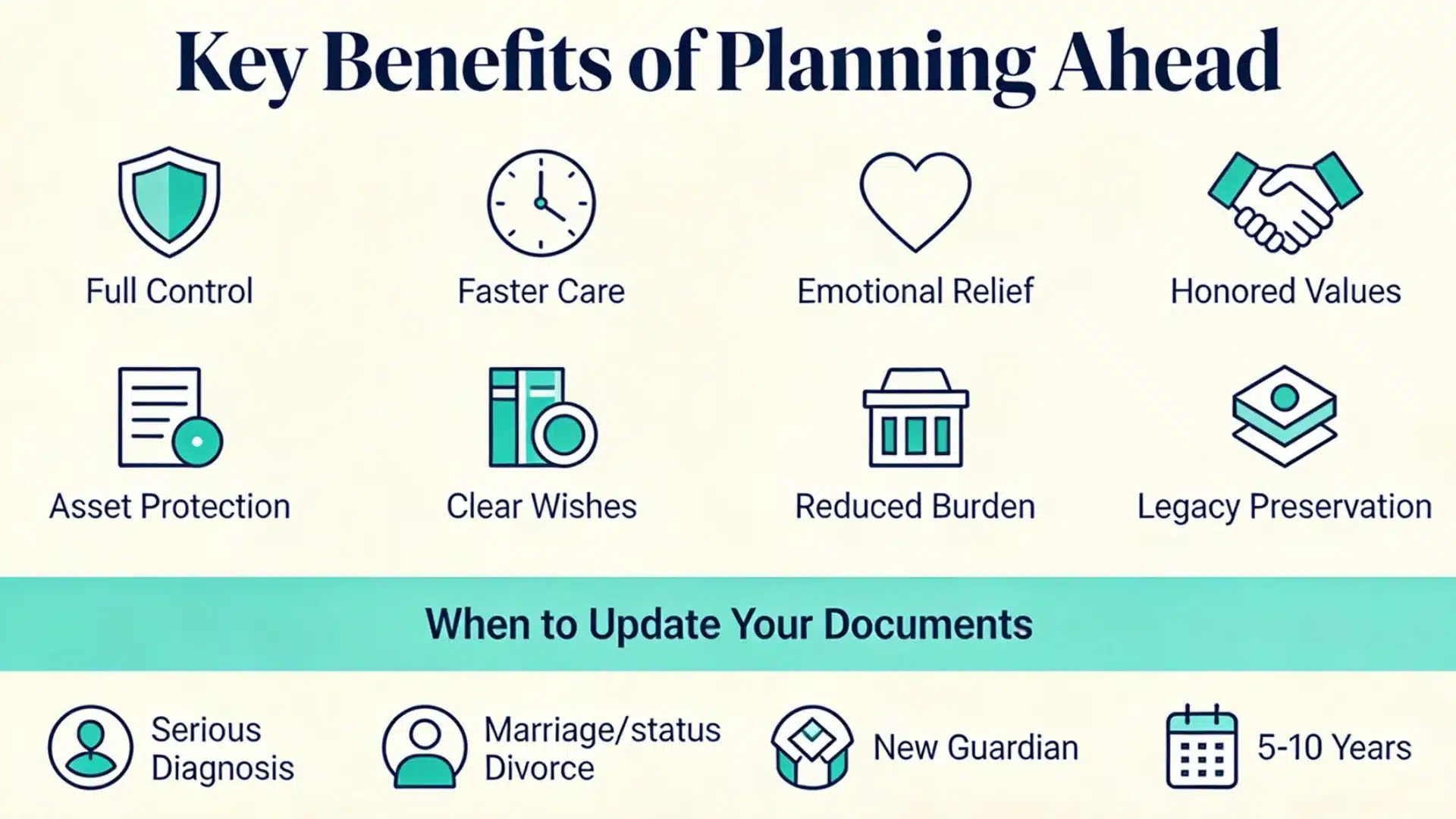
Planning medical decisions in advance brings clarity during uncertain situations. Instead of leaving important choices to chance, these documents provide a structured way to guide care.
- Gives full control over medical treatment choices instead of leaving decisions to others.
- Helps doctors act quickly without waiting for family approval in critical situations.
- Reduces emotional stress on family members during difficult medical conditions.
- Prevents conflicts between relatives about life support or treatment options.
- Ensures personal values and beliefs are respected in healthcare decisions.
- Avoids unnecessary or unwanted medical procedures.
- Reduces the risk of costly treatments that contradict personal preferences, a factor often overlooked in estate planning until it is too late.
- Reduces the risk of prolonged and costly interventions that contradict personal preferences, a financial and emotional burden that often arrives alongside the medical one.
On document maintenance, share copies with close family members and your primary care physician.
Keep both physical and digital versions accessible. Review and update these documents after any major life or health change.
Specific triggers worth noting include a new serious diagnosis, a change in marital status, the appointment of a new healthcare proxy, or, as a general rule, approximately every 5-10 years.
A document that reflects who you were ten years ago may not reflect your current values, relationships, or medical circumstances.
What Medical Choices Can Be Included in a Living Will?
A living will focuses on specific medical treatments and clearly states what should or should not be done during critical health situations.
The goal is precision: the more specific the instructions, the less room there is for interpretation or conflict when those instructions need to be followed.
Common decisions typically included in a living will:
- CPR (Cardiopulmonary Resuscitation): Decide whether to attempt revival if the heart stops.
- Ventilator support: Specify if breathing machines should be used and for how long.
- Artificial nutrition and hydration: Indicate whether feeding tubes or IV fluids should be used in long-term care.
- Life support continuation: Define conditions where treatment should be continued or stopped.
- Pain management: State preference for comfort care, even if it may affect life expectancy.
- Dialysis: Indicate whether kidney dialysis should be continued or started if the kidneys fail.
- Antibiotics and antivirals: Specify whether infection-fighting medications should be administered in a terminal condition.
- Organ and tissue donation: This can be documented directly in the living will and is generally considered the most reliable method of recording donation preferences, since it is tied to a legally witnessed document rather than a driver’s license notation that may not be readily available in all care settings.
Step-by-Step Guide to Creating a Living Will or Advance Directive
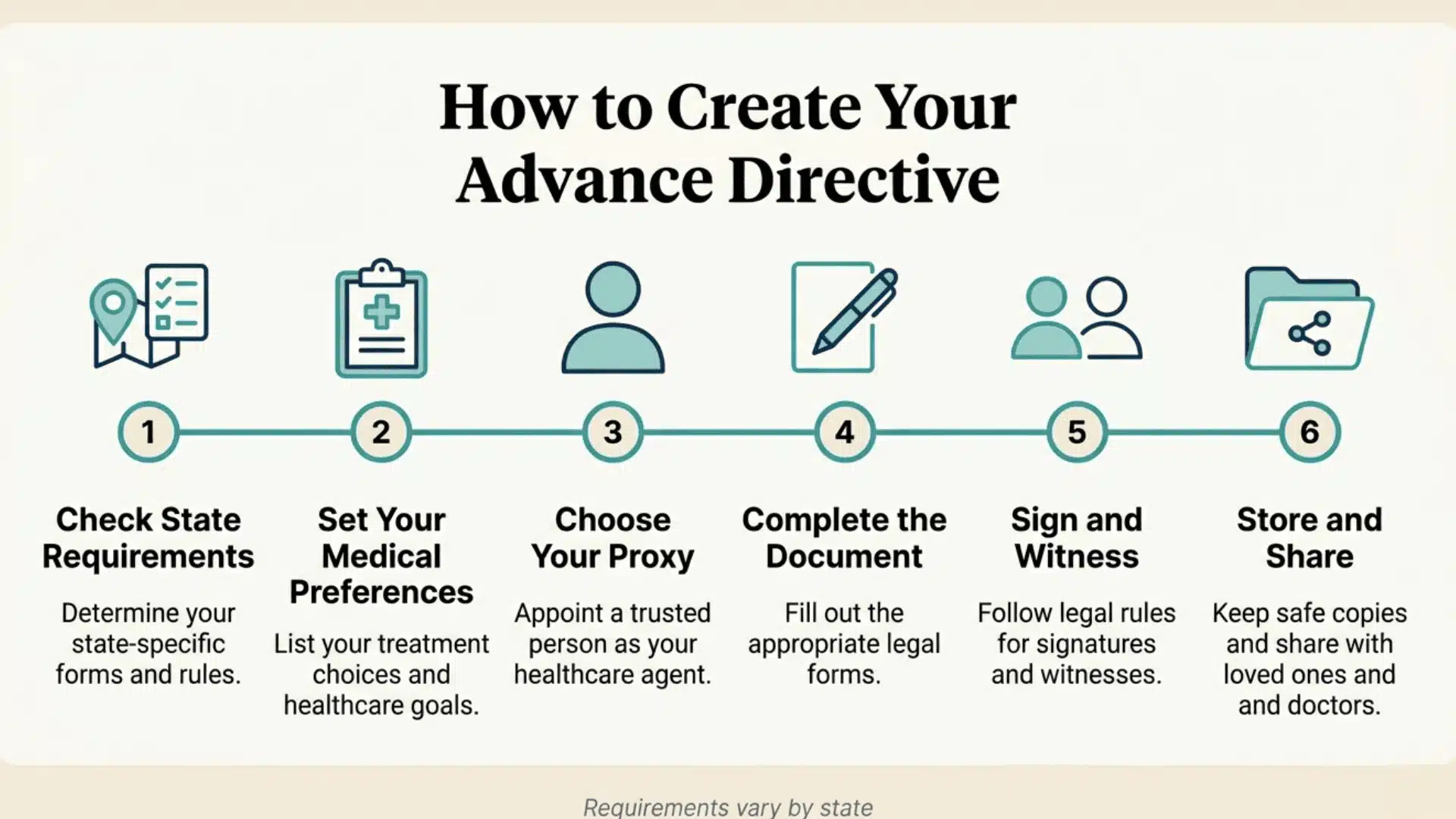
Creating these documents requires careful thought and attention to legal details. The process is not complicated, but each step matters. Before filling out any forms, think carefully about what quality of life means to you personally.
What activities or relationships make life worth living? Would you want every possible treatment if recovery were possible?
At what point would comfort-focused care matter more than extending life? Answering these questions first produces instructions that are genuinely yours.
1. Check Your State Requirements
Each U.S. state has its own legal guidelines, formats, and requirements for creating these documents. Using a generic or incorrect form may result in the document not being accepted when needed.
It is important to visit official state health department websites or trusted legal resources to download the correct version.
Some states also have specific rules about witnesses, notarization, or language used in the document.
State-specific forms are also available through organizations such as the National Hospice and Palliative Care Organization’s CaringInfo, the American Bar Association, and AARP.
Some states also require specific language around incapacity definitions or terminal condition thresholds, language that a generic form may omit.
2. Decide Your Medical Preferences
Consider treatments such as CPR, ventilators, feeding tubes, dialysis, and pain management. These decisions should reflect personal values, beliefs, and quality-of-life expectations.
Discussing these options with your primary care physician before completing the document is strongly recommended.
Physicians can explain what each intervention realistically involves, what it looks like in practice, not just in the abstract, which often changes how people think about their choices.
3. Choose a Healthcare Proxy (If Creating an Advance Directive)
If preparing an advance directive, selecting the right healthcare proxy is one of the most important decisions.
This person will make medical choices on your behalf when situations are unclear or not fully covered in written instructions.
The ideal proxy should understand your values, remain calm under pressure, and communicate effectively with doctors and family members.
It is also important to have an open discussion with this person so they fully understand your preferences and are willing to take on the responsibility.
Some individuals also choose to pair a healthcare proxy with a financial power of attorney that only takes effect under defined conditions, rather than granting immediate authority.
4. Fill out the Document Properly
Completing the document requires accuracy and clarity. Every section should be filled out carefully, and vague language should be avoided.
Instead of using general phrases, provide direct instructions such as “yes,” “no,” or “only under specific conditions.”
Vague language such as “no heroic measures” is among the most common and most consequential drafting errors.
The phrase has no standard legal meaning and leaves medical staff and family members to debate what you intended. Specific clinical language tied to defined conditions produces the clearest, most reliable instructions.
5. Sign with Witnesses or Notarization
To be legally valid, most states require the document to be signed in the presence of one or two witnesses. Some states also require notarization.
Witnesses confirm that the document was signed willingly and without pressure.
California, for example, requires two witnesses who are not the healthcare agent, not a healthcare provider, and not an employee of the healthcare facility.
Failing to meet the witness requirements is one of the most common reasons an advance directive is found invalid when it is most needed.
6. Store and Share Copies
Once completed, the document should be stored in an easily accessible location during emergencies.
Keeping copies with family members, your primary doctor, and your healthcare proxy ensures that it can be quickly used when required.
Consider registering the document with your state’s advance directive registry if one exists.
California, for example, maintains an optional registry through the Secretary of State’s office. Many states also allow the document to be uploaded to your electronic medical record through hospital systems.
Digital accessibility matters: a document that cannot be located within minutes in an emergency may as well not exist.
Mistakes People Make When Drafting These Documents
Even a well-written document can fail if common mistakes are overlooked. Many people focus on creating a living will or advance directive, but miss key details that affect how it works in real situations.
Avoiding these errors ensures that medical decisions are followed correctly.
| Mistake | Impact in Real Situations | How to Avoid It |
|---|---|---|
| Vague instructions | Doctors may apply treatments that don’t match your actual wishes due to unclear language | Use specific instructions for CPR, ventilators, feeding tubes, and life support |
| Not updating the document | Outdated preferences may lead to decisions that no longer reflect your current health or beliefs | Review and update after major life or medical changes |
| Not informing the family | Family members may disagree or delay decisions during emergencies | Share copies and clearly discuss your wishes in advance |
| Choosing the wrong proxy | The person may feel overwhelmed or make decisions under pressure that don’t align with their intent | Select someone who understands your values and can handle critical situations |
| Poor accessibility | The document may not be found in time, leading hospitals to proceed without it | Keep copies with your doctor, family, and in easily accessible locations |
| Using a non-state-specific form | The document may be missing required witnessing language or state-specific definitions, rendering it unenforceable when presented | Use the official form from your state health department or a licensed attorney familiar with your state’s requirements |
Conclusion
Planning ahead for medical decisions is not something to delay. A clear understanding of an advance directive vs living will helps ensure that personal wishes are respected, even when communication is not possible.
Both documents serve important roles, whether through written instructions in a living will or through the authorized decision-making authority of a healthcare agent named in an advance directive.
In most situations, relying on a living will alone leaves gaps that only a named agent can fill.
The two work best together, and neither is a permanent document; both should be reviewed and updated as life circumstances evolve.
Waiting until a crisis happens often limits options, so acting early makes a real difference. If these documents are not in place yet, now is the right time to start.
Review personal preferences, choose a trusted proxy if needed, and make sure everything is documented and accessible when it matters most.
Frequently Asked Questions
Can an Advance Directive Be Changed After It Is Created?
Yes, an advance directive can be updated or revoked anytime, as long as the person is mentally capable of making informed decisions.
Do Hospitals Automatically Ask for an Advance Directive?
Most hospitals ask about advance directives during admission, but they cannot require one. Providing it helps guide medical decisions more effectively.
What Happens if Someone Has Neither a Living Will nor an Advance Directive?
Doctors follow standard procedures, and family members may be asked to decide, which can cause delays, confusion, or disagreements during critical medical situations.
When family members disagree, hospitals may seek court-appointed guidance or defer to the attending physician’s judgment, neither of which reflects the individual’s personal wishes in any documented way.
Can a Healthcare Proxy Override a Living Will?
A healthcare proxy usually follows the living will, but may make decisions if the situation is unclear or not specifically addressed in the document.
Some states, including Illinois, specify by statute that a healthcare agent cannot override the terms of a validly executed living will. The two documents are designed to work in tandem, not to compete.
Is a Living Will Recognized in Every State?
No. While advance directives are recognized in all 50 states, living wills as standalone documents are not legally recognized in every jurisdiction.
Massachusetts is one of the most commonly cited examples: it recognizes healthcare proxies under Mass. Gen. Laws Chapter 201D, but does not give living wills independent legal force.
For residents of states with limited living will recognition, ensuring a properly executed healthcare proxy or full advance directive is in place becomes the more critical priority.