

Murder is not treated as a single, one-size-fits-all offense under U.S. law. Instead, the legal system separates it into different degrees, most commonly first-degree and second-degree murder, and in three states, third-degree murder as well.
Each category reflects a different level of intent, planning, and circumstances, which directly affects how the case is prosecuted and the severity of punishment.
This blog goes beyond surface-level definitions.
It explains how these charges work in real courtrooms and highlights differences across states, with particular attention to Florida, where I practice.
It also compares how other countries handle similar crimes and offers practical insights for anyone dealing with or trying to understand serious criminal charges.
What is Third Degree Murder?
Third-degree murder is a lesser-known homicide charge that exists in only three U.S. states: Florida, Minnesota, and Pennsylvania.
It applies to situations where a death occurs without premeditation and without a clear intent to kill, placing it below first- and second-degree murder but above manslaughter in seriousness.
The key element that defines third-degree murder is extreme recklessness. This means the accused engaged in conduct so dangerous that it showed a complete disregard for human life.
Unlike manslaughter, which often involves negligence or heat-of-the-moment actions, third-degree murder requires conduct that crosses a higher threshold, behavior a reasonable person would recognize as almost certain to cause death, not merely possible.
Each state interprets the charge slightly differently.
Under MN Stat. § 609.195, Minnesota limits it to deaths caused by dangerous acts without targeting a specific individual, while Pennsylvania’s 18 Pa. C.S. § 2502(c) includes certain drug-related deaths.
Florida’s Fla. Stat. § 782.04 may apply when a death occurs during the commission of a non-violent felony.
Penalties are severe, often resulting in lengthy prison sentences, reflecting the serious nature of the reckless conduct.
Third Degree Murder Laws: State by State

Only three states in the entire United States formally recognize third-degree murder as a statutory charge. Each defines it differently, and those differences are significant if you or someone you know is facing charges.
1. Minnesota: The “Depraved Mind” Standard
Minnesota’s third-degree murder law (MN Stat. § 609.195) became national news during the Derek Chauvin trial (2021).
The charge requires proving the defendant acted with a “depraved mind,” a callous disregard for human life, without intending to kill.
Under MN Stat. § 609.195, Minnesota also applies this statute to drug-related deaths where someone sells a controlled substance that causes a fatal overdose.
A provision that has been used with increasing frequency as fentanyl-related deaths have surged across the state.
Typical sentence in Minnesota: 12.5 years for a first offense under sentencing guidelines; the law allows up to 25 years.
2. Florida: The Non-Violent Felony Murder Rule
Florida’s approach (Fla. Stat. § 782.04) applies third-degree murder when someone unintentionally causes a death while committing a non-violent felony.
If the underlying felony is violent (such as robbery or assault), the charge would typically be elevated to first- or second-degree murder under Florida’s felony murder rule.
Example: A person commits drug trafficking, and a death results from that activity. Since drug trafficking is a felony but not classified as violent in this context, the charge may be brought as third-degree murder under Fla. Stat. § 782.04.
What this means in practice, and what I explain to clients who are surprised by it, is that you do not have to touch another person, threaten them, or even be in the same room when the death occurs.
The classification of the underlying felony, therefore, becomes the most critical factor in a Florida third-degree murder case.
Defense attorneys frequently challenge whether the predicate offense was truly non-violent, since that designation directly controls which murder statute applies, and whether a life sentence is on the table.
Understanding how courts handle overlapping criminal charges and whether sentences are served back-to-back or simultaneously is also essential in these cases.
Consecutive vs. concurrent sentencing can dramatically change the total prison exposure for a defendant facing multiple charges tied to the same criminal act.
3. Pennsylvania: The Catch-All Category
Under 18 Pa. C.S. § 2502(c), third-degree murder serves as a residual or catch-all category.
Any unlawful killing that does not qualify as first-degree murder, which involves intent and premeditation, or second-degree murder, which occurs during the commission of a felony, is generally classified under this section.
This makes the law broader and more adaptable compared to other states.
In Pennsylvania, third-degree murder often applies to cases where there is a clear intent to cause serious bodily harm but not necessarily a planned intent to kill.
It can also include situations involving extreme recklessness or disregard for human life, where actions show a high risk of causing death even without direct intent.
Because of this flexible definition, prosecutors have more room to charge cases that fall between clearly intentional killings and accidental deaths.
This has made Pennsylvania one of the few states where third-degree murder is frequently used in a wide range of homicide cases.
Pennsylvania has the broadest and most flexible definition of the three states, and also the highest maximum sentence: 40 years.
What is the Difference Between First, Second, & Third Degree Murder?
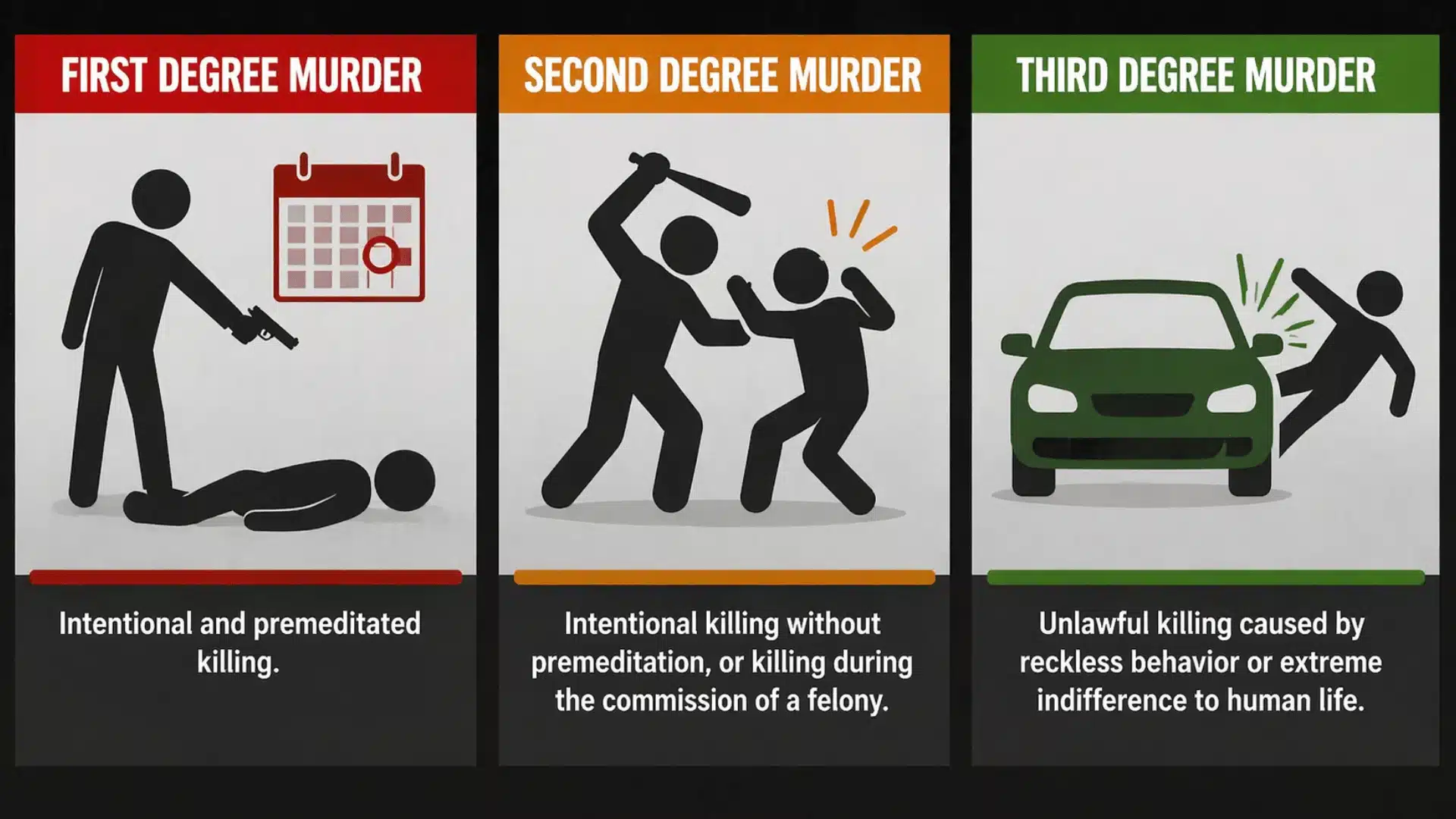
Understanding the difference between first, second, and third-degree murder matters because the degree of the charge determines the sentence, the defense strategy, and the prosecution’s burden of proof.
1. First-Degree Murder
The most serious form of homicide under U.S. law. First-degree murder involves premeditation, meaning the act was planned, even if only briefly.
It also requires malice aforethought, showing a clear and deliberate intention to take a life. Courts often look for evidence such as prior threats, preparation, or calculated actions.
This charge can also include felony murder in many states, where a death occurs during the commission of a serious felony like robbery or kidnapping.
Example: Hiring someone to kill a business rival, or poisoning a spouse after weeks of planning. Penalties are the harshest, often including life imprisonment or the death penalty, where applicable.
Related charges are frequently filed alongside murder in cases involving coordinated criminal activity.
If prosecutors believe multiple individuals participated in planning or executing a crime that led to a death, criminal conspiracy charges are often added and can carry substantial penalties of their own.
2. Second-Degree Murder
This charge applies when a person intentionally kills another, but without prior planning. The act is impulsive rather than prearranged, yet still driven by intent to cause death or serious harm.
It may also cover situations involving a “depraved heart,” where someone acts with extreme indifference to human life.
Example: a bar fight escalates, and one person kills the other in a sudden burst of rage. There is no premeditation, but the intent is clear.
Sentences are severe, typically involving long-term imprisonment, though generally less than first-degree murder.
3. Third-Degree Murder
Recognized in only a few states, this charge involves no intent to kill. Instead, it centers on extreme, reckless conduct so dangerous as to show a complete disregard for human life.
The defendant did not plan or aim to cause death, but their actions created an objectively high risk of fatal consequences.
This distinction from manslaughter is critical: manslaughter typically involves a lower degree of recklessness or a heat-of-passion circumstance, whereas third-degree murder requires conduct that a reasonable person would see as almost certain to produce death.
Example: Distributing dangerous drugs that lead to a fatal overdose, or engaging in highly reckless behavior that results in death.
Although less severe than first- and second-degree murder, penalties still include significant prison time due to the seriousness of the conduct.
Third Degree Murder vs Manslaughter
Third-degree murder involves extreme recklessness with a clear awareness of deadly risk, while manslaughter involves less intent and lower foreseeability, leading to lighter penalties.
The mental state of the defendant at the time of the act is the most decisive factor in determining which charge applies.
| Aspect | Third-Degree Murder | Manslaughter |
|---|---|---|
| Definition | Killing caused by extreme recklessness or depraved indifference to human life | Killing resulting from negligence or actions taken in the heat of the moment |
| Mental State | Depraved indifference; aware actions are highly likely to cause death | Lower level of intent; impaired judgment or negligence |
| Level of Recklessness | Very high; complete disregard for human life | Moderate to low; careless or impulsive behavior |
| Moral Culpability | Higher level of blame | Lower level of blame |
| Example | Actions that knowingly put lives at extreme risk | Drunk driving incident leading to a fatality |
| Sentencing Range | Typically 10 to 40 years (varies by state) | Typically 1 to 15 years (varies by state) |
| Legal Severity | Considered more serious | Considered less severe |
Clients often come to me after being told by someone, a family member, a friend, or occasionally even a general practice attorney, that the charge will “probably just be manslaughter.” That assumption can be dangerous.
Legal Defenses Against a Third-Degree Murder Charge
Several legal defenses can apply in third-degree murder cases, depending on the facts, evidence, and how the prosecution frames the charge.
- Actual innocence: The accused argues they were not responsible for the death, often involving mistaken identity, unreliable witnesses, or false accusations.
- Lack of recklessness: The defense challenges whether the conduct meets the level of depraved indifference required for a murder conviction.
- Reduced culpability: If actions were reckless but not extreme, the charge may be lowered, leading to a significantly different sentencing outcome.
- Self-defense or defense of others: Force was used to prevent immediate harm, supported in Florida by Stand Your Ground laws under Fla. Stat. § 776.012.
- Castle Doctrine: Individuals have the right to use force inside their home to protect themselves, recognized in states like Florida and Pennsylvania.
- Charge classification strategy: Attorneys may argue for a lesser charge based on facts, and a related overview of aggravated assault vs. simple assault explains how intent and injury level affect charge classification.
- Mental incapacity: A psychological condition prevented the accused from understanding their actions or distinguishing right from wrong.
- Underlying felony challenge: In Florida, the defense may argue that the alleged felony does not qualify under third-degree murder laws.
- Plea negotiation: Accepting a lesser charge like manslaughter can reduce sentencing risk in complex or uncertain cases.
Real-Life Third Degree Murder Cases

Legal definitions make more sense when you see how they play out, so let’s look at some real-world third-degree murder cases.
Case 1: Derek Chauvin, Minnesota (2021)
Former Minneapolis police officer Derek Chauvin was convicted of second-degree unintentional murder, third-degree murder (depraved indifference), and second-degree manslaughter for the death of George Floyd on May 25, 2020.
The third-degree charge under MN Stat. § 609.195 was significant because prosecutors did not need to prove that Chauvin intended to kill Floyd, only that his conduct demonstrated depraved indifference to human life.
He was sentenced to 22.5 years in prison, with the third-degree murder conviction serving as one of the three bases for that sentence.
Case 2: Myzeh Ross, Pennsylvania (Convicted 2024)
In January 2024, a Philadelphia jury found 21-year-old Myzeh Ross guilty of three counts of third-degree murder after racing through multiple red lights and crashing into a Lyft, killing three people in August 2022.
This case is a clear demonstration of how Pennsylvania’s broad residual statute captures reckless vehicular homicide when the defendant’s behavior is sufficiently wanton and sustained.
The prosecution did not need to prove Ross intended to kill anyone, only that his conduct was so dangerous it reflected a complete disregard for human life.
Case 3: Mohamed Noor, Minnesota (2019)
Former Minneapolis police officer Mohamed Noor was convicted of third-degree murder and second-degree manslaughter in 2019 for the July 2017 shooting death of Justine Ruszczyk Damond, who had called 911 to report a possible assault near her home.
The third-degree charge under MN Stat. § 609.195 was applied because prosecutors argued that Noor acted with depraved indifference to human life when he fired his weapon across his partner’s body and out the squad car window without identifying a clear threat.
He was originally sentenced to 12.5 years in prison.
However, the Minnesota Supreme Court overturned the third-degree murder conviction in September 2021, ruling that Noor’s actions were directed at a single specific person, which did not satisfy the “depraved mind” standard under the statute.
Noor was subsequently resentenced to 57 months (approximately 4.75 years) in prison for his remaining second-degree manslaughter conviction and was released on supervised release in June 2022.
Case 4: Timothy Flannery, Pennsylvania (2019)
Timothy Flannery was convicted of third-degree murder in the 2017 death of his girlfriend, Jenna Burleigh, a Temple University student.
Burleigh disappeared after a night out, and her remains were found in a trash bag in Flannery’s storage unit.
Pennsylvania prosecutors pursued third-degree murder rather than first-degree because they argued the killing, while intentional in the moment, lacked the necessary premeditation for first-degree murder.
The jury agreed, finding malice a forethought but not a deliberate, premeditated plan, which is the hallmark distinction in Pennsylvania’s framework.
This case illustrates how Pennsylvania uses third-degree murder as a genuine middle-ground charge, capturing intentional killings that fall just short of the planning element required for first-degree.
Case 5: Kim Potter, Minnesota (2021)
Former Brooklyn Center police officer Kim Potter was convicted of first- and second-degree manslaughter in the April 2021 fatal shooting of Daunte Wright during a traffic stop, claiming she mistook her firearm for her Taser .
The case is directly relevant here because prosecutors initially evaluated third-degree murder charges under the same MN Stat. § 609.195 standard used in the Chauvin case.
That charge was ultimately not pursued, in large part because of ongoing appellate uncertainty at the time over whether the statute required the act to be aimed at more than one person, the very issue that would lead to the Noor conviction being overturned that same year.
Potter was sentenced to two years in prison in February 2022, well below the roughly seven years recommended under Minnesota sentencing guidelines.
She served 16 months before being released in April 2023.
Conclusion
Third-degree murder is not always easy to understand, especially since laws differ across states like Florida, Minnesota, and Pennsylvania.
I have seen how small details in a case can change how charges are applied and how outcomes are decided. This is why knowing the exact legal standard in your state matters more than general assumptions.
You should also pay attention to how intent, recklessness, and surrounding facts are viewed, since these factors often shape the direction of a case.
Even similar situations can yield very different results depending on how the law is applied.
If you are dealing with a serious charge like this, getting legal advice early can make a real difference in understanding your options and next steps.
Have questions about third-degree murder laws or how they apply in your state? Tell us, share with us in the comments below.
Frequently Asked Questions
Can a Drug Dealer Be Charged with Third-Degree Murder if a Customer Dies?
Yes, in Minnesota and Florida. Minnesota explicitly includes causing another’s drug-related death by selling a Schedule I or II controlled substance in its third-degree murder statute. Florida can apply its felony murder rule to drug-related deaths.
Can a Third-Degree Murder Charge Be Reduced to Manslaughter?
Yes. Through plea bargaining or a successful defense, a third-degree murder charge can sometimes be reduced to manslaughter, which carries a significantly lighter sentence. This is a common negotiation point between defense attorneys and prosecutors.
What Should I Do If I am Charged with Third-Degree Murder?
Do not speak to law enforcement without an attorney present. Invoke your right to counsel immediately.
Third-degree murder charges are prosecuted aggressively, and anything said before legal representation is in place can and will be used against you.
Contact a criminal defense attorney experienced in your state’s homicide statutes as soon as possible.