

Two people sit in a car, talking about a plan to rob a bank, thinking it is just a random talk and nothing serious has happened yet.
Under U.S. law, that moment can already count as criminal conspiracy, even if no money is taken and no real action follows after that point.
That is what makes people confused about what a conspiracy is in law, because it focuses more on agreement and intent than the actual crime itself.
I will be telling you about how criminal conspiracy works, what courts look for, and how these charges are handled in real cases.
You will also understand how simple actions like calls or meetings can change everything legally and put someone at risk without them realizing it.
But before moving ahead, take a closer look at how planning alone can cross into criminal territory and why the law treats it so seriously.
When Does Planning Cross into Criminal Territory?
Most people think a crime starts when something actually happens. In reality, the law steps in much earlier than that.
Under U.S. law, the moment two or more people agree to commit a crime and take even one small step toward it, it becomes a criminal conspiracy.
That step is called an overt act. It does not need to be illegal on its own. Renting a car, buying tools, or even checking out a location can count.
The key point is intent plus action. In my experience handling felony cases in Florida, people are genuinely surprised by this.
They come in believing that because nothing actually happened, they cannot be in real legal trouble. But prosecutors do not need a completed crime.
Another big factor is shared responsibility. Once you are part of a conspiracy, you can be held responsible for what others do in that plan, even if you did not directly take part. That is where things get serious fast.
This principle of shared liability has a formal legal name: the Pinkerton doctrine, established by the Supreme Court in Pinkerton v. United States (1946).
Under it, every member of a conspiracy can be convicted for substantive crimes committed by co-conspirators during and in furtherance of the plan, even acts they had no personal knowledge of.
It is one of the most consequential and least understood aspects of how conspiracy law actually works in practice.
What is Conspiracy in Law: The Legal Definition

In simple terms, conspiracy in law means an agreement between two or more people to commit a crime, along with the intent to make it happen.
The law does not wait for the crime to actually take place. From a defense point of view, this is where most people get it wrong.
They think no harm means no charge, but the agreement itself can be enough.
At the federal level, this is covered under 18 U.S.C. § 371. What matters is proving that people agreed, shared intent, and took a step forward.
Courts have consistently held that the agreement does not need to be explicit or documented.
In United States v. Feola (1975), the Supreme Court confirmed that conspirators do not even need to know every legal element of the underlying offense, only that they agreed to pursue the conduct at issue.
Key elements of criminal conspiracy:
- Agreement between two or more people: This does not need to be written or clearly spoken. Courts often look at behavior, messages, or coordinated actions to prove it
- Intent to commit a crime: Every person involved must share the goal of carrying out the illegal act, even if they play different roles
- Overt act: At least one person must take a step toward the plan, even if that step is legal on its own. Note that certain federal drug conspiracy charges under 21 U.S.C. Section 846 do not require an overt act at all. The agreement plus intent is sufficient for prosecution.
One important point people miss: just knowing about a plan is not enough. Being present or hearing something does not make you guilty.
The law needs proof that you chose to be part of it and helped move it forward.
From English Courts to U.S. Federal Law: The Origins of Conspiracy Law
Conspiracy law did not start as a broad rule. It slowly grew as courts and lawmakers tried to control group-based wrongdoing.
Over time, it became a powerful legal tool used across many types of cases.
- 1293 England Origins: The earliest law targeted people who misused courts, like false accusers and corrupt jurors. It introduced the idea that group misconduct could be punished separately
- 1600s to 1700s Expansion: Courts widened the scope to include agreements to do unlawful acts or use unlawful methods. Judges shaped much of this growth through decisions
- 1800s U.S. Development: During the Civil War, Congress passed laws to deal with fraud and organized threats against the government
- 1909 to 1948 Codification: The law was structured into clear elements like agreement, intent, and overt act, which still guide cases today
- 1970 RICO Law: This law allowed prosecutors to target entire criminal groups, especially in organized crime and large-scale fraud cases
How Criminal Conspiracy Differs From a Regular Crime?
At first glance, a conspiracy and a regular crime may look similar, but legally, they work very differently. The biggest difference is that conspiracy focuses on the agreement and intent, not just the final act.
| Factor | Regular Crime | Criminal Conspiracy |
|---|---|---|
| What triggers the charge | A criminal act must happen or be clearly attempted | An agreement plus one overt act is enough, even if the crime never happens |
| Number of people required | Can be done by one person | Always needs two or more people |
| What must be proven | The act, the result, and the intent | The agreement, shared intent, and an overt act |
| Responsibility | You are liable for your own actions | You can be held liable for the actions of co-conspirators under the Pinkerton doctrine, even acts you had no direct involvement |
| Need for success | Crime must succeed or be attempted | No need for the crime to succeed |
| Charges | Usually stands alone | Can be charged along with the actual crime |
| Evidence rules | Normal rules apply | Statements by co-conspirators can be used against all members |
Charges and Penalties Come With a Conspiracy Conviction
The punishment for a conspiracy conviction depends on what the group planned to do and whether the case is handled at the federal or state level.
The conspiracy charge alone can carry serious time, even before the main crime is proven.
At the federal level, a basic conspiracy under 18 U.S.C. § 371 can result in up to 5 years in prison and heavy fines.
But things get much harsher when the conspiracy involves drugs, fraud, or organized crime.
Here is where it escalates:
- Drug conspiracy: Under 21 U.S.C. Section 846, penalties mirror the actual drug offense and are calculated based on the total quantity of drugs attributable to the entire conspiracy, not just what an individual personally handled.
- Terrorism-related conspiracy: These cases can lead to life imprisonment due to the threat level involved.
- RICO conspiracy:Racketeering Conspiracy can bring up to 20 years per count, along with asset seizure and forfeiture of proceeds tied to the criminal enterprise.
Another key point: conspiracy does not merge with the main crime.
That means a person can be punished for both the conspiracy and the actual offense, which increases total sentencing exposure significantly.
How Conspiracy Law Varies Across Key U.S. States?
Conspiracy law is not exactly the same everywhere in the United States. While federal law sets a base rule, each state adds its own twist. Here are some state variations of the conspiracy law:
- California: Requires an agreement and an overt act. The penalty usually matches the target crime, so serious plans can lead to life sentences.
- New York: Uses a degree system with six levels. The charge depends on the seriousness of the planned crime, making it more structured than in most states.
- Texas: Needs both agreement and an overt act. The punishment rises with the severity of the intended offense.
- Florida: Does not always require an overt act. Charges depend on the target crime, with serious conspiracies carrying a maximum of 30 years.
- Illinois: Often reduces the charge by one level compared to the main crime, though some lower-level crimes stay the same.
- Arizona: One of the strictest states. Conspiracy can carry the same level of punishment as the main offense, including life terms.
- Pennsylvania: Requires an overt act and allows renunciation as a full defense if the person actively stops the plan before it happens.
Famous Criminal Conspiracy Cases in the United States
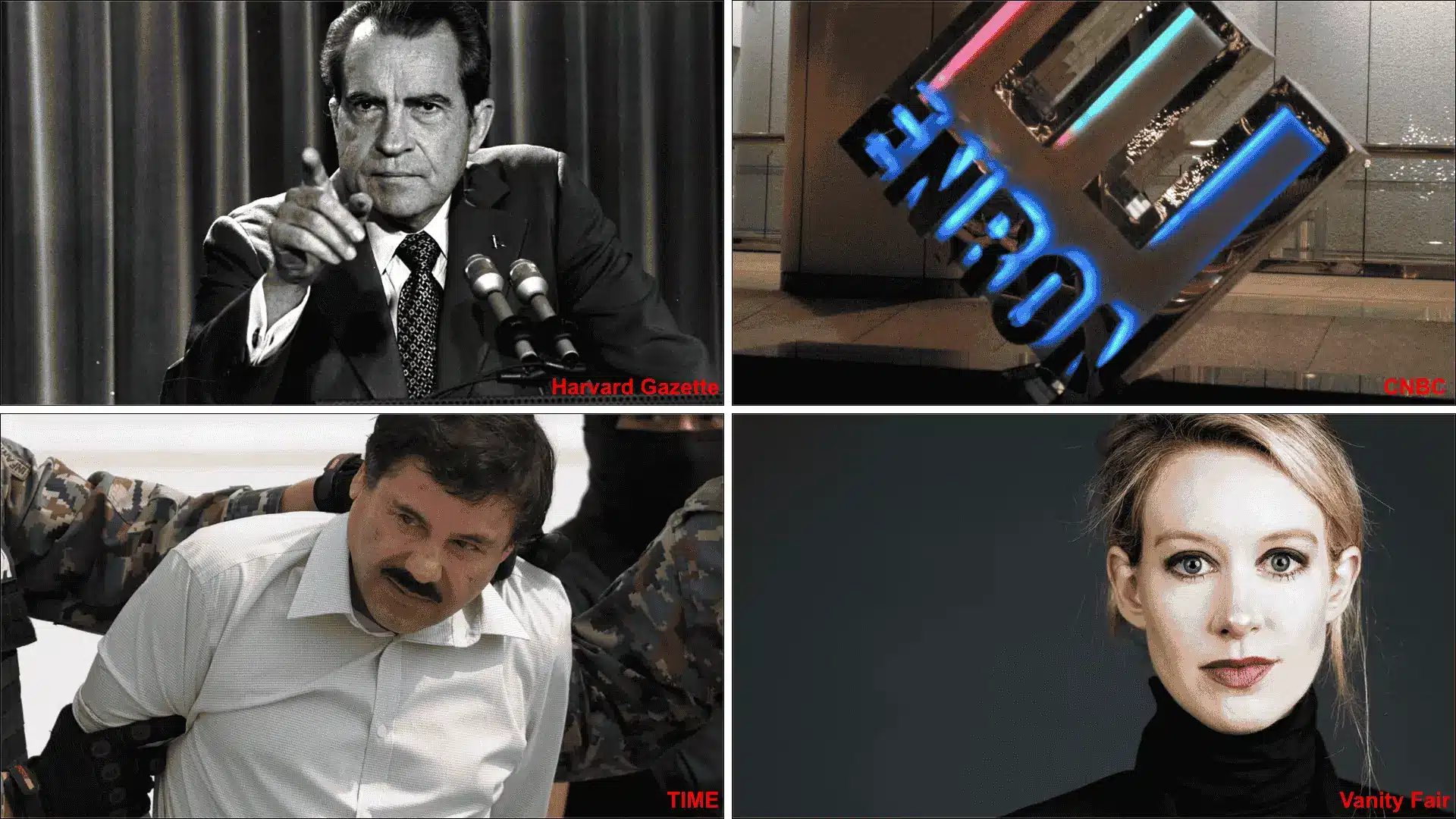
Some of the biggest legal battles in U.S. history have relied on conspiracy charges to prove how groups planned and carried out unlawful actions.
1. Watergate Scandal
What started as a simple break-in at a political office turned into one of the biggest conspiracy cases in U.S. history.
Investigators proved that top officials worked together to hide the truth and block justice. Several senior aides were convicted, and President Nixon resigned before facing impeachment.
The case showed how conspiracy law can reach the highest levels of power.
2. Enron Corporate Fraud
Enron executives created a massive fraud by hiding billions in debt while misleading investors and employees.
Prosecutors used conspiracy charges to show a shared plan between top leaders. Jeffrey Skilling was convicted and served roughly a decade in prison.
The case changed how financial crimes are investigated and led to stricter corporate laws.
3. El Chapo Drug Network
Joaquin Guzman led a global drug operation for years. Prosecutors built the case using conspiracy charges tied to drug trafficking across borders.
Testimony from insiders helped prove the agreement and structure of the network.
He was convicted on multiple counts and sentenced to life in prison, showing how conspiracy law targets large criminal groups.
4. Theranos Fraud Case
Elizabeth Holmes and her partner misled investors about blood-testing technology that did not perform as promised.
Prosecutors proved a long-running agreement to commit fraud. Holmes was convicted and sentenced to more than 11 years in prison.
The case became a major example of conspiracy charges in the startup world.
5. The Lindsay Shiver Murder-for-Hire Case
A more recent example of how conspiracy charges work without a completed crime is the Lindsay Shiver trial, currently underway in Nassau, Bahamas.
A former beauty queen faces conspiracy to commit murder charges based largely on WhatsApp messages discovered during an unrelated investigation.
No physical act of violence occurred. The prosecution’s case rests entirely on the alleged agreement, the digital communication, and a purported verbal confession.
The case illustrates how a conspiracy charge can be built, tried, and carry life-altering consequences even when the underlying crime never took place.
What Evidence Prosecutors Use to Prove a Conspiracy?
Proving a conspiracy is not about finding one single piece of evidence. It is about building a full picture using different clues that point to an agreement and shared intent.
In most cases, there is no written contract or clear confession, so prosecutors rely on patterns and connections.
Communication is often the starting point. Text messages, emails, call records, and chats help show who was in touch and when.
Even if no one explicitly states the plan, repeated contact at key moments can raise strong suspicion.
The timing of communication matters more than most people realize.
I have handled cases where prosecutors built their conspiracy argument almost entirely on the sequence of calls and messages around a specific event, without a single message that explicitly referenced anything criminal.
Money trails also matter a lot. Unusual payments, shared accounts, or cash movements linked to events can suggest involvement in a plan.
Juries find those patterns compelling, which is why digital evidence is now the backbone of most conspiracy prosecutions.
Other useful evidence includes surveillance footage, location data, and digital records. Each piece may seem small, but together they help build a timeline that connects people to the conspiracy.
One evidentiary rule that catches defendants off guard: statements made by any co-conspirator during and in furtherance of the conspiracy are admissible against all members of the conspiracy under Federal Rule of Evidence 801(d)(2)(E).
This means something one person said can be used against someone else entirely, even if that person was never in the same room or conversation.
Defenses Against a Criminal Conspiracy Charge
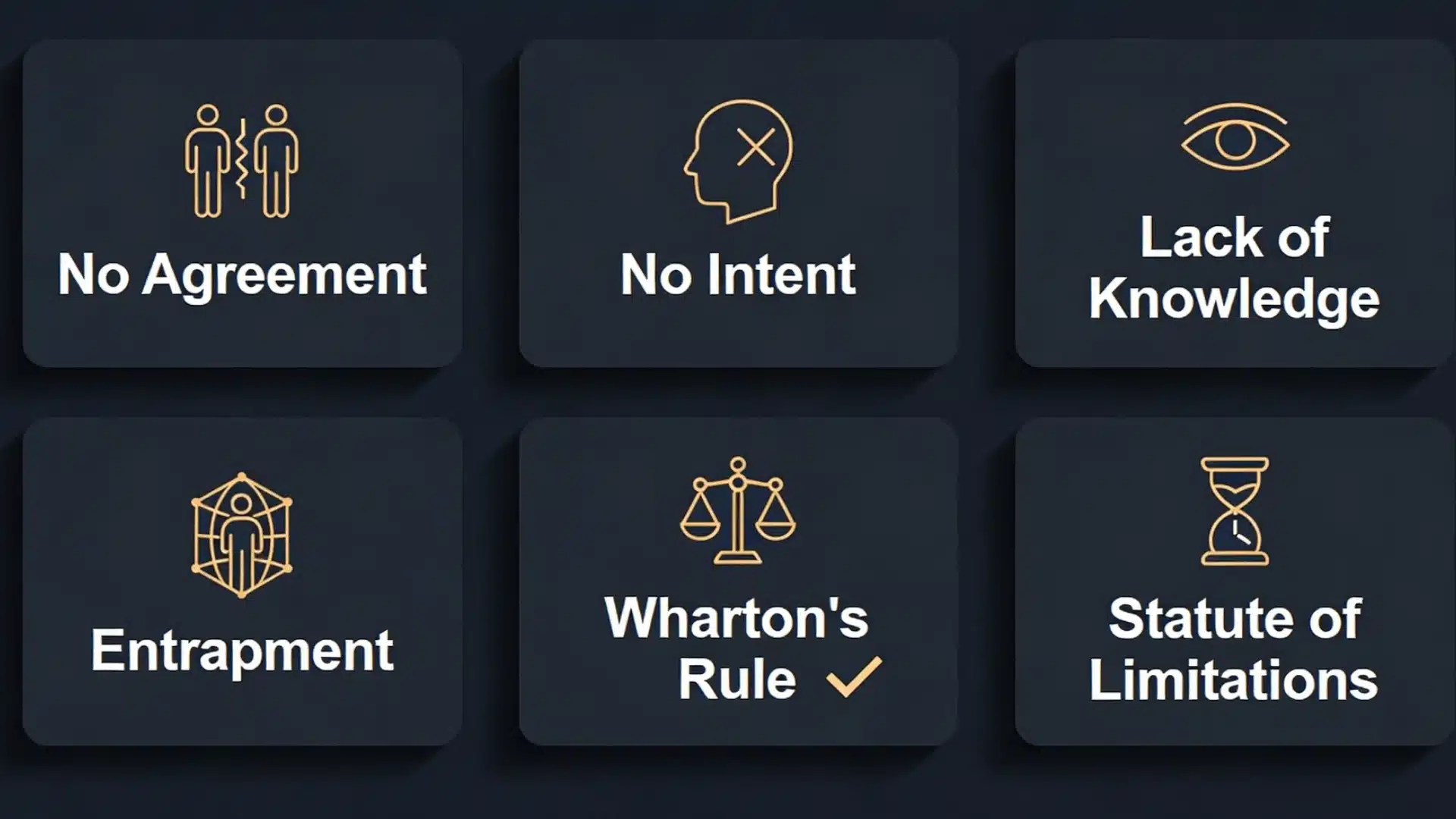
Facing a conspiracy charge does not mean the case is over. The law requires the prosecution to prove every element clearly, which gives room for strong defenses if the facts support them.
- No agreement: The person never actually agreed to take part in the plan. Being around people or hearing discussions is not enough to prove involvement
- No intent: Even if present, the person did not share the goal of committing a crime. Intent must be clear, not assumed
- Lack of knowledge: The person did not know the plan was illegal. This can apply in layered setups where roles are limited
- Entrapment: Law enforcement pushed or convinced the person to join a plan they would not have joined on their own
- Wharton’s Rule: Some crimes already need more than one person, so adding a conspiracy charge may not apply in the same way
- Statute of limitations: For most federal conspiracies, the five-year limitations period runs from the date of the last overt act committed in furtherance of the plan, not from when the agreement was formed.
In ongoing conspiracies, the clock does not begin until the conspiracy ends, which can significantly extend prosecution windows.
Of all the defenses available in conspiracy cases, attacking intent is often the most effective and the most realistic path.
The prosecution has to show the jury that the defendant genuinely meant for something criminal to happen.
When communications are informal, heated, or taken out of context, that burden can be challenged effectively. Small details in the surrounding conversation often matter more than the one-line prosecutors put on their exhibit list.
Can You Walk Away From a Conspiracy?
Yes, you can step away from a conspiracy, but legally it is not as simple as just leaving or staying quiet.
Many people assume that stopping involvement is enough, but the law expects something much clearer and more active.
To truly withdraw, a person must take a direct step that shows they are no longer part of the plan.
This could mean informing law enforcement or clearly telling others involved that they are out.
The Supreme Court addressed the legal standard for withdrawal in Smith v. United States (2013), holding that the burden of proving withdrawal falls on the defendant and must be demonstrated by a preponderance of the evidence.
Courts look for affirmative communication of disavowal to the other co-conspirators. Simply going silent, reducing contact, or stepping back from active participation is not enough under federal law.
Even if withdrawal is accepted, it only protects against future acts. Anything that happened while you were part of the conspiracy still counts against you.
Silence is not withdrawal. Drifting away is not withdrawal. And if anything happened after you stopped showing up but before any affirmative communication of your exit, you can still carry exposure for it.
Common Myths About Conspiracy Charges
There is a lot of confusion around conspiracy law, mainly because people mix legal meaning with everyday use of the word. Here are some common myths and the actual legal reality.
| Myth | Reality |
|---|---|
| Conspiracy only applies to serious or violent crimes | It is widely used in white-collar cases like fraud, tax issues, and financial scams |
| The crime must happen to be charged | The agreement and one overt act are enough, even if the plan never succeeds |
| You must do something illegal | Even legal actions like booking a place or making a call can count as an overt act |
| You need to know everyone involved | You can be charged even if you only knew one person in the plan |
| It is a minor or extra charge | It can carry equal or higher penalties than the main crime |
| If others are not convicted, your case fails | A conspiracy charge can still stand on its own |
| Talking about a crime equals conspiracy | Discussion alone is not enough without agreement and action |
| Leaving the plan clears everything | Withdrawal only protects future acts, not past involvement |
Even a planned assault can result in a felony conspiracy charge depending on how the underlying offense is classified under state law.
Conclusion
Conspiracy law shows that crime is not just about action; it is also about planning, agreement, and intent between people working toward the same unlawful goal.
What conspiracy in law often surprises people, because even small steps can turn into a criminal conspiracy charge much earlier than expected.
From what I have seen, many people do not realize how fast simple talks or shared plans can lead to serious legal trouble without warning.
You now have a clearer idea of how these charges work, but real cases often include facts, defenses, and risks that go beyond what is commonly discussed.
If you ever face such a situation, knowing your rights early and acting carefully can make a major difference in how things play out.
Have you ever seen a situation where planning alone could lead to legal trouble, tell us, share with us in comments below.
Frequently Asked Questions
Can One Person Be Convicted of Conspiracy?
No. A conspiracy needs at least two people agreeing to commit a crime. One person alone cannot form a conspiracy. Even if others are acquitted or immune, one person’s conviction can still legally stand.
Is Conspiracy a Felony or a Misdemeanor?
It depends on the planned crime. If the target is a felony, conspiracy is usually a felony. If it is a misdemeanor, the charge stays at that level with similar penalty limits.
Can You Be Charged Without Knowing All Details?
Yes. The law only requires that you knew about the illegal plan and chose to take part. You do not need to know every step or every person involved.
What is the Difference Between Conspiracy and Aiding and Abetting?
A conspiracy focuses on agreeing to commit a crime before it happens. Aiding and abetting involves helping during the crime. Both can apply, but they deal with different stages of involvement.
Does a Conspiracy Charge Require a Written Agreement?
No. There is no need for a written or formal agreement. Courts often rely on behavior, communication, and surrounding facts to prove that an agreement existed.
Can a Conspiracy Charge Be Dropped if You Cooperate?
Not always. Cooperation can lead to reduced charges or lighter sentences through plea deals. The final decision depends on prosecutors and how valuable the cooperation is.