

One heated moment can lead to a charge that changes everything. But is it assault or aggravated assault?
Many people use these terms interchangeably, yet the law treats them very differently.
That confusion can carry serious consequences, especially when charges, penalties, and long-term effects are on the line.
Aggravated assault vs assault is not just a matter of wording. The distinction often depends on factors such as the level of injury, use of a weapon, the identity of the alleged victim, and the intent behind the act.
In some cases, what seems minor can quickly become a felony offense. This blog breaks down both charges in clear, practical terms.
Definitions, real-life examples, possible penalties, and lasting consequences will be explained to make the legal differences easier to understand.
What is Assault?
Assault is generally defined as an intentional act that causes another person to reasonably fear imminent harmful or offensive contact.
Actual physical injury is not always required. In many cases, the law focuses on the threat itself and the intent behind it.
The United States Department of Justice, through the Bureau of Justice Statistics, defines assault as an unlawful physical attack or threat of attack, and distinguishes between simple assault and aggravated assault based on severity.
Depending on state law, assault may involve verbal threats paired with threatening behavior, an attempt to strike someone, or minor unwanted physical contact.
Intent is central to the charge. Prosecutors typically must show that the accused acted deliberately.
In Florida, Florida Statute 784.011 defines assault as an intentional, unlawful threat, whether by word or act, to do violence to another person, combined with an apparent ability to carry it out and conduct that creates a well-founded fear that violence is imminent.
No physical contact is required to satisfy the elements of this offense.
Some states treat assault and battery as separate offenses, while others combine them under one statute.
After more than twelve years of handling cases in Florida courtrooms, what stands out is how frequently clients are genuinely surprised to learn they can face an assault charge without ever making physical contact.
What is Aggravated Assault?
Aggravated assault is a more serious form of assault that involves factors increasing the level of harm or danger.
While simple assault may involve minor injury or the threat of harm, aggravated assault typically includes circumstances that make the offense more severe under criminal law.
Certain elements can raise an assault charge to aggravated assault.
These often include causing serious bodily injury, using or displaying a deadly weapon such as a firearm or knife, or acting in a way that shows extreme disregard for human life.
The extent of injury and the level of force used are major considerations.
Charges may also become aggravated when the alleged victim is considered vulnerable, such as a child, elderly person, or law enforcement officer.
In most states, aggravated assault is classified as a felony due to the heightened risk and harm involved.
What Factors Elevate Assault to Aggravated Assault?
This question sits at the center of most aggravated assault vs assault cases. The answer generally comes down to a defined set of aggravating circumstances that prosecutors use to pursue elevated charges.
When any of the following factors are present, a simple assault charge can become a felony:
- Use or display of a deadly weapon: firearms, knives, and in some cases, everyday objects used in a threatening manner, such as a baseball bat or vehicle
- Serious bodily injury: injury that creates a substantial risk of death, causes permanent disfigurement, or results in the long-term loss or impairment of a body part or organ
- Intent to commit a felony: where the assault was carried out in furtherance of another offense, such as robbery or sexual battery
- Victim status: assaulting a law enforcement officer, firefighter, healthcare worker, elderly person, or child triggers enhanced charges in most jurisdictions
- Prior conviction history: In some states, a previous assault conviction can itself serve as an aggravating factor that pushes a new charge into felony territory
Aggravated Assault vs Assault: Key Legal Differences
The difference between aggravated assault vs assault becomes clearer when the main legal factors are compared side by side.
| Legal Factor | Assault (Simple Assault) | Aggravated Assault |
|---|---|---|
| Level of Harm Involved | Minor injury or threat of harm without serious bodily damage | Serious bodily injury or conduct creating substantial risk of severe harm |
| Presence of a Weapon | No deadly weapon involved | Use, display, or threat of a deadly weapon such as a firearm or knife |
| Degree of Intent | Intent to cause fear or minor harm | Intent to cause serious harm or extreme recklessness |
| Status of the Victim | General victim | The victim may be a child, an elderly person, a law enforcement officer, or another protected individual |
| Criminal Classification | Commonly charged as a misdemeanor | Typically charged as a felony with more severe penalties |
| Prior Criminal Record | May affect sentencing range, but generally does not change the charge level | Prior assault convictions can function as an aggravating factor that elevates charges or triggers mandatory enhancements in some states |
What is the Difference Between Assault and Battery?
This distinction creates confusion regularly, and it is worth addressing directly because the two terms are often used as if they mean the same thing.
Assault centers on the threat of imminent harm, placing someone in reasonable fear of it.
Battery involves the actual, unwanted physical contact. Where assault is the anticipation of harm, battery is the act itself.
In states that treat them as separate offenses, a person can be charged with both arising from the same incident, threatening someone and then striking them, for example.
In Florida, assault and battery are charged under separate statutes: assault under Florida Statute 784.011 and battery under Florida Statute 784.03.
Other states, including Texas, fold what many jurisdictions call “battery” into the broader assault statute.
Understanding which framework applies in your state matters because the elements the prosecution must prove and the defenses available can differ depending on how the charge is structured.
Criminal Penalties and Legal Consequences
The difference between aggravated assault vs assault becomes most serious at sentencing. In many states, simple assault is commonly charged as a misdemeanor.
This may result in county jail time, fines, probation, community service, or court-ordered anger management programs.
Jail sentences for misdemeanor assault often range from a few days to up to one year, depending on the circumstances and prior record.
Aggravated assault is typically a felony, leading to state prison sentences of several years, higher fines, extended probation, and stricter post-release supervision.
Courts may also issue restraining or protective orders, especially if the case involves domestic violence.
Penalties vary by state and by the specific facts of the case, including the level of injury, the presence of a weapon, and criminal history.
In New Jersey, causing serious bodily injury is classified as a second-degree aggravated assault, carrying 5 to 10 years in prison and fines up to $150,000.
Knowingly pointing a firearm, however, may qualify as a fourth-degree offense under the same statute, with up to 18 months in prison and fines up to $10,000.
These distinctions within aggravated assault itself reflect how gradations of conduct affect sentencing even within the same charge category.
Even within the same state, sentencing outcomes can differ based on the severity of the offense.
Common Legal Defenses for Assault and Aggravated Assault
Facing either charge does not mean a conviction is inevitable. Depending on the facts of the case, several recognized legal defenses may apply.
1. Self-Defense or Defense of Others
This is the most frequently raised defense in assault cases. If the accused had a reasonable belief that they or someone else faced imminent harm, the use of proportionate force to prevent it may be legally justified.
In Florida, the Stand Your Ground statute removes the duty to retreat in situations where a person is lawfully present and is not engaged in criminal activity , a factor that can significantly affect how a self-defense argument is built and presented.
2. Lack of Intent
Assault requires proof of intentional conduct.
If the act was accidental or the product of a misunderstanding rather than a deliberate threat, the prosecution may not be able to establish the required mental state.
A client once came in after being charged with assault following what amounted to a startled reflex during a heated confrontation; the sequence of events and surrounding context ultimately told a very different story than the initial police report.
3. Consent
In limited circumstances, consent can be a defense, most commonly in contact sports or situations where some level of physical engagement was mutually understood.
It rarely succeeds as a defense to aggravated assault charges involving serious injury or a weapon.
4. Mistaken Identity
In incidents involving multiple parties or chaotic circumstances, a defendant may be able to demonstrate that they were not the individual who committed the assault.
Surveillance footage, witness accounts, and alibi evidence are all commonly used to support this defense.
5. Inability to Carry Out the Threat
For simple assault specifically, the prosecution must establish that the accused had an apparent ability to follow through on the threatened harm.
If that element is missing, for example, a firearm that was inoperable and appeared to pose no real threat, the charge may not hold.
Real World Examples of Assaultand Aggravated Assault
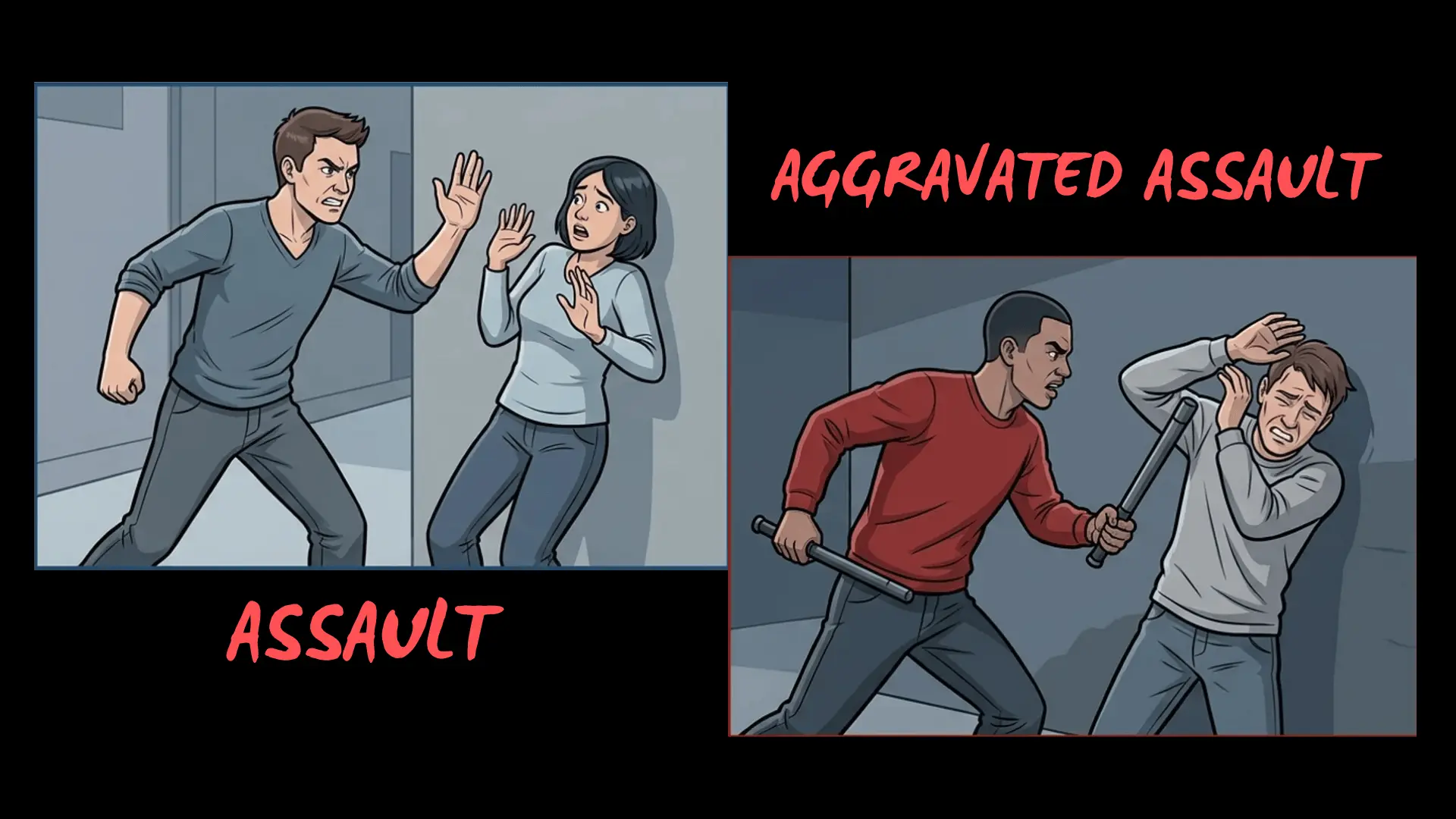
Courts and state statutes provide clear guidance on how assault and aggravated assault are defined and punished.
In Vetter v. Morgan, the Kansas Court of Appeals held that a threat, along with the surrounding acts and circumstances, can place a person in reasonable fear of immediate bodily harm.
Similarly, underCalifornia Penal Code §240, assault is defined as an unlawful attempt, combined with the present ability, to commit violent injury against another person.
Penalties increase when the offense becomes aggravated.
In New Jersey, causing serious bodily injury is classified as a second-degree aggravated assault, punishable by 5 to 10 years in prison and fines up to $150,000.
Knowingly pointing a firearm, however, may qualify as fourth-degree aggravated assault, carrying up to 18 months in prison and fines up to $10,000.
Long-Term Impact of a Conviction
The consequences of aggravated assault vs assault often extend far beyond jail time or fines. A conviction can follow a person for years and affect major areas of life.
- Criminal Record Implications: Both misdemeanor and felony convictions become part of a permanent criminal record. Background checks for jobs, housing, or loans may reveal the offense, limiting future opportunities.
- Employment Challenges: Many employers conduct background screenings. A conviction for assault or aggravated assault can make it harder to secure certain positions.
- Housing Restrictions: Landlords frequently review criminal history. A violent offense on record may reduce rental options or lead to denied applications.
- Professional License Issues: Licenses for nurses, teachers, commercial drivers, and other regulated professions may be suspended or revoked after a conviction.
- Firearm Rights Limitations: Felony convictions and some misdemeanor domestic violence convictions can result in loss of firearm rights under federal and state law.
- Immigration Consequences: For non-citizens, an aggravated assault conviction can trigger deportation proceedings or permanently bar a green card application.
When to Seek Legal Guidance?
Legal representation becomes critical the moment an arrest, investigation, or formal charge for assault or aggravated assault occurs.
Even before charges are filed, speaking with a criminal defense attorney can help protect legal rights during police questioning.
Statements made early in a case can significantly affect how prosecutors evaluate evidence.
Immediate legal guidance is especially important if the case involves serious bodily injury, a weapon, domestic violence allegations, or a prior criminal record.
These factors can increase the likelihood of felony charges and stricter penalties.
An experienced defense attorney can review evidence, identify weaknesses in the prosecution’s case, and advise on possible defenses.
Early involvement may influence charge reduction, plea negotiations, diversion programs, or trial strategy.
Acting quickly can make a meaningful difference in how the case progresses and ultimately resolves.
Conclusion
Understanding aggravated assault vs assault is essential because the legal consequences can differ dramatically.
While both charges involve intentional conduct, the distinction usually turns on the severity of the conduct.
The level of injury, use of a weapon, degree of intent, and specific circumstances surrounding the incident often determine if the offense remains a misdemeanor or rises to a felony.
Even small factual differences can lead to significantly different outcomes in court.
State laws add another layer of complexity, making it important to review local statutes and understand how prosecutors apply them.
A clear grasp of these differences can help individuals make informed decisions and respond appropriately if legal issues arise.
Have questions about how your state defines these charges? Share your thoughts or experiences below and keep the conversation going.
Frequently Asked Questions
Is It Possible To Expunge An Aggravated Assault Conviction?
In most states, felony aggravated assault convictions are not eligible for expungement. Some jurisdictions allow sealing or expungement for misdemeanor assault convictions after completing probation and meeting waiting period requirements.
Can A Juvenile Be Charged With Aggravated Assault?
Yes. Juveniles can face aggravated assault charges. Depending on age, the seriousness of the offense, and criminal history, cases may be transferred to adult court, carrying adult-level penalties.
Does Verbal Provocation Reduce An Aggravated Assault Charge?
Rarely, courts generally hold that verbal provocation alone does not justify an assault. However, it may be considered during sentencing or in negotiating a reduction from aggravated to simple assault.