
Missed paperwork. A skipped court date. An unexpected notice in the mail. Small moments like these can quickly turn into serious legal stress.
Many people search for information about bench warrants after realizing something went wrong with a court obligation.
The uncertainty can be overwhelming, and the questions that follow, about arrest risk, jail time, and long-term consequences, deserve clear and direct answers.
Understanding how court enforcement works, what risks may arise, and what steps can reduce further trouble is essential.
This blog breaks down the legal implications, potential consequences, and practical actions to consider.
If court compliance is in question, knowing the facts can help prevent additional complications and support smarter decisions moving forward.
Note: This content is for informational purposes only and should not be considered legal advice. Laws vary by state, so consult a licensed attorney in your jurisdiction.
What is a Bench Warrant?
A bench warrant authorizes law enforcement to arrest a person who has failed to appear in court or comply with a court order, as explained by the Legal Information Institute at Cornell Law School.
The word “bench” refers to the judge’s seat in the courtroom, which means the order comes directly from the judge rather than from a police investigation.
A bench warrant does not require probable cause that a new crime was committed.
It requires only that the court find a person failed to comply with an existing obligation, whether that is a court appearance, a payment schedule, or a condition of release. This is a meaningful legal distinction.
It does not always involve a new crime, but it does signal that the court expects immediate attention and compliance.
Civil Bench Warrants vs. Criminal Bench Warrants
Bench warrants arise in both criminal and civil contexts, and the distinction matters.
- Criminal bench warrants are issued when a defendant misses a hearing, violates probation, or fails to comply with a court-ordered program in a criminal case.
- Civil bench warrants can be issued when a party ignores a civil subpoena, fails to appear in a family law proceeding, or repeatedly fails to comply with a civil court order, such as a child support order. If you are involved in what is litigation, a civil bench warrant remains a real enforcement risk.
Both types carry arrest authority, but the downstream consequences, including sentencing exposure, differ significantly by case type and jurisdiction.
Common Reasons a Bench Warrant is Issued
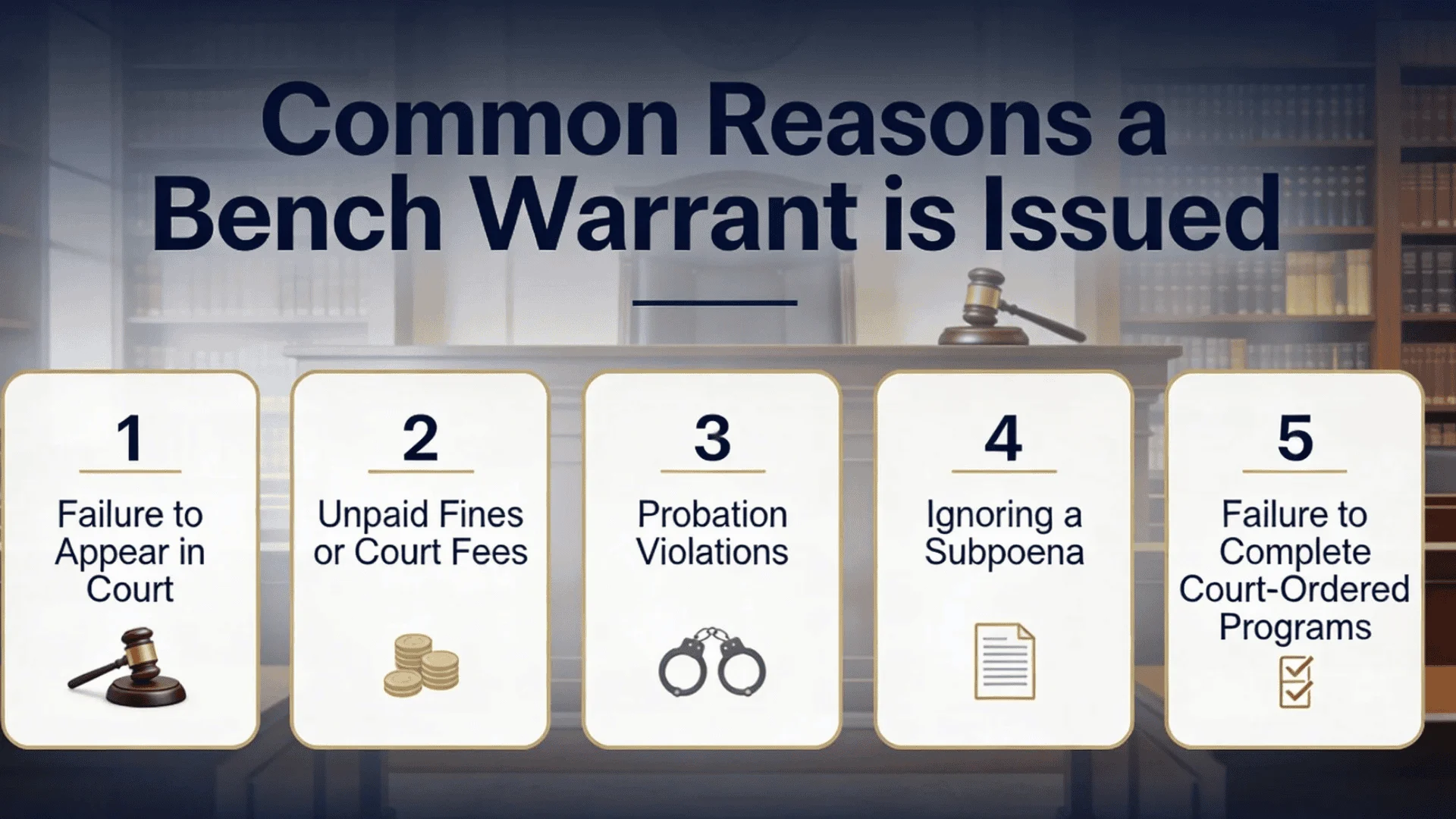
In most cases, the issue stems from non-compliance with existing court instructions rather than a new criminal offense.
- Failure to Appear in Court: Missing a scheduled court date, even for a minor traffic matter, is the most common trigger.
- Probation Violations: Failing to report to a probation officer, testing positive for a prohibited substance, or committing a new offense while on probation, including offenses ranging from minor infractions to aggravated assault vs. assault charges, may result in a bench warrant being issued during a revocation proceeding.
- Unpaid Fines or Court Fees: Ignoring payment deadlines without approved arrangements can lead to court action.
- Probation Violations: Failing to report to a probation officer or breaking court-ordered conditions may result in a warrant.
- Ignoring a Subpoena: Failing to respond to a lawful order to appear as a witness can prompt enforcement.
- Failure to Complete Court-Ordered Programs: Skipping required classes, community service, or other obligations may trigger a judge’s response.
- Civil Non-Compliance: Disregarding court orders related to child support, divorce proceedings, or other civil matters can also result in a bench warrant in many jurisdictions.
In my years reviewing case intake files, probation violation bench warrants were consistently the fastest to result in actual custody. Unlike FTA warrants, which sometimes go unserved for months, probation bench warrants are often flagged for active enforcement, particularly when the underlying charge involved violence or drug offenses. If a client disclosed a probation bench warrant during intake, the attorney’s first call was almost always to the probation officer, not the court clerk.
How Serious is a Bench Warrant?
A bench warrant is a serious legal matter because it gives law enforcement the authority to take a person into custody at any time.
An arrest can occur during routine police contact, leading to unexpected detention and court involvement.
In many cases, the judge may impose additional fines or penalties for failing to comply with the original court order.
Bond conditions can also change. The court may increase bail, deny release, or add stricter requirements based on prior noncompliance.
Future hearings may become more complicated, and judges often view missed appearances negatively. Bench warrants do not expire on their own in most jurisdictions.
They typically remain active until the individual appears before the court and the issue is formally resolved. Prompt action is often critical to limit further legal consequences.
What Happens After a Bench Warrant is Issued?
Once a bench warrant becomes active, it is entered into law enforcement databases. Any officer who runs a name during a routine interaction may see it.
An arrest can happen during a traffic stop, at home, at work, or during any standard police contact.
In some jurisdictions, the warrant will include instructions on whether officers should hold the individual or issue a notice to appear, though this varies by case severity and jurisdiction.
In some cases, officers may attempt to serve the warrant directly at a known address.
After arrest, the individual is taken into custody for booking. This includes fingerprinting, photographs, and documentation of the arrest.
At this stage, anything said during booking can become part of the case record, which is one reason why understanding the distinction between being detained vs arrested matters practically, not just theoretically.
A court appearance is scheduled, often within a short period.
Whether the judge sets bail, requires a secured bond, or remands the individual depends on the original charge, the reason for the missed appearance, and any history of prior noncompliance.
From reviewing bond hearing transcripts in Cook County, one pattern was consistent: judges asked directly whether the defendant had voluntarily appeared or had been picked up on the warrant.
Those who came in voluntarily, especially with counsel, almost always received more favorable bond terms. Being brought in on the warrant after weeks or months of avoidance rarely helped, regardless of the reason.
Bench Warrant vs Arrest Warrant
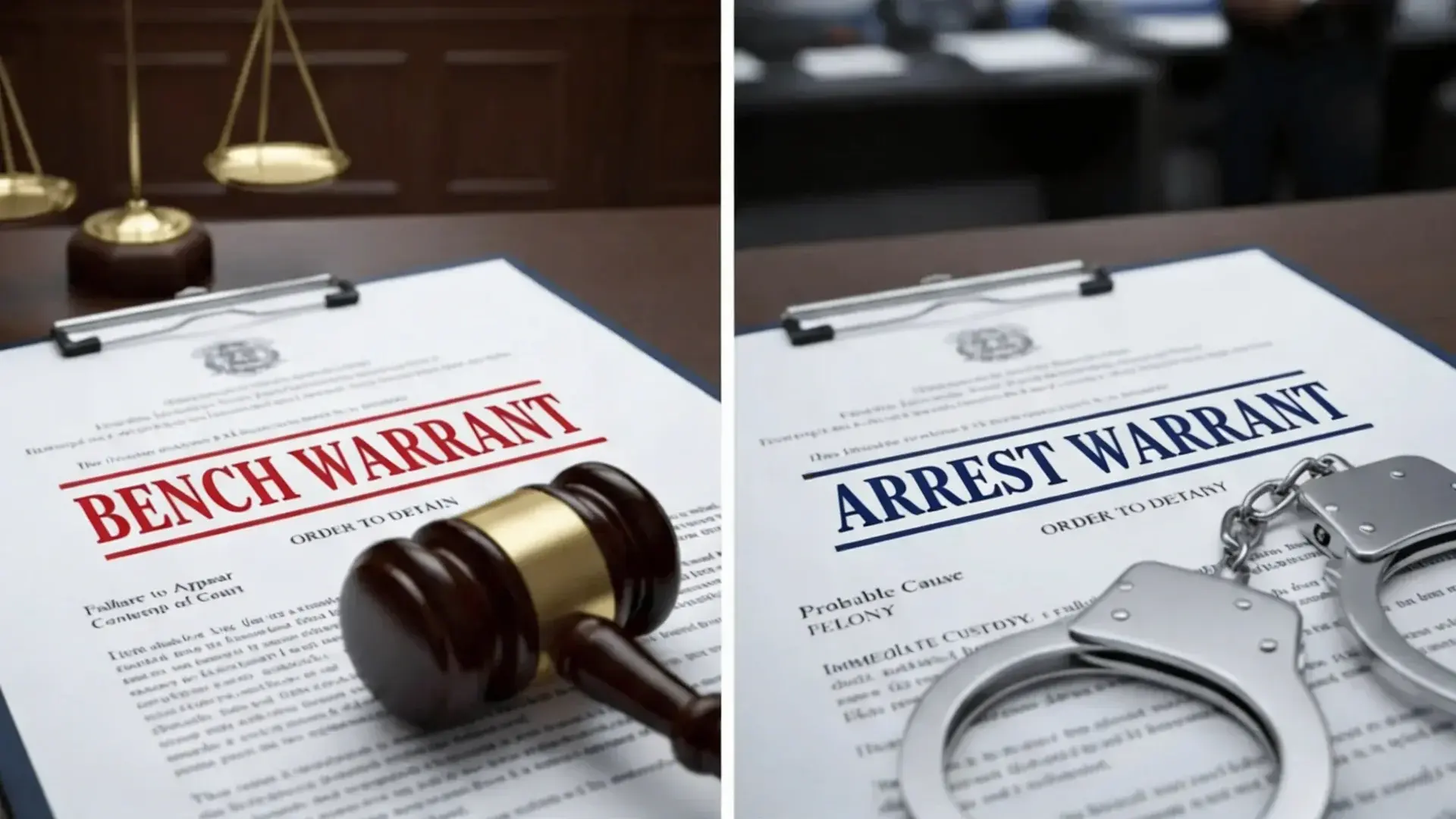
A bench warrant and an arrest warrant both authorize law enforcement to take someone into custody, but they are issued for different reasons.
According to Cornell Law School, an arrest warrant is issued when a judge finds probable cause that a person committed a crime. It is generally used at the start of a criminal case.
In contrast, a bench warrant is issued by a judge when a person fails to appear in court or comply with a court order.
It typically arises during an existing case due to non-compliance rather than a new alleged offense.
Bench Warrant vs. Arrest Warrant: Key Differences
Here is a quick comparison between a bench warrant and an arrest warrant to help you understand the key differences clearly:
| Factor | Bench Warrant | Arrest Warrant |
|---|---|---|
| Who issues it | The presiding judge | A judge or magistrate, upon prosecutorial request |
| Trigger | Failure to appear or comply with a court order | Probable cause of a new criminal offense |
| Stage in case | During an existing case | At or before the start of a criminal case |
| New crime required | No | Yes |
| How to resolve | Court appearance, motion to quash, voluntary surrender | Arrest, arraignment, bail hearing |
| Expiration | Does not expire; active until recalled by the judge | Typically does not expire; jurisdiction-dependent |
How to Check If You Have a Bench Warrant?
If there is concern about a possible bench warrant, taking careful and informed steps can help confirm the situation safely.
- Review official court records first: Many state and county courts offer online case search tools where names or case numbers can be entered to check current case status.
- Use only verified government court websites: Relying on official court websites helps avoid scams, unofficial databases, and incorrect information.
- Contact the court clerk’s office directly: Court staff can confirm whether a warrant exists and explain possible next steps in the process.
- Prepare identifying information before calling: Have your full legal name and date of birth ready to help locate records quickly.
- Consult a licensed criminal defense attorney: An attorney can check warrant status discreetly and explain the safest legal options.
- Be cautious about third-party warrant search services. Many commercial “warrant search” websites aggregate outdated or incomplete records and charge fees. Verified court portals are almost always the better option.
- Protect privacy during the inquiry process: Professional guidance can reduce the risk of unexpected arrest while verifying warrant information.
One thing I consistently saw during intake reviews: clients who had called the court themselves, without counsel, to ask about a warrant, sometimes inadvertently triggered faster enforcement action.
A clerk confirming an active warrant in the system can, in some jurisdictions, log that inquiry. Routing the status check through an attorney is not just caution for its own sake. It provides a procedural buffer that matters.
How to Resolve a Bench Warrant?
Resolving a bench warrant usually requires direct action through the court. One common step is scheduling a new court date to address the missed appearance or unmet obligation.
In some cases, a person may file a motion to quash, which asks the judge to cancel the warrant and set a hearing instead of enforcing the arrest.
Paying outstanding finesor completing previously ordered requirements may also help resolve the issue, depending on the case.
Some individuals choose to voluntarily appear before the court, often with legal representation, to show good faith and request reconsideration of bond or penalties.
Timely action is critical. Bench warrants typically remain active until formally cleared by a judge.
Delays can increase the risk of arrest, add penalties, and lead to stricter bond conditions at future hearings.
Voluntary Surrender with Counsel: A Practical Advantage
Some individuals choose to voluntarily appear before the court with legal representation. This is often called a controlled surrender.
Courts consistently treat voluntary appearances more favorably than warrant arrests at the time of a standard interaction.
An attorney who arranges this process can often negotiate bond terms in advance, prepare the client for the hearing, and request that the bench warrant be recalled without an overnight hold.
This option is not available in every jurisdiction or case type, but where it applies, the difference in outcome can be substantial.
When to Contact a Criminal Defense Attorney?

Legal guidance is strongly recommended if a bench warrant has been issued or is suspected.
An attorney can confirm the warrant status, explain the specific charges involved, and outline available options before any court appearance.
This is especially important if the underlying case involves probation violations, missed felony hearings, or prior bond conditions.
Professional representation may also help reduce the risk of immediate custody.
In some situations, an attorney can file motions on a client’s behalf, arrange a controlled court appearance to request bond reinstatement or warrant recall, or negotiate with the court to avoid a custodial appearance altogether.
For clients with warrants tied to older cases, an attorney may also determine whether the original charge has procedural deficiencies that warrant simultaneous review.
Early action with proper counsel often leads to better outcomes and fewer long-term consequences.
Conclusion
A bench warrant is not a minor administrative issue. It is an active court order that authorizes arrest, carries bond consequences, and does not resolve on its own.
Whether the warrant stems from a missed traffic court date or a more serious underlying matter, the legal framework is the same: the warrant remains active until a judge formally clears it, and every day it remains open represents a risk of unexpected custody.
Checking court records, confirming warrant status through an attorney, and taking action before enforcement occurs are the most practical steps available.
Courts are more likely to favor defendants who address compliance issues proactively. Knowing the facts and acting on them is the most reliable path toward resolution.
Have you ever encountered a situation involving a bench warrant or court appearance? Share your thoughts or questions in the comments below. Your experience could help others understand what to expect.
Frequently Asked Questions
Do Bench Warrants Expire?
Bench warrants do not expire on their own in most jurisdictions. They remain active in law enforcement databases indefinitely until a judge formally recalls or quashes the warrant. A warrant issued 10 years ago for a missed traffic hearing can still result in arrest during a routine traffic stop today.
Will a Bench Warrant Show Up on a Background Check?
A bench warrant may not always appear directly, but its effects often do. If it led to an arrest, that record usually shows up. Some checks may also flag active warrants. Employers or landlords using detailed screening services can see this information.
Can a Bench Warrant Be Issued Without You Knowing?
Yes, this can happen if court notices are sent to an outdated address. Missing a hearing may still result in a warrant, even if you never received notice. Keeping your address updated and checking your case status helps avoid this.
Can a Bench Warrant Be Enforced in Another State?
Yes. Bench warrants entered into national databases can be seen across states. Enforcement depends on the extradition status. Felony warrants are usually enforced nationwide, while some misdemeanors may be limited to certain areas.