
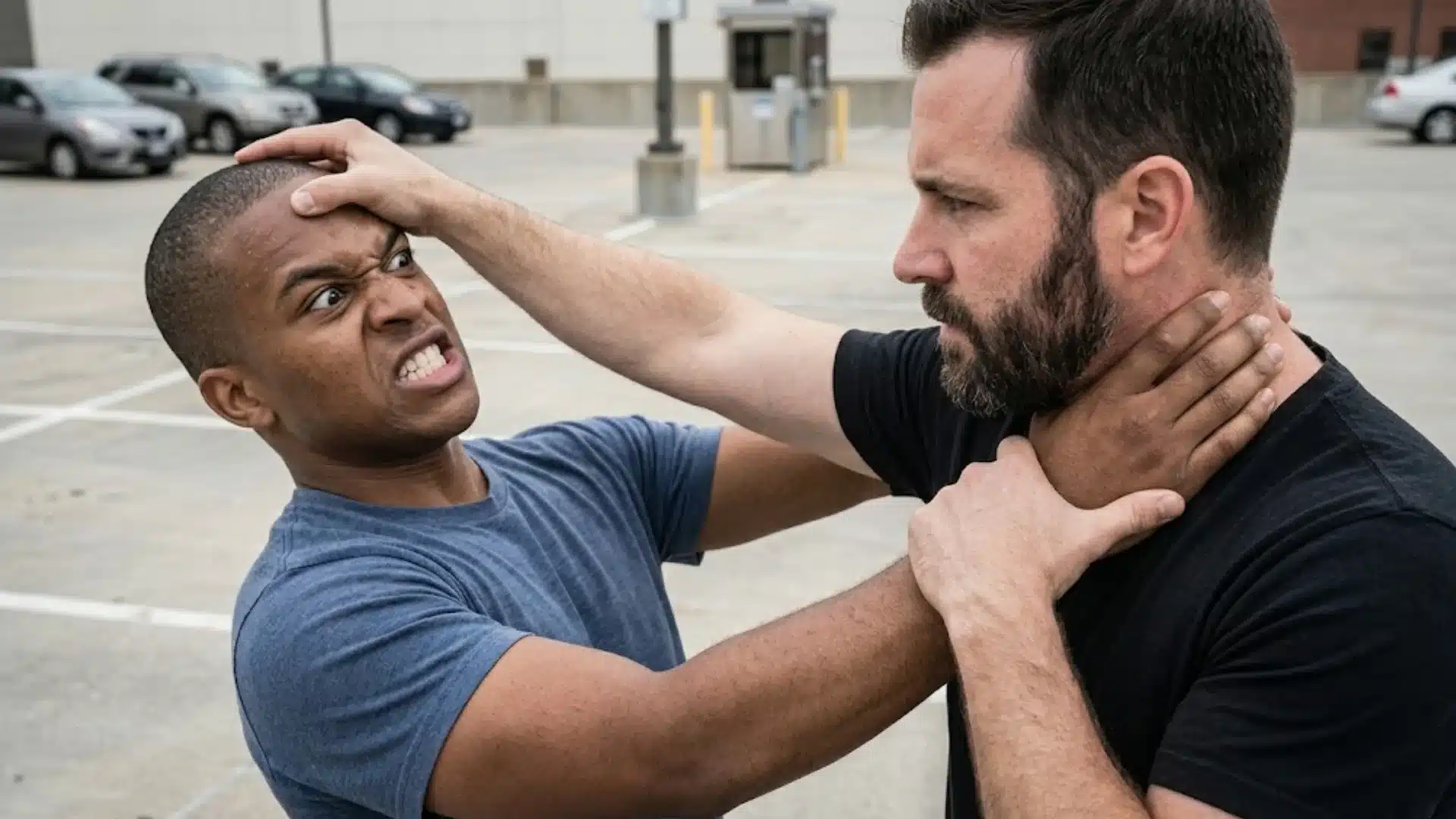
If you are walking down the street and two people square off in a parking lot, both yelling and ready to throw punches, you might assume both of them are headed to jail when the police arrive.
But whether charges are filed depends heavily on where this is happening and whether the situation satisfies the specific legal standards of mutual combat.
Over more than a decade of handling criminal defense cases, I have worked with clients who believed that a consensual fight automatically kept them out of legal trouble.
That assumption, more often than not, led to real charges and real consequences.
This blog breaks down exactly what it means legally, how courts evaluate it, and where it does and does not hold up across the United States.
What is Mutual Combat?
It occurs when two individuals voluntarily agree to fight each other with a shared intent to exchange blows, and neither claims to be an unwilling victim.
Courts generally treat it as a consensual physical confrontation in which both sides participate willingly, as opposed to one person being the victim of an unprovoked attack.
Both parties agreed to fight, stepped in willingly, and law enforcement later recognized the altercation as consensual rather than one-sided.
Only a small number of U.S. jurisdictions have legal frameworks that explicitly address it.
Washington State and Texas are the only two states where consenting adults can, under very specific conditions, engage in a fight without facing automatic criminal liability.
In most other states, fighting is prosecuted under standard assault statutes regardless of whether both parties agreed beforehand.
To better understand how these charges are classified, especially in more serious cases, knowing when assault is a felony becomes a critical legal question.
What Courts Look for in Mutual Combat Cases?
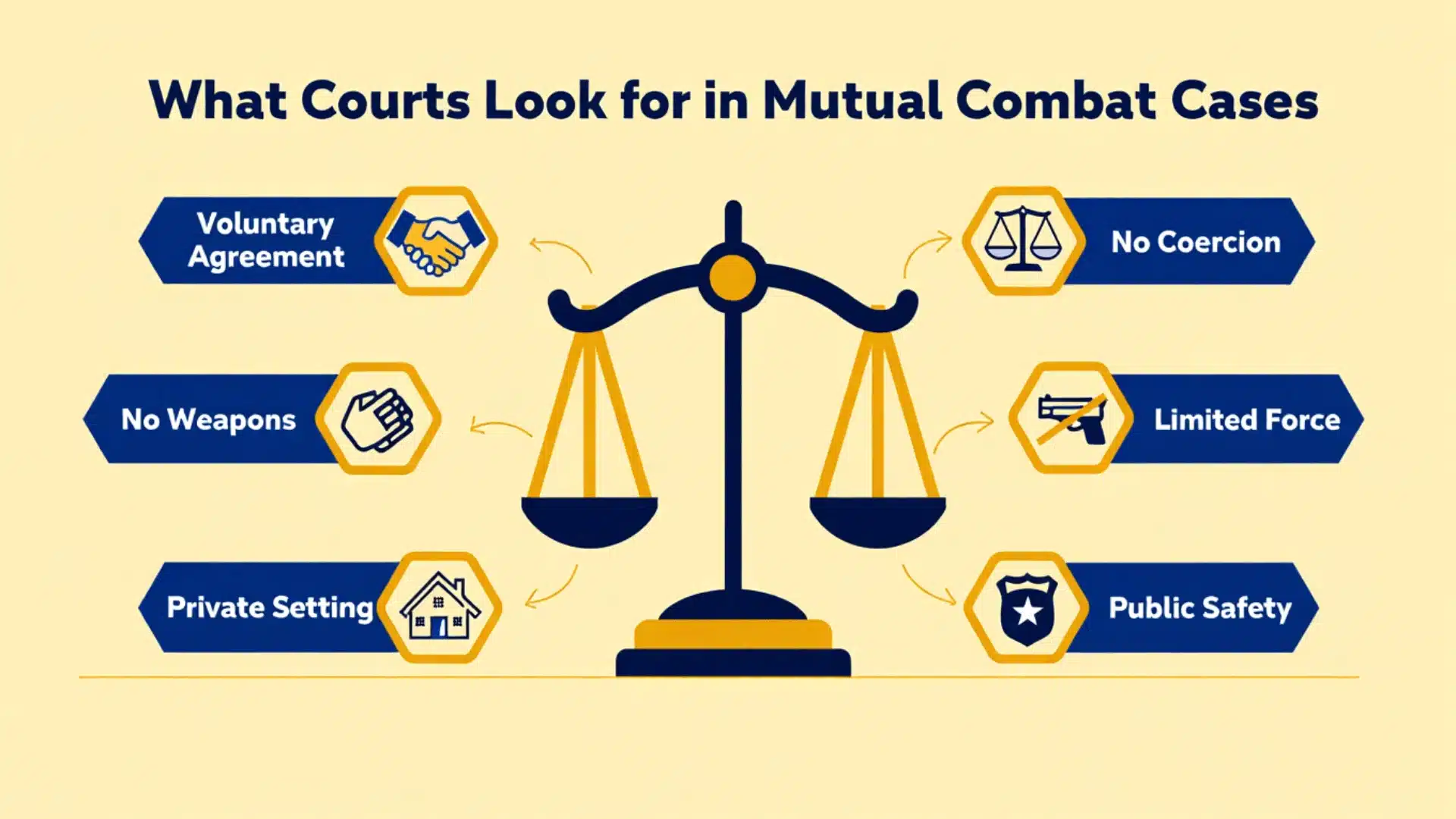
When judges assess a mutual combat case, they focus on several key elements to determine whether consent was genuine and whether the altercation stayed within acceptable boundaries. Here is what courts typically examine:
- Voluntary Agreement: Explicit or implied consent must have existed before any physical contact occurred.
- Equal Participation: The fight must reflect balanced involvement, free from coercion or undue pressure on either side.
- No Weapons: Using objects capable of escalating harm typically disqualifies the claim.
- Limited Force: Excessive force that results in serious injury can override any consent-based defense entirely.
- No Bystander Risk: Courts look for evidence that no uninvolved individuals were put in danger during the altercation.
- Police Oversight or Private Setting: Depending on the state, either the presence of a police officer or a non-public location is a relevant factor that courts will consider.
Mutual Combat Laws by State: A State-by-State Breakdown
Some have explicit legal frameworks that permit it under strict conditions, one state bans it outright by statute, and most fall into a gray area governed by standard assault laws. Here is how the most relevant states approach the issue.
1. Washington State
Washington is one of only two places in the U.S. with a specific legal framework for mutual combat.
Under Seattle Municipal Code 12A.06.025, fistfights are permitted within city limits as long as no bystanders are harmed and no property is damaged.
Washington’s assault law also requires a complaining victim to prosecute to move forward. If neither participant files a complaint, no formal crime is typically recognized under state law.
A police officer is generally expected to observe the fight and step in once a clear winner has emerged.
2. Texas
Under Texas Penal Code Section 22.06, consent is an affirmative defense to assault charges, provided the fight does not result in serious bodily injury.
Consent does not need to be stated out loud. If someone’s words and actions make their willingness to fight clear, Texas courts can treat that as valid consent.
Similar to Washington, a police officer’s presence is generally expected to keep the situation from going too far.
3. Oregon
Oregon is the only state that explicitly bans it by statute. Under ORS 161.215(3), physical force is not justified when it is the product of an agreed-upon fight that is not specifically authorized by law.
Even consensual fights between adults are illegal in Oregon unless they take place within a licensed, state-approved setting such as a sanctioned sporting event.
4. Other States
Most states treat it as a gray area governed by standard assault and battery statutes.
California, for instance, recognizes it as a partial defense in misdemeanor battery cases but not in felony battery involving serious injury.
In Florida, where I practice criminal defense, consensual fighting is prosecuted under standard assault and battery laws without any exception.
Many clients I have worked with arrive believing that prior mutual consent functions as a complete shield from criminal liability, but Florida courts simply do not recognize that protection.
Mutual Combat: Real-Life Examples
Real-world examples show how willingness, context, and local laws influence whether charges are filed or dismissed.
1. Seattle MMA Fighter Incident (2012)
In 2012, Seattle’s costumed vigilante Phoenix Jones, a trained MMA fighter, engaged in a street altercation captured on video that spread widely online.
After breaking up a dispute, he agreed to a consensual fight with an individual while police observed, adhering to Washington’s provisions.
No charges were filed because consent was clear, no bystanders were harmed, and local law permitted the altercation under those conditions.
This case remains the most documented public instance being formally applied in a U.S. street setting, and it continues to spark debate about the role of police discretion in such situations.
2. Zac Efron Skid Row Fight (2014)
Actor Zac Efron was involved in a late-night skirmish in Los Angeles’ Skid Row in 2014, where he and his bodyguard clashed with transients after a vehicle issue.
When police arrived, they determined that both sides had participated willingly and that no serious injury had occurred, so no arrests were made.
The outcome showed how law enforcement weighs consent, level of harm, and surrounding context before deciding whether to press charges, even in states without an explicit statute.
3. Texas Domestic Cases (e.g., Hughes v. State)
In Texas, cases like Hughes v. State (1986) demonstrate how it affects domestic disputes, where an agreement to fight can invalidate self-defense claims.
The court reversed a conviction due to improper jury instructions on retreat in a third-party defense but also highlighted that prior consent to combat negates certain justifications.
This is a pattern I have seen in practice as well. When a client attempts to argue both mutual combat and self-defense, the claims can undermine each other.
Admitting to a consensual fight weakens the position that the actions were purely defensive, making the argument difficult to sustain legally.
4. Mutual Combat in Licensed Sports
Boxing and MMA are the clearest legal examples of combat in regulated practice.
Both competitors sign contracts, follow established rules, and compete under licensed athletic commissions with medical staff and referees present throughout.
Because everything takes place within a fully sanctioned environment, injuries that occur during the event do not typically result in criminal charges.
Street fights operate in entirely the opposite direction. Without contracts, official oversight, or safety measures, participants risk arrest regardless of whether both agreed to fight beforehand.
Legal Implications of Mutual Combat
When individuals engage in combat, law enforcement may still impose criminal charges on both parties.
Consent alone does not guarantee legal protection, and outcomes vary significantly depending on state law, injury level, and whether public safety was at risk.
- Fines ranging from $500 to $5,000 or more
- Probation or community service requirements
- Jail time up to 1 year for misdemeanors, or 1 to 10 years for felony-level charges
- A permanent criminal record that can affect employment opportunities and housing applications
- Civil liability, where the other party may pursue financial damages through a lawsuit
If weapons are involved or the fight causes severe injury, charges can escalate to aggravated assault charges, a separate offense that carries substantially heavier penalties and a distinct legal classification from simple assault.
Fighting in public spaces may also lead to disorderly conduct or public affray charges, even when both parties initially agreed to the altercation.
Mutual Combat vs Self-Defense: Key Differences
Understanding the distinction between the two is critical because it directly affects whether someone faces criminal charges or avoids them entirely.
| Factor | Mutual Combat | Self-Defense |
|---|---|---|
| Consent to Fight | Yes, by both parties | No, the victim did not consent |
| Who Initiates | Either party | Aggressor only |
| Legal Outcome | Both may face charges | Defender may be protected |
| Retreat Required? | Varies by state | Depends on Stand Your Ground laws |
| Valid Legal Defense? | Rarely | Yes, in most jurisdictions |
Common Misconceptions About Mutual Combat
Misunderstandings around it often lead to poor decisions during confrontations. Many assumptions come from casual conversations rather than actual legal standards.
- Saying “Mutual Combat” does not make it legal: Simply declaring combat during a fight has no legal effect. Courts require clear, prior consent before any physical contact occurs.
- Not every two-sided fight qualifies: It requires genuine agreement from both parties. Factors like coercion, intoxication, or unequal conditions can invalidate claims of shared intent.
- It is not recognized nationwide: Only a few states, such as Washington and Texas, have defined frameworks. Even there, enforcement depends on circumstances like injury severity and public safety concerns.
- No complaint does mean no charges: In many states, prosecutors can pursue charges using evidence like police reports or surveillance, even if neither party files a complaint or cooperates.
Mutual Combat Safety Steps and Legal Precautions
Even where combat is recognized, legal protection is never absolute. Situations can escalate quickly, and what begins as a consensual altercation may still lead to serious charges.
- Consent is Not Legal Immunity: An agreement between two individuals to fight does not guarantee protection from arrest or prosecution under state laws.
- Police Response Matters: Knowing the difference between detention and formal arrest can influence how an individual responds during initial law enforcement interaction.
- De-escalation is The Safest Option: Walking away, creating distance, or using calm communication can prevent a situation from escalating into a criminal offense.
- Public Settings Increase Risk: Altercations in crowded areas may lead to additional charges, including disorderly conduct or harm to bystanders.
- Alcohol and Weapons Escalate Charges: Intoxication or the presence of objects capable of causing harm can elevate charges from minor offenses to serious felonies.
- Document Attempts To Withdraw: Evidence such as messages or witness accounts showing an attempt to disengage can be critical in legal proceedings.
- Legal Counsel is Essential After Incidents: Consulting a criminal defense attorney after an arrest or injury ensures proper guidance and protection of rights.
- No Guaranteed Protection Exists: These agreements do not eliminate legal consequences, and outcomes depend heavily on the circumstances.
Conclusion
Mutual combat remains a narrow and often misunderstood legal concept within criminal law.
While some states recognize limited forms of law, consent does not automatically protect against arrest or prosecution.
Courts carefully examine voluntary agreement, level of force, public safety risks, and whether the situation escalated beyond what was initially intended.
A fight that begins with shared intent can quickly turn into a serious criminal matter if weapons, injuries, or bystanders become involved.
Understanding how it is treated in your state is essential before making assumptions about legality. Laws vary, and outcomes depend heavily on specific facts.
Do you have questions about these laws in your state? Drop them in the comments below.
Frequently Asked Questions
What is the Difference Between Mutual Combat and a Street Fight?
A typical street fight involves no established prior consent, no official oversight, and no structured conditions. Combat as a legal concept requires verifiable agreement from both parties before the confrontation begins, along with compliance with applicable state or local requirements.
Can Mutual Combat Laws Apply in Domestic Situations?
Courts apply particularly strict standards in domestic settings. A prior agreement to fight can sometimes complicate a self-defense claim, but it does not eliminate criminal liability, especially in states with strong domestic violence statutes.
Does Mutual Combat Work as a Legal Defense in Court?
Rarely, and only in specific jurisdictions. In Texas and Washington, a successful defense requires clear evidence of genuine pre-fight consent, no serious bodily injury, and full compliance with applicable local regulations.