You are driving home, and a cop pulls up next to you. You are annoyed, and in an instinct, you raise your middle finger. Then it hits you: Is it illegal to flip off a cop?
Some insist it is protected speech, while others claim you can get arrested on the spot.
Viral videos and real court cases only deepen the confusion, leaving people genuinely unsure if they can flip off a cop without facing real legal consequences.
The line between exercising your rights and creating a bigger problem is not always clear.
Before acting on impulse, it makes sense to understand what the law actually says and how these situations play out in the real world.
As a civil rights attorney who has handled First Amendment and police encounter cases, I have watched clients face real legal exposure, not because the gesture itself was criminal, but because of what they did in the seconds immediately after it.
Why Flipping Off a Cop Becomes A Serious Debate?
Flipping someone off is usually an emotional act, not planned. It happens in a split second, often out of frustration or anger.
But when the person on the receiving end is a police officer, the stakes feel different. Officers represent authority, and that changes how people think about even a small gesture.
What might seem like a harmless expression toward a stranger suddenly feels risky. There is also a constant push-and-pull between personal freedom and public order.
A simple hand gesture can turn into a serious legal debate.
Add viral videos and online arguments to the mix, and confusion spreads fast, leaving people unsure about what is protected and what crosses a line.
Is It Illegal to Flip Off a Cop?
The short answer is generally no. In most cases, flipping off a police officer is considered protected speech under the First Amendment.
In the cases I have reviewed and handled, the gesture itself is rarely what creates lasting legal trouble.
It is the refusal to comply during the stop that follows, the verbal escalation through the car window, or the secondary confrontation that are the moments that transform a constitutionally protected act into a prosecutable one.
The Constitution protects not only polite opinions but also speech that is rude, offensive, or unpopular.
Courts have repeatedly ruled that gestures like the middle finger fall within the realm of symbolic expression.
Several federal cases have backed this view, making it clear that disrespect alone is not a crime. That said, there is a difference between offensive speech and illegal behavior.
A rude gesture by itself is usually protected, but pairing it with threats, obstruction, or aggressive actions can shift the situation into something that is no longer protected.
What the First Amendment Actually Protects?

The First Amendment protects your right to speak freely without government punishment. That includes opinions that are unpopular, offensive, or disrespectful.
It applies not only to spoken or written words but also to expressive conduct, meaning actions meant to communicate a message.
Courts call this symbolic speech, and gestures can fall into that category.
The foundational Supreme Court precedent here isCohen v. California, 403 U.S. 15 (1971), in which the Court held that offensive language directed at government authority is constitutionally protected unless it rises to the level of a true threat or incitement to immediate lawless action.
That ruling has been applied repeatedly to obscene gestures, including the middle finger, in encounters with law enforcement. However, this protection is not unlimited.
True threats, direct incitement to immediate violence, and certain forms of harassment are not protected.
Courts have also established the “fighting words” doctrine, originating in Chaplinsky v. New Hampshire, 315 U.S. 568 (1942). Fighting words are those which, by their very utterance, tend to incite an immediate breach of the peace.
The key point is that a single rude gesture made through a car window, without any face-to-face confrontational exchange, has consistently failed to meet this threshold in federal courts.
It is also important to understand that the First Amendment protects you from government action, including police retaliation, not from social criticism or tense reactions in public settings.
Where First Amendment Protection Ends
Knowing that the gesture is generally protected is only half the picture. Courts have established clear categories of conduct that fall outside that protection.
- Paired with direct verbal threats: If the gesture is accompanied by an explicit threat, “I will hurt you” or similar language, the combination can constitute a true threat and remove First Amendment cover entirely.
- Face-to-face fighting words: Courts draw a meaningful legal distinction between a gesture made through a car window while driving away and the same gesture made on foot, in close physical proximity to an officer, as part of an escalating exchange. The fighting words doctrine applies far more readily in the latter scenario.
- Conduct that obstructs law enforcement: If the gesture is part of a broader pattern, blocking the officer, refusing lawful commands, or interfering with an active arrest nearby, it can be introduced as evidence of intent, even if the gesture is not the charge itself.
- Expression paired with active unlawful behavior: Flipping off an officer while committing a traffic violation, resisting a stop, or driving recklessly gives the officer separate legal grounds. The same applies to more serious offenses, where voyeurism crime carries its own separate legal consequences regardless of any expression involved.
Can You Flip Off a Cop Without Getting Arrested?
Legally, you may be protected, but in reality, that does not guarantee you will avoid trouble. There is a gap between constitutional rights and how situations unfold on the street.
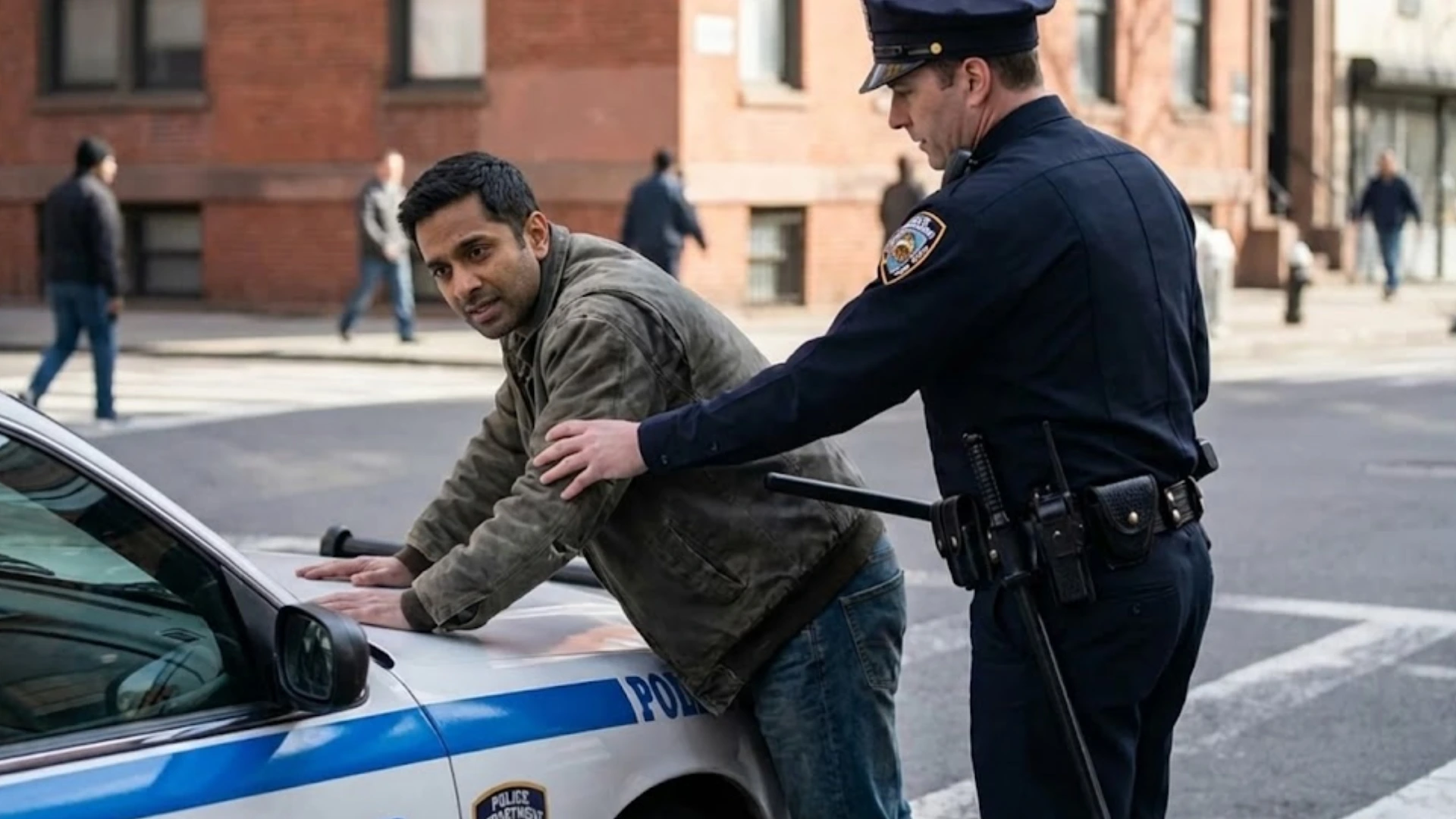
Some officers may ignore the gesture. Others may view it as provocative and look for grounds such as disorderly conduct, especially if they believe it is causing a disturbance.
Context plays a big role; during a calm, random encounter, it might end with nothing more than a glare. During a traffic stop, where tension is already high, it can escalate quickly.
Even if charges do not hold up later, the temporary detention, stress, and legal hassle can be very real.
Even if an arrest is made and later thrown out, the practical consequences, temporary detention, stress, a court date, and potential legal fees, are very real.
The constitutional protection does not erase those costs. It simply gives you legal recourse after the fact.
There is also a Fourth Amendment dimension that often goes unmentioned. When an officer pulls someone over or detains them solely because of the gesture, that stop is not just a First Amendment violation.
It is also an unreasonable seizure under the Fourth Amendment. In Cruise-Gulyas v. Minard, the Sixth Circuit held that the second traffic stop violated both constitutional provisions simultaneously.
This matters because it broadens the basis for a civil rights lawsuit if your rights are violated.
Understanding how these constitutional protections apply in real encounters requires knowing the difference between a stop, a detention, and a formal arrest.
Real Court Cases Regarding This Issue
Courts have tested this issue in real situations, and the rulings make one thing clear: judges have directly addressed flipping off police officers.
1. Cruise-Gulyas v. Minard
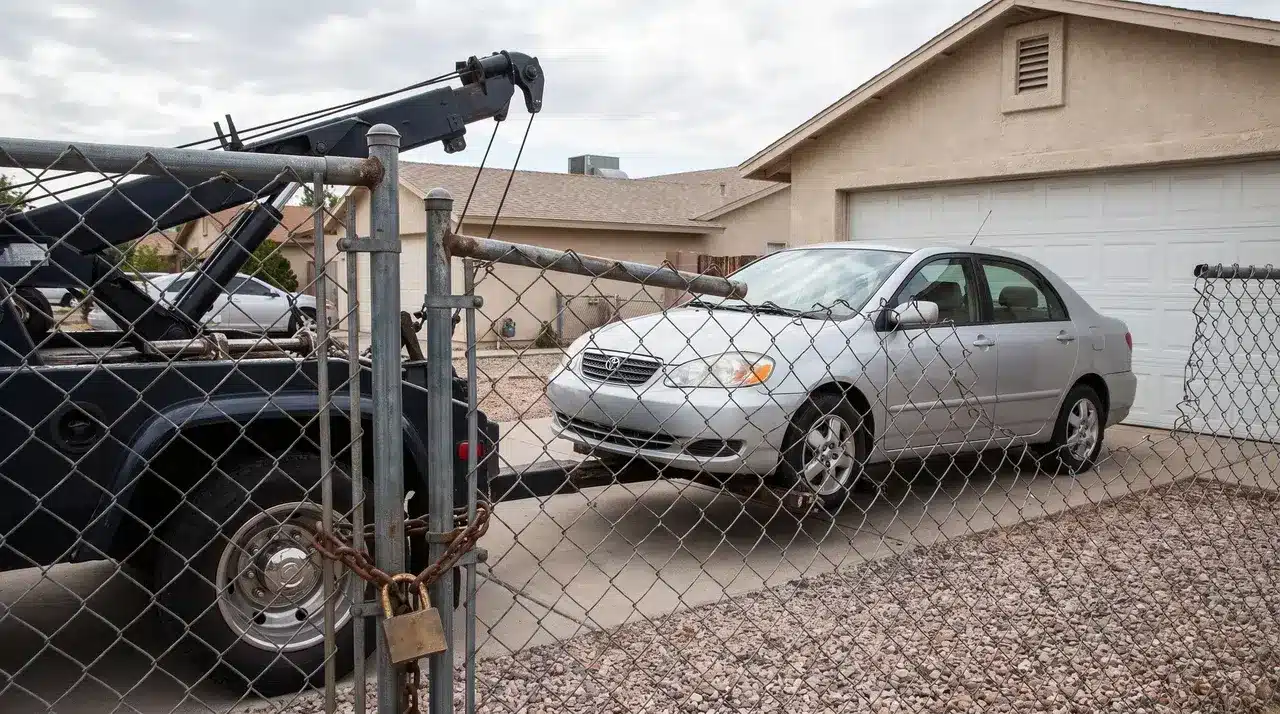
This is the most cited case. In 2017, a Michigan woman flipped off a police officer after receiving a minor speeding ticket. The officer pulled her over again and increased the citation.
She sued, and in 2019, the Sixth Circuit Court of Appeals ruled the officer violated her First Amendment rights.
The court made it clear that giving the finger is protected speech and not grounds for retaliation. The ruling stated plainly that an officer cannot punish someone just for that gesture.
This is the case I cite most often when advising clients on potential civil rights claims stemming from police stops.
It is one of the cleaner examples in federal case law of a court drawing an explicit line between officer discretion and constitutional retaliation, and it has been widely adopted in other circuits as persuasive authority.
2. Swartz v. Insogna
A passenger in a vehicle gave an officer the middle finger as they drove by. The officer pulled the car over, suspecting something was wrong.
The Second Circuit Court of Appeals ruled that the gesture alone did not create reasonable suspicion of criminal activity.
The court confirmed that a single rude gesture, without more, falls within protected speech. Federal courts have consistently ruled in favor of citizens on this issue.
3. Brown v. Wilson (Georgetown, Texas)
A Texas court dismissed disorderly conduct charges against a man cited for flipping off an officer while driving.
The court found that the gesture, made through a closed window of a moving vehicle and not as part of a face-to-face confrontation, did not amount to fighting words and therefore did not meet the legal threshold for disorderly conduct under Texas Penal Code section 42.01.
4. North Carolina v. Ellis (North Carolina Court of Appeals, 2019)
In North Carolina, the Court of Appeals addressed a driver who extended his middle finger at an officer and later refused to identify himself after being stopped.
The state conceded there was no reasonable suspicion to stop the vehicle based on the gesture alone.
The court held that officers are held to a higher standard of restraint than the average citizen when subjected to offensive expression and that the gesture did not justify the initial stop.
The subsequent refusal to identify himself, however, became a separate legal issue under state obstruction statutes.
5. Additional Federal Court Rulings
Cruise-Gulyas is not an isolated decision. In Duran v. City of Douglas, the Ninth Circuit ruled that a man who shouted profanities and made obscene gestures at an officer was still protected by the First Amendment.
The court stressed that police cannot detain someone simply for being offensive. Similar reasoning appeared in Thurairajah v. City of Fort Smith, where a driver’s middle finger did not justify a traffic stop.
In everyday terms, federal courts have repeatedly said irritation alone is not a crime.
Community Opinions: What People Are Saying?
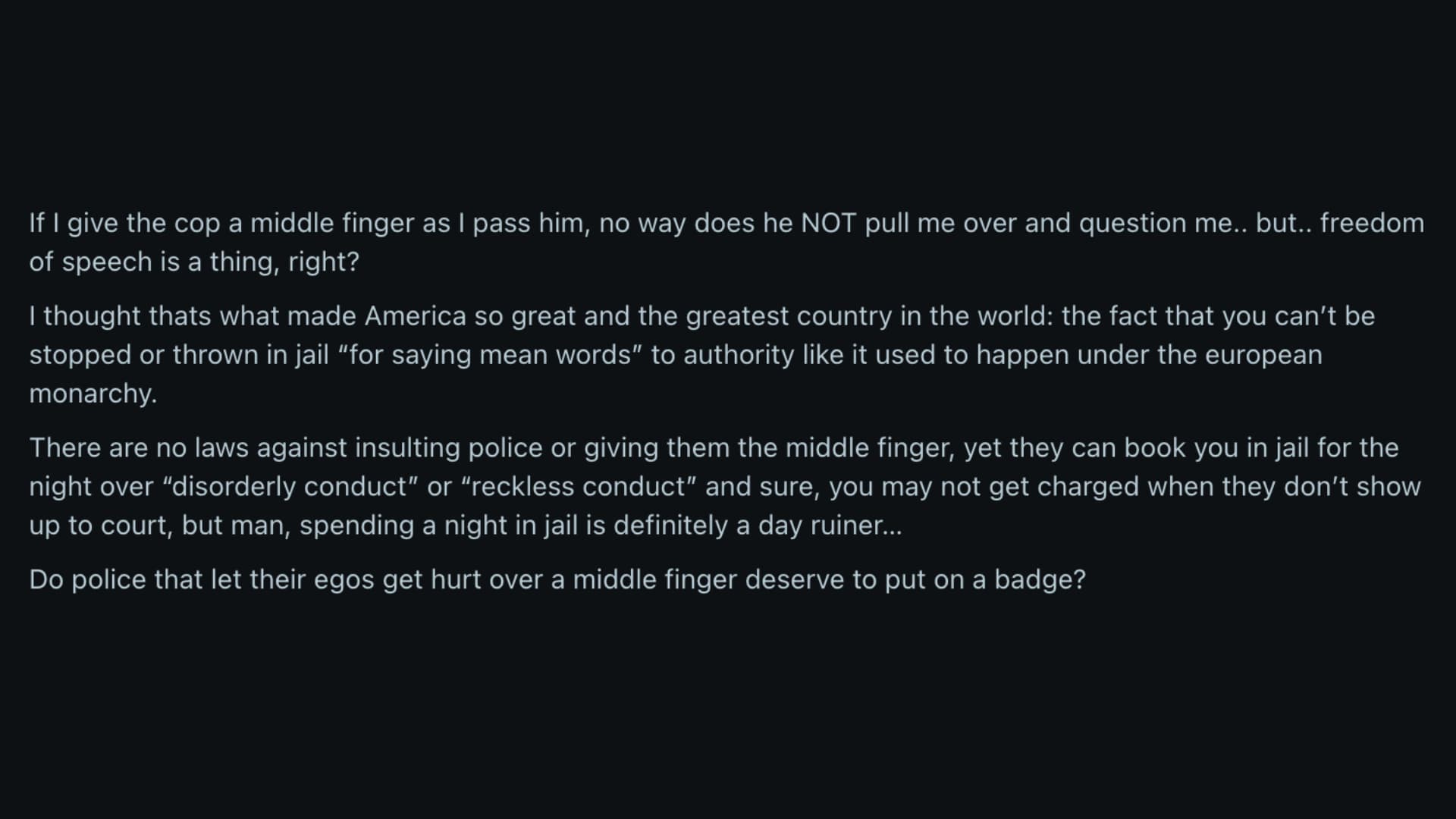
Many people on Reddit expressed their frustration about this exact issue. They pointed out the confusing gap between what the law says and what actually happens on the street.
People acknowledged that flipping off a cop is generally protected under the First Amendment, yet they expressed concerns about being stopped, detained, or charged under broad laws such as disorderly conduct.
Several people stressed that even if charges are later dropped, the temporary arrest, legal fees, and stress can feel like punishment.
The overall discussion reflects a common worry: legal protection does not always prevent real-world consequences when authority and discretion come into play during tense encounters.
What to Do If Your Rights Are Violated Over a Gesture
If an officer stops, detains, or arrests you solely because of a middle finger, you may have the basis for a civil rights claim under 42 U.S.C. Section 1983, the federal statute that allows individuals to sue state officials for constitutional violations.
The cases discussed above, Cruise-Gulyas, Swartz, and Duran, were all Section 1983 claims.
To succeed, you generally need to show that the officer’s action was taken under color of law, that it violated a clearly established constitutional right, and that the officer is not shielded by qualified immunity.
Documentation is critical; a dashcam recording, witness accounts, badge numbers, and the exact wording of any charges filed all become important evidence.
The moment of the gesture itself matters less than what the officer did in response to it.
If you believe your rights were violated and want to pursue a claim, working with an attorney who handles constitutional disputes is the right next step.
In some cases, especially where your reputation or public image is affected, consulting a defamation-attorney can also help you understand your legal options more clearly.
Practical Tips for Handling this Situation in the Future
Before reacting in the moment, it helps to balance your rights with smart judgment. These are practical steps to protect yourself without escalating the situation:
- Know Your Right to Express Frustration: The First Amendment generally protects offensive gestures toward police, meaning disrespect alone is not automatically a crime under U.S. law.
- Stay Calm and Comply If Arrested: If an officer escalates or arrests you, do not resist. Comply peacefully and challenge the legality later through the court system.
- Document the Encounter: Use a dashcam if possible, note badge numbers, and gather witness details. Clear documentation can become critical evidence if rights are violated.
- Think Twice in Volatile Situations: During traffic stops, detentions, or already tense encounters, a gesture can increase scrutiny and escalate an otherwise manageable interaction.
- Seek Legal Guidance if Charged: If you face charges over a gesture, consult a civil rights attorney and review free speech resources from organizations like the ACLU.
Conclusion
Understanding whether it is illegal to flip off a cop is more than a matter of legal trivia; it is a question people ask because they have genuinely been in this situation and are uncertain about where their rights actually begin and end.
The answer, consistently confirmed by federal courts across multiple circuits, is that the gesture alone is protected speech.
But as I have seen in civil rights practice, what happens in the moments after the gesture matters far more than the gesture itself.
Courts draw the line at expression combined with obstruction, escalation, or threats, not at rudeness alone.
Know your rights and know your state’s specific laws. Document every encounter where you believe retaliation has occurred.
Have questions about a specific encounter or your rights in your state? Drop them in the comments below.
Frequently Asked Questions
Can You Get Arrested For Flipping Off a Cop Even If It Is Protected Speech?
Yes, temporarily, officers may use broad statutes like disorderly conduct to justify an arrest, even if the gesture itself is protected, though such charges often do not hold up in court.
Can Flipping Off a Cop Give Police Probable Cause To Search Your Car?
No, the gesture alone does not establish probable cause. However, separate factors like visible contraband, traffic violations, or signs of impairment can independently justify a lawful vehicle search.
Is The Legal Analysis Different If You Are On Foot Versus Inside a Moving Vehicle?
Yes, courts recognize a difference. Gestures made from a moving vehicle typically lack direct confrontation, making them less likely to be considered fighting words or provoke immediate disturbances.
Does This Protection Apply the Same Way in All 50 States?
Not in practice. Federal constitutional protections apply everywhere, but how broadly individual states define disorderly conduct or disturbing the peace affects how much discretion officers have at the point of contact.