
Most people writing a letter of recommendation for immigration have good intentions. They want to help.
But good intentions don’t automatically translate into a useful letter, and in immigration, a weak recommendation can quietly work against the very person you’re trying to support.
After years of reviewing immigration files, I’ve seen officers set aside letters that were full of warm words but short on substance. I’ve also seen a single well-written paragraph from a neighbor tip a discretionary decision in the applicant’s favor.
The difference usually comes down to knowing what to include, who should write it, and how to frame it for the person reading it.
This guide covers all of that, without the complex legal terms.
What is a Letter of Recommendation for Immigration?
An immigration letter of recommendation is a written statement from someone who knows the applicant, personally, professionally, or academically, that supports their visa, green card, or citizenship application.
Under U.S. immigration law, specifically the Immigration and Nationality Act (INA), officers reviewing applications may consider evidence of good moral character and community ties when making discretionary decisions.
A well-constructed letter of recommendation directly addresses both of those factors.
It gives U.S. Citizenship and Immigration Services or an immigration judge a human picture of the applicant that paperwork alone can’t provide.
It’s not always required, but when it’s done right, it adds real weight. It can reinforce moral character, show community ties, or demonstrate professional value depending on what the application needs.
Who Should Write It?
It matters more than most people realize. The best letters come from people who have known the applicant for at least a year or two, can speak from firsthand experience, and have some credibility.
It includes an employer, professor, community leader, clergy member, or long-time friend, who is a U.S. citizen or permanent resident, since that status tends to carry extra weight.
Relatives can write letters, but they’re generally less persuasive unless the case specifically involves family relationships.
A letter from a cousin vouching for someone’s character won’t carry the same weight as one from an employer of five years.
One thing I always tell applicants: do not ask someone just because they have an impressive title. Ask someone who genuinely knows you and can write with specificity.
A heartfelt letter from a neighborhood pastor who has known the applicant for eight years will often do more than a formal one from a senior executive who barely remembers their name.
What Every Immigration Recommendation Letter Needs?
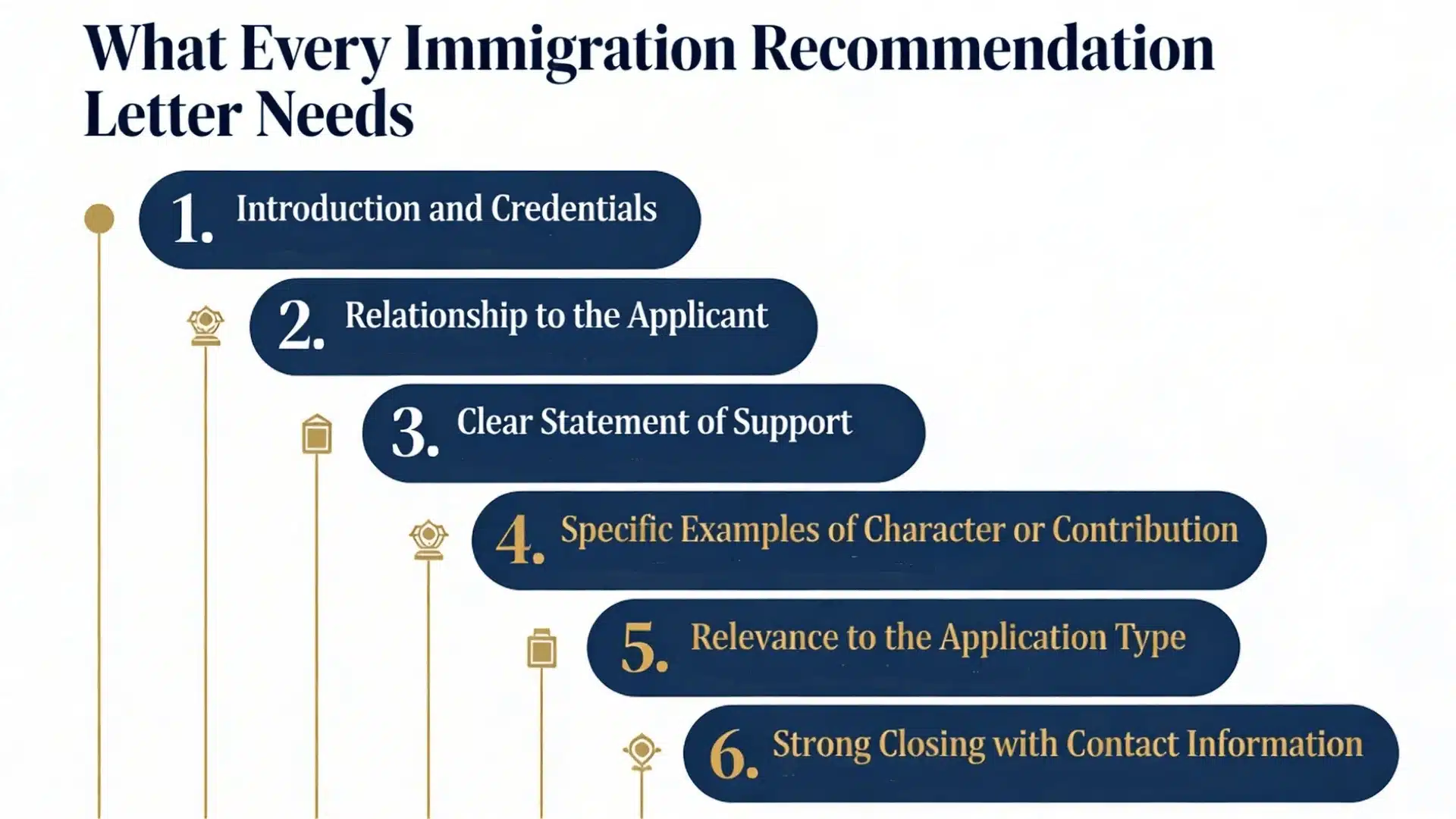
The format is fairly standard across visa types. Here’s what a solid letter includes.
1. Introduction and Credentials
Start by clearly stating who you are, your role or profession, and how you know the applicant. Mention how long you have known them and why your perspective matters.
This builds trust right away and helps the officer understand the value of your opinion.
Keep it short and direct, usually two or three sentences, but make sure it shows your credibility and connection.
2. Relationship To the Applicant
Clearly explain how you know the applicant and in what capacity.
Be specific about your role, whether you are a supervisor, colleague, neighbor, or family member, and include how long you have known them.
Adding context about your interactions helps show how closely you have observed their behavior and character.
A detailed relationship makes your letter more credible and gives the officer a stronger reason to trust your perspective.
3. Clear Statement of Support
State your support clearly and early in the letter so there is no confusion about your position. Do not place it deep within the content where it can be missed.
A direct sentence like “I fully support this application” works best.
This helps the officer quickly understand your stance and sets the tone for the rest of the letter, making your intent strong and unmistakable from the beginning.
4. Specific Examples of Character or Contribution
This section carries the most weight, so avoid vague praise that does not add value. Instead, include detailed examples that show how the applicant acted in real situations.
Mention specific events, actions, and outcomes to make your points stronger.
When you explain how the applicant handled responsibility or challenges, it gives the officer a clearer and more realistic understanding of their character and reliability.
5. Relevance to the Application Type
Make sure the letter matches the purpose of the application instead of using a general format.
For employment-based cases, highlight work performance, skills, and achievements. For family-based cases, focus on relationships and community ties. For legal relief cases, emphasize conduct and integration.
When the content aligns with the application type, it becomes more useful and persuasive for the officer reviewing it.
It is also worth knowing that USCIS officers are experienced readers.
They review large volumes of these letters and can tell within the first paragraph whether the writer has genuine, direct knowledge of the applicant.
The specificity of the examples is often the first thing that distinguishes a credible letter from a form letter.
6. Strong Closing With Contact Information
End the letter with a clear and confident closing that reinforces your support and invites verification.
Offer to be contacted directly for any questions or clarification, and include your phone number and email address. This shows that you stand behind what you have written and are willing to confirm it if needed.
While it may seem like a small detail, officers often notice when contact information is missing, and its inclusion strengthens credibility and trust.
Sample Immigration Recommendation Letter Templates
Knowing what to include is one thing. Seeing it on paper is another. Below are three templates, one from an employer, one from a personal contact, and one from a community leader.
Use them as a starting point, not a copy-paste. Every bracketed field should be replaced with specific, real details from your relationship with the applicant. The more lived-in the letter feels, the more weight it carries.
Sample 1: Letter of Recommendation from an Employer
[Your Full Name]
[Your Job Title]
[Company Name]
[Company Address]
[Your Email]
[Your Phone Number]
[Date]
U.S. Citizenship and Immigration Services [USCIS Office Address]
Subject: Letter of Recommendation for [Applicant’s Full Name] -[Visa/Green Card Application]
Dear Sir/Madam,
My name is [Your Name], and I am the [Your Title] at [Company Name], where I have directly supervised [Applicant’s Name] for the past [X] years. I am a U.S. citizen and have worked in [industry] for over [X] years. I am writing to express my full support for [Applicant’s Name] ’s application for [visa type or permanent residency].
During [his/her/their] time at [Company Name], [Applicant’s Name] has consistently demonstrated the kind of professional integrity and commitment that is genuinely rare. In [specific year], when [describe a specific challenge or project], [Applicant’s Name] [describe what they did and the outcome]. That single example reflects how [he/she/they] approaches every responsibility, with care, precision, and follow-through.
Beyond [his/her/their] professional contributions, [Applicant’s Name] is a person of strong moral character. [He/She/They] [mention a community or personal quality]. This is someone who contributes meaningfully, not just on paper, but in practice.
I fully support this application and am confident that [Applicant’s Name] will continue to be a valuable member of both [his/her/their] workplace and the broader community. Please feel free to reach me at [phone] or [email] if you have any questions.
Sincerely,
[Your Signature]
[Your Printed Name, Title]
Sample 2: Personal Letter of Recommendation (Friend or Neighbor)
[Your Full Name]
[Your Address]
[Your Email]
[Your Phone Number]
[Date]
To Whom It May Concern,
My name is [Your Name]. I am a [U.S. citizen / permanent resident] residing in [City, State], and I am writing this letter in support of [Applicant’s Full Name]’s immigration application. I have known [Applicant’s Name] for [X] years as [describe relationship, neighbor, close friend, etc.].
Over the course of our friendship, I have come to know [Applicant’s Name] as someone who is [specific quality]. One example that stays with me is [describe a specific moment or situation]. That experience reflects who [he/she/they] consistently is, not just in a single moment.
[Applicant’s Name] is actively involved in [mention any community involvement]. [He/She/They] [add a specific detail about their character or community ties].
I support [his/her/their] application without reservation. [He/She/They] is exactly the kind of person who strengthens any community [he/she/they] is part of. Should you wish to speak with me directly, please contact me at [phone] or [email].
Sincerely,
[Your Signature]
[Your Printed Name]
Sample 3: Letter of Recommendation from a Community or Religious Leader
[Your Full Name]
[Your Title / Organization]
[Organization Address]
[Your Email]
[Your Phone Number]
[Date]
To Whom It May Concern,
I am [Your Name], [Title] at [Organization Name] in [City, State]. I have served this community for [X] years and have known [Applicant’s Full Name] through [his/her/their] involvement with our [church/community center/nonprofit/etc.] for the past [X] years. I am writing to offer my strong support for [his/her/their] immigration application.
[Applicant’s Name] has been an active and consistent presence in our community. [He/She/They] [describe specific involvement]. In [specific year or timeframe], [describe a concrete example of impact].
What I can say with confidence, from years of direct observation, is that [Applicant’s Name] is someone of genuine integrity. [He/She/They] does not look for recognition; [he/she/they] simply shows up and contributes. That kind of character is not easily taught, and it is exactly what this community benefits from.
I wholeheartedly support this application and trust that [Applicant’s Name] will continue to be a positive presence wherever [he/she/they] is. I am happy to answer any questions at [phone] or [email].
Respectfully,
[Your Signature]
[Your Printed Name, Title]
What Type of Letter Fits Which Application?
Not all immigration recommendation letters are the same.
For green card applications, if family or employment-based, the letter should focus on character, community ties, and work ethic.
Specifically, officers reviewing green card petitions under INA Section 245(i) often weigh discretionary factors, and a letter that documents consistent, positive community presence speaks directly to that review.
For O-1 or EB-1 extraordinary ability cases, U.S. Citizenship and Immigration Services expects independent expert opinions that detail specific accomplishments and demonstrate field impact.
H-1B and PERM cases call for employer letters that emphasize qualifications and the genuine need for that specific role.
Asylum and deportation defense cases benefit most from character witnesses, community leaders, clergy, and teachers who can speak to how the applicant has integrated and contributed to the community.
Naturalization letters work best from long-term neighbors, employers, or community members who can speak to the applicant’s history and conduct over time.
For O-1 cases especially, USCIS pays close attention to whether the recommender has a prior professional relationship with the applicant.
A letter from a genuine peer in the field, someone who knows the work but was not a direct collaborator, carries far more weight than one from a close colleague or co-author.
One area that often gets overlooked: if the applicant is preparing for an upcoming USCIS interview or consular appointment, recommendation letters can be submitted as part of the supporting evidence package.
Preparing for the immigration interview well in advance includes gathering letters that directly address the specific questions an officer is likely to raise about ties, character, or employment.
Common Mistakes That Get Letters Dismissed

This is the part most guides skip over, and it’s where a lot of well-meaning letters fall apart.
- Generic language is one of the biggest problems. “She is a wonderful person who deserves this opportunity,” says an officer, but it is nothing meaningful.
- Copied templates are another; officers review hundreds of letters and recognize templated phrasing quickly, and it does real damage to the letter’s credibility.
- Praise without concrete examples reads as opinion rather than evidence. Overstating the relationship is a risk too; claiming you know someone “very well” when the letter’s vagueness makes that impossible to believe will undercut the entire endorsement.
- Missing contact information removes any possibility of verification. And letters that appear to have been written by the applicant themselves, which happens more than most people expect, are a serious red flag that officers are trained to identify.
One pattern I see consistently: letters written in elevated or formal language that do not match the recommender’s stated profession.
A warehouse supervisor who writes in dense legal prose raises a flag. The letter should sound like the person who signed it, professional, but natural to who they are.
How to Brief the Person Writing Your Letter?
One thing applicants consistently overlook: the quality of the letter depends partly on what you give the recommender to work with.
Before they sit down to write, share a brief summary of your immigration case and what you’re applying for.
Key experiences or moments the two of you have shared that they could reference, the timeline of your relationship, and any specific qualities or contributions the application needs to highlight.
You’re not writing the letter for them; that would be a mistake. But giving them context means they can write something accurate and useful, rather than a generic character endorsement that does little for your case.
I usually advise applicants to write a one-page briefing document for each recommender, including a short summary of the application’s purpose, 2-3 shared experiences or examples worth mentioning, and the qualities that matter most to highlight.
It takes about 20 minutes to prepare, and the difference in the letters that come back is noticeable.
I’ve seen applicants hand a recommender a blank sheet and say, “just say something nice.” The resulting letters are usually the ones that get set aside.
Conclusion
A letter of recommendation for immigration won’t replace the core evidence in a case, but it can humanize a file and help an officer or judge understand who the applicant really is beyond the paperwork.
The situations where I’ve seen these letters make the biggest difference are almost always the discretionary ones, where the facts alone don’t clearly tip the scale either way.
In those moments, a specific, credible, well-written letter from the right person can genuinely change the outcome.
If you’ve been asked to write one, take it seriously. Think about what you actually know about this person, what you’ve witnessed firsthand, and why you believe their presence in this country matters.
Write that; not a template. If you’re the applicant coordinating this process, choose your recommenders thoughtfully, give them the context they need, and give yourself enough time to review the letters before they’re submitted.
A rushed letter written the night before a deadline rarely reflects the quality of the person you’re trying to help.
If this guide helped you, pass it along to someone currently navigating the immigration process. One good resource shared at the right moment can save a lot of stress and guesswork.
Frequently Asked Questions
Can the Same Letter Be Reused for a Different Immigration Application?
Technically, yes, but it’s not a good idea. A letter reused across different applications without customization may weaken your case, since each visa type has specific requirements.
A letter written for an H-1B petition won’t read the same way to an officer reviewing a green card file.
How Recent Does the Letter Need to Be?
Immigration offices typically prefer letters dated within the past three to six months to ensure the information reflects the applicant’s current situation.
A letter from three years ago, even a strong one, raises questions about whether the relationship or circumstances are still relevant.
Can the Letter Writer Be from Outside the United States?
Yes, there’s no rule requiring the recommender to be a U.S. resident.
However, letters from people already living in the U.S., especially citizens or permanent residents, tend to carry more weight because they can speak to how the applicant fits into the American community and professional life.
Does a Letter of Recommendation for Immigration Need to Be Notarized or Translated?
If the letter is written in a language other than English, USCIS requires that a certified English translation accompany it. The translator must certify their competence and the accuracy of the translation.
Notarization is generally not required unless specifically requested by the receiving office, but having the letter on official letterhead with a dated signature adds credibility and is strongly recommended.
How Many Letters of Recommendation Should You Submit?
There is no set requirement, but quality matters far more than quantity. For most standard visa or green card applications, two to four letters from credible, specific recommenders are sufficient.
For O-1 or EB-1 extraordinary ability petitions, USCIS regulations specifically call for reference letters from experts in the field; typically, three to six is considered appropriate, but each must carry real evidential weight.