Choosing between temporarily staying in the United States and building a life there permanently ranks among the most important decisions many immigrants face today.
A green card vs visa comparison often leaves people unsure which option fits their goals, family plans, and long-term future.
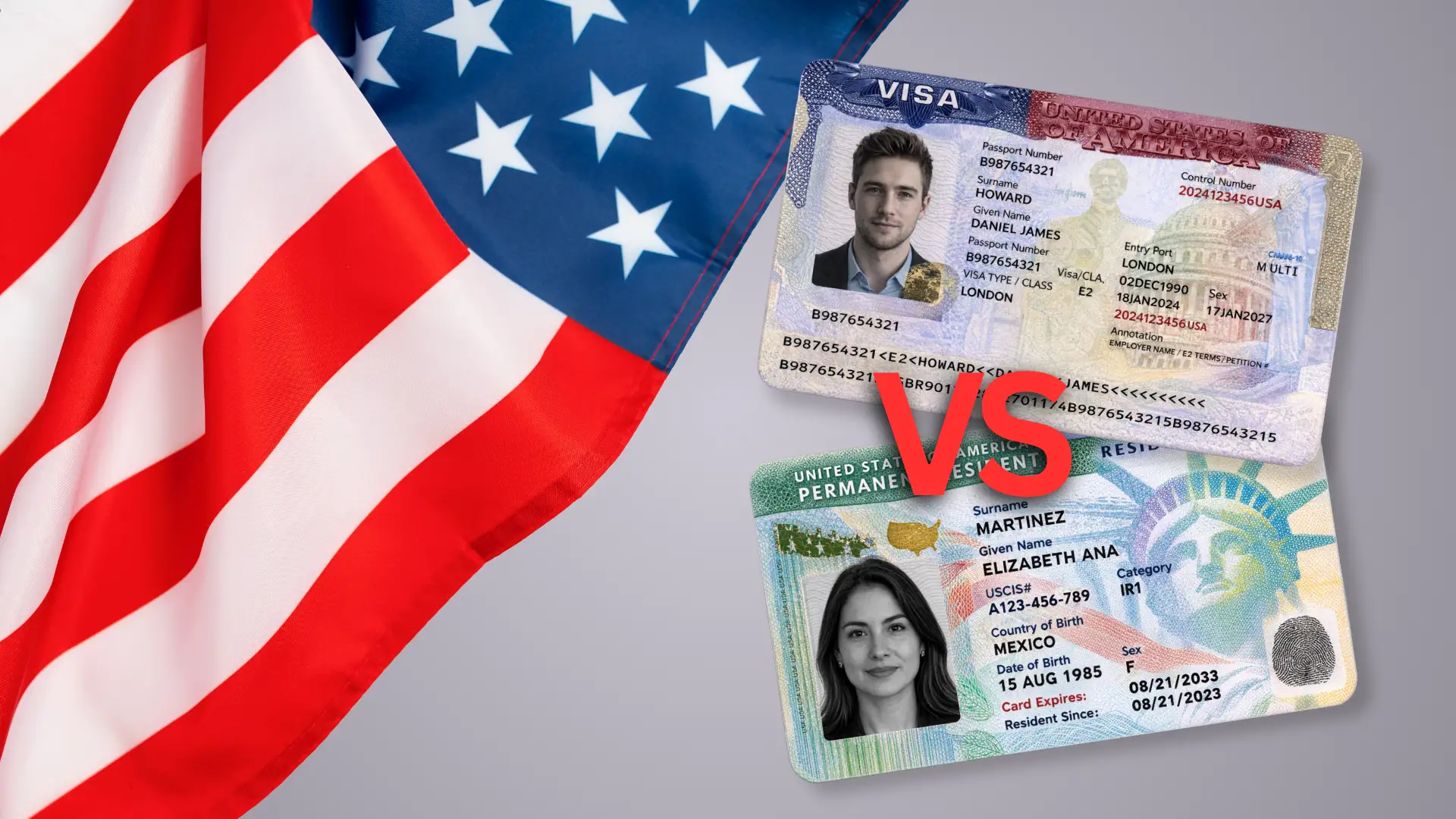
One grants lawful permanent residency with nearly all the rights of a U.S. citizen, while the other offers only time-limited entry for a specific purpose.
In this guide, you will find a clear, side-by-side breakdown of green card vs visa rules, eligibility requirements, benefits, application steps, and real-world implications.
If you already have a visa or are just beginning the process, these details will help you determine which status best fits your situation.
What is a Green Card?
A green card, officially known as the Permanent Resident Card (Form I-551), is issued by U.S. Citizenship and Immigration Services(USCIS).
It serves as legal proof of lawful permanent resident (LPR) status and grants the holder the right to live and work in the United States indefinitely, without being tied to a specific employer, purpose, or fixed end date.
Having spent over years helping applicants and families through this process, I have seen firsthand how much changes once someone moves from temporary visa status to permanent residency.
Beyond the legal upgrade, clients consistently describe it as a shift in long-term stability, the ability to plan years ahead rather than thinking in visa renewal cycles.
The core purpose of a green card is to provide a stable legal foundation for immigrants who intend to make the United States their permanent home.
As a lawful permanent resident, you can accept employment anywhere in the country, build long-term financial stability, and eventually apply for U.S. citizenship after meeting residency requirements.
It is also worth noting what a green card does not grant. Lawful permanent residents cannot vote in local, state, or federal elections, and certain government positions with security clearance requirements may remain inaccessible.
These are distinctions that matter when weighing permanent residency against the eventual step of naturalization.
What is a Visa?
A visa is an official document placed in a foreign national’s passport, issued by a U.S. embassy or consulate abroad.
According to the U.S. Department of State, most foreign nationals must obtain a visa before traveling to a U.S. port of entry, where a Customs and Border Protection (CBP) officer ultimately determines admission.
Visas fall into two main categories, and understanding the distinction between them matters for anyone considering a future in the United States:
- Non-immigrant visas are for temporary stays tied to a specific purpose and duration. Common examples include the B-1/B-2 visa for business or tourism, the F-1 visa for full-time academic study, and the H-1B visa for specialty occupation workers.
- Immigrant visas are for those planning to live in the United States permanently. They are typically the first step toward obtaining a green card and generally require sponsorship from a qualifying family member or employer.
One clarification worth understanding early: a green card is technically a type of immigrant visa. The distinction is procedural.
The immigrant visa stamp gets you to the U.S. port of entry, while the green card is the physical document USCIS issues to confirm your permanent resident status once you are inside the country.
Green Card vs Visa: Detailed Comparison
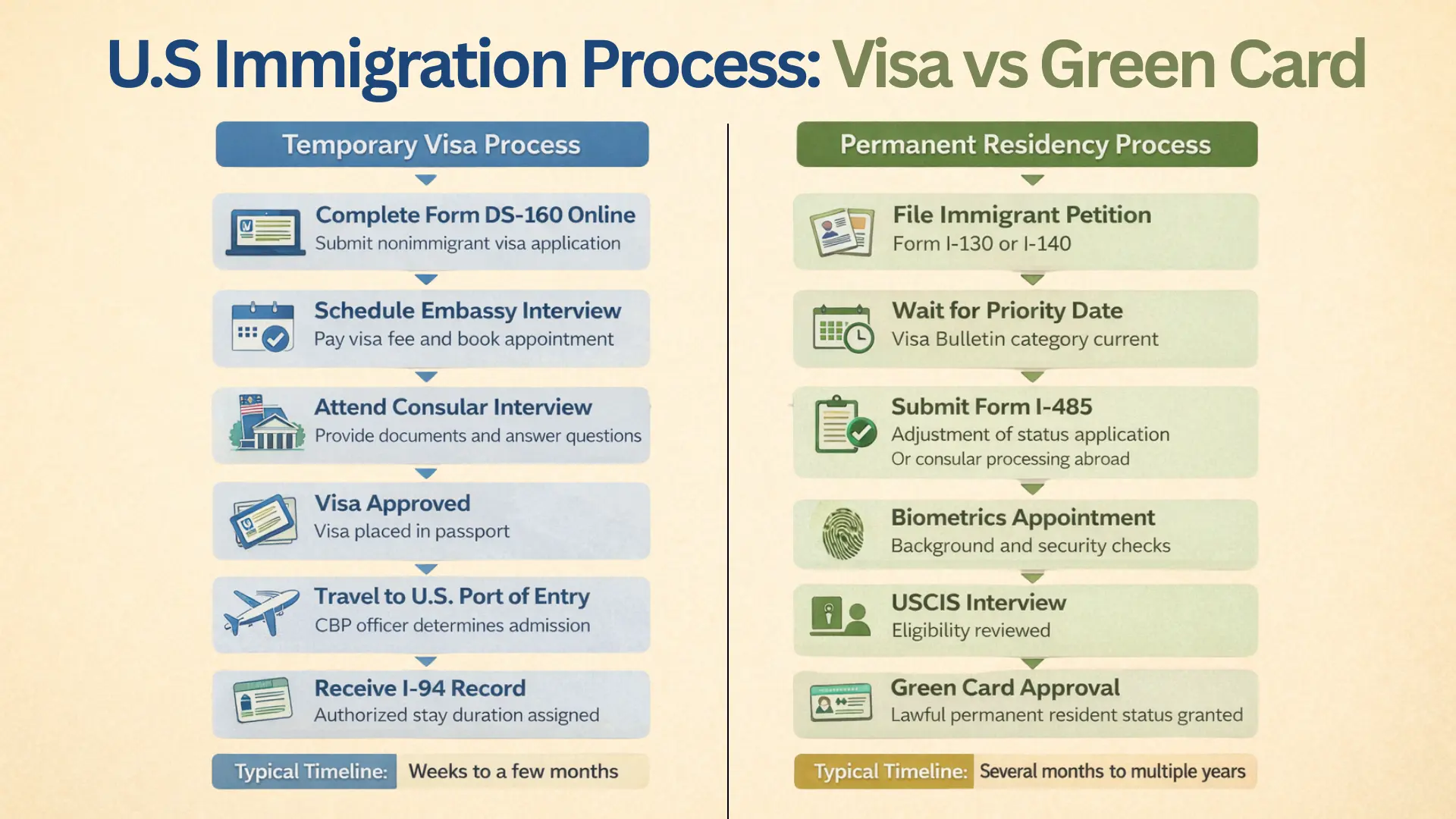
Green card vs visa reveals fundamental distinctions in duration, legal authority, and long-term opportunities that directly shape U.S. immigration outcomes.
1. Eligibility Requirements
Visa eligibility focuses on a clear temporary purpose, such as travel, specialized work, study, or short-term family visits.
Visa applicants must demonstrate their intent to return to their home country and meet category-specific requirements such as proof of funds or a confirmed job offer.
Green card eligibility is narrower and is intended for people who plan to live in the United States permanently.
Qualifying routes include family sponsorship, employer sponsorship, refugee or asylee status, and the Diversity Visa Lottery, among others.
In general, temporary visas are more accessible for short-term purposes, while green cards require stronger qualifications and a long-term commitment to residing in the U.S.
Applications can also be denied for reasons that catch people off guard, such as prior immigration violations, gaps in documentation, or a criminal record that disqualifies the applicant under admissibility standards.
One situation I encounter regularly is clients who were previously issued a visa but overstayed, even briefly, and later face complications when applying for a green card.
These situations are not automatically disqualifying, but they require careful documentation and often a formal waiver process.
2. Rights and Privileges of Each Status
Understanding the rights and privileges tied to each status clarifies how work options, access to benefits, and family opportunities differ between visa holders and green card holders.
Someone navigating an unrelated legal issue, such as a civil dispute or even understanding what what is litigation means in their situation, should be aware that legal proceedings on record can affect immigration adjudications.
| Right/Privilege | Visa Holder | Green Card Holder |
|---|---|---|
| Work Rights | Employer-specific | Any U.S. employer or self-employed |
| Public Benefits | Generally ineligible | Eligible after a 5-year waiting period |
| Family Sponsorship | Not available | Available for spouse, children, parents |
| In-State Tuition | Often out-of-state rates | Eligible in most states |
| Military Service | Limited categories | Full eligibility |
| Voting in Elections | Not permitted | Not permitted, citizenship required |
3. Legal Status and Authorization
A visa gives you nonimmigrant status, meaning you can enter and stay in the United States for a specific reason and for a limited time.
Your authorized stay is recorded on Form I-94, and once it expires, you must either leave the country or apply for an extension.
A green card gives you lawful permanent resident (LPR) status, allowing you to live in the United States indefinitely as long as you maintain eligibility.
Green card holders are also treated as U.S. tax residents by the IRS and must report worldwide income regardless of where it was earned. Nonimmigrant visa holders, by contrast, generally only report U.S.-sourced income. This legal difference shapes daily life in meaningful ways.
Green card holders face fewer restrictions, have broader financial options, and gain access to Social Security benefits after meeting work credit requirements.
Visa holders face stricter limitations on their permitted activities and length of stay.
4. Application Process
The visa process usually begins outside the United States and tends to move faster. Applicants complete Form DS-160 online and attend a consular interview.
If approved, they receive a visa stamp to travel to a U.S. port of entry. Many temporary visas are processed within weeks or a few months, depending on the category and consulate workload.
The green card process involves more steps. It typically starts with an immigrant petition, either Form I-130 for family-based cases or Form I-140 for employment-based cases.
This is followed by waiting for a priority date to become current under the monthly Visa Bulletin.
Eligible applicants already in the United States may then file Form I-485 to adjust their status without leaving the country.
5. Validity and Renewal
Visa validity depends on the category and may range from 30 days to 10 years. However, the actual authorized stay is controlled by the I-94 arrival record, not the visa stamp itself.
If a visa expires without an approved extension, the person may face overstay penalties and possible future entry bars.
A green card is typically valid for 10 years, or 2 years if issued conditionally through marriage or investment. The permanent resident status itself does not expire, but the physical card needs to be renewed using Form I-90.
Conditional residents must file Form I-751 within the 90-day window before their two-year card expires to remove the conditions on their residency.
So, if a visa expires without extension, the person may face penalties or future entry bans. Whereas if a green card expires, it simply means that the status is intact, and the document needs updating.
Green Card vs Visa: Key Differences at a Glance
A side-by-side comparison highlighting rights and long-term immigration implications can help you determine what is better suited to your needs.
| Basis of Comparison | Visa | Green Card |
|---|---|---|
| Legal Status | Temporary authorization | Lawful permanent resident status |
| Length of Stay | Limited, category-dependent | Indefinite residence |
| Purpose | Specific temporary purpose | Permanent residence in the U.S. |
| Work Authorization | Category restricted | Work for any employer |
| Employer Sponsorship | Often required | Not required for most employment |
| Path to Citizenship | No direct path | Eligible after the statutory period |
| Risk of Status Loss | Overstaying causes a violation | Abandonment may cause loss |
| Travel Re-entry | A new visa stamp may be required after traveling abroad | The green card itself serves as a re-entry document |
| Issuing Authority | U.S. Department of State | USCIS |
| Voting Rights | Not permitted | Not permitted (citizenship required) |
| Federal Tax Obligation | U.S.-sourced income only (generally) | Worldwide income reportable to the IRS |
Types of Green Cards
Not all green cards come through the same route, and the category you qualify for directly affects your wait time, required documents, and overall process.
Understanding which category fits your situation matters because processing times and annual visa number availability vary widely across them.
- Family-based green cards are available to immediate relatives of U.S. citizens, including spouses, unmarried children under 21, and parents, as well as additional family preference categories tied to both U.S. citizens and lawful permanent residents.
- Employment-based green cards are divided into five preference categories (EB-1 through EB-5), covering priority workers, professionals with advanced degrees, skilled workers, certain special immigrants, and investors who create U.S. jobs.
- Humanitarian green cards are available to refugees and asylees after one year of qualifying status, as well as to survivors of abuse, trafficking, or crime who qualify under specific federal programs.
- Diversity Visa Lottery green cards are issued annually to up to 55,000 applicants from countries historically underrepresented in U.S. immigration, selected through a random draw administered by the U.S. Department of State.
Many applicants qualify for more than one green card category, and the right choice depends on which path is both available and fastest given your current status and country of birth.
An immigration consultant or attorney can map the options side by side before you commit to a single route.
Benefits of a Green Card Over a Visa
For anyone planning a long-term future in the United States, a green card offers advantages that go well beyond what any temporary visa can provide.
- Flexible Work Opportunities: You are free to work for almost any employer or start your own business without needing special sponsorship approvals.
- More Travel Flexibility: You can travel internationally and return to the United States using your green card as a re-entry document, without applying for a new visa stamp each time.
- Family Sponsorship Options: You can petition for close family members like your spouse, children, and sometimes parents to join you in the United States.
- Path to U.S. Citizenship: After meeting residency requirements, typically three years if married to a U.S. citizen, or five years otherwise, you can apply for U.S. naturalization.
- Access to Public Benefits: After applicable waiting periods, you may qualify for certain federal programs, including Social Security retirement benefits and other public assistance programs
- Greater Financial Stability: Permanent resident status generally makes it easier to qualify for mortgages, long-term loans, and other financial products that lenders are often reluctant to extend to temporary visa holders.
When is a Visa the Better Option?
In the green card vs visa decision, short-term goals usually favor a visa. It is the better option when you need only a short stay in the United States for a specific purpose.
If you are planning a vacation, a business trip, or a family visit for a few weeks or months, a tourist visa allows you to enter the country without a long-term commitment.
Students often use an F-1 visa to complete their studies and then return home. Temporary workers select work visas that match the duration of their employment contracts.
Visas are also the appropriate option for medical treatment, attending a conference, or joining an exchange program.
A temporary visa typically involves less paperwork and shorter processing times for short-term purposes, though timelines vary by category and consulate workload.
One thing worth knowing: choosing a visa does not close the door on a green card later.
In many situations, starting on a temporary visa and transitioning to permanent residency is a well-established and entirely legal pathway, and one that many of my clients have taken successfully.
Pathways from Visa to Green Card
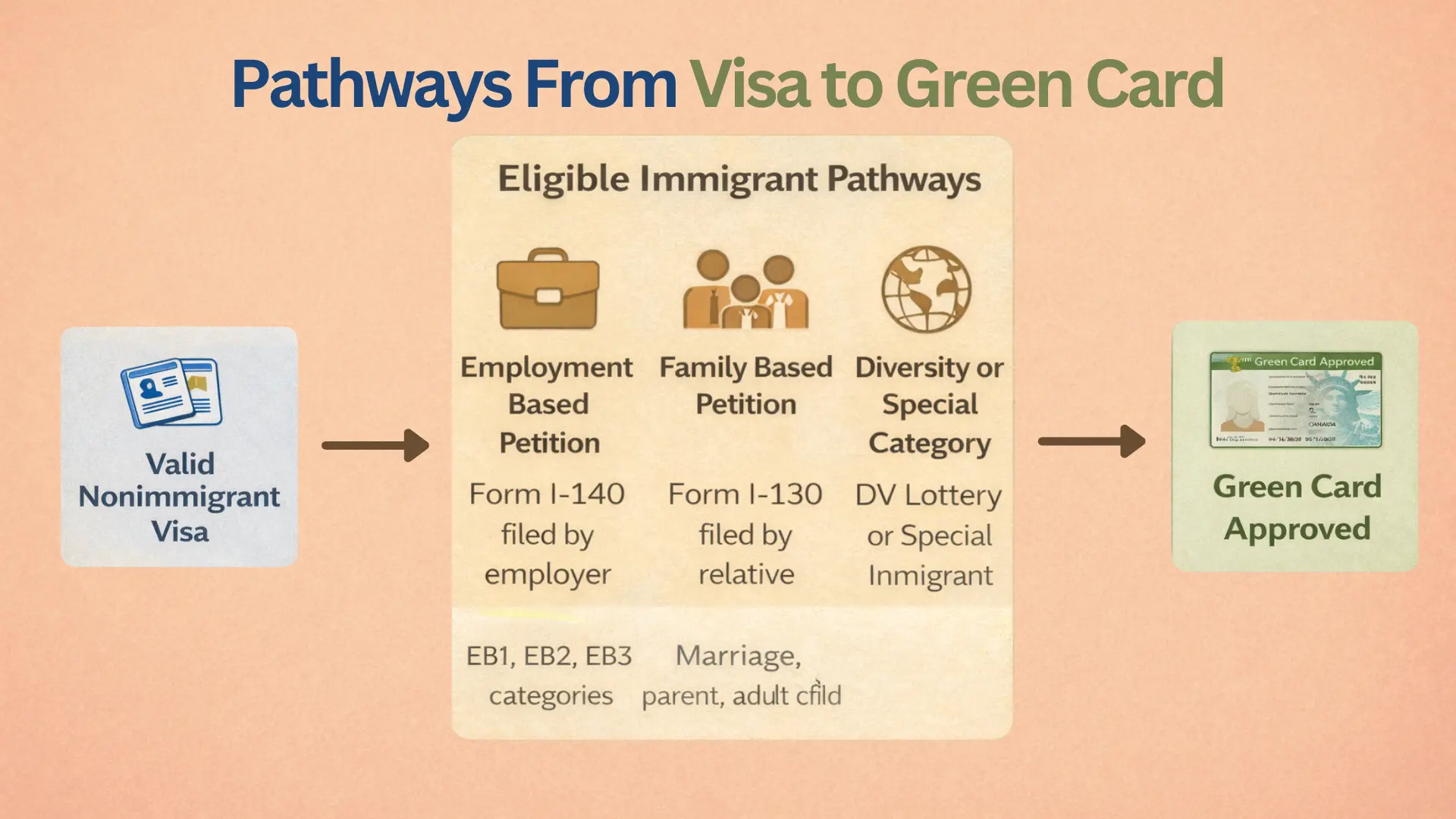
Many people come to the United States on a temporary visa and later decide to stay permanently.
In several cases, this can be done without leaving the country through a process called adjustment of status, given that your lawful status is maintained.
- Employment-based adjustment: Skilled workers on H-1B visas can proceed through employer-sponsored immigrant petitions toward a green card.
- Marriage-based adjustment: Those who marry a U.S. citizen may apply to adjust status from within the country.
- Family-based sponsorship: Parents, adult children, or siblings who are U.S. citizens may petition on your behalf.
- Diversity Visa Lottery: Winners of the Diversity visa lottery who are already in a valid non-immigrant status may be able to adjust from within the United States.
- Refugees and asylees: Those granted refugee or asylee status may apply for a green card after one year of qualifying residence.
An important concept to understand here is the dual intent doctrine. Most non-immigrant visas require applicants to demonstrate a clear intent to return to their home country.
However, certain visa categories, mostly the H-1B and L-1, permit dual intent, meaning you can hold a temporary nonimmigrant visa while simultaneously pursuing permanent residency without violating your current visa status.
If you are on a visa that does not allow dual intent, such as an F-1 student visa or a B-2 tourist visa, openly pursuing a green card while in that status can be treated as misrepresentation of your original intent to return home.
I have worked with clients who made this mistake and faced denial of future visa applications or a formal finding of inadmissibility as a result.
What Happens If You Miss a Filing Deadline or Overstay?
Overstaying a visa, even by a short period, triggers unlawful presence under 8 U.S.C. § 1182(a)(9)(B). An unlawful presence of more than 180 days but less than one year results in a three-year bar from reentry.
Unlawful presence exceeding one year triggers a ten-year bar. These bars can apply even if the overstay was unintentional.
For green card holders, extended absences from the United States, generally more than six months in a single trip, can raise abandonment concerns with CBP officers at reentry.
Absences exceeding one year typically require a returning resident visa (Form I-131A) to preserve the permanent resident status.
Neither of these situations is automatically fatal to your immigration future, but both require proactive handling before the departure or immediately upon return.
Conclusion
Choosing between a green card vs visa is not just a paperwork decision. It shapes career flexibility, family options, financial security, and long-term plans in the United States.
A temporary visa offers flexibility and quick access for specific goals, while a green card provides the stability, rights, and security needed to build a future here.
Deciding the right path between a green card vs visa comes down to your long-term vision for life in the United States.
The decision carries real consequences for your career, family, finances, and peace of mind.
Immigration rules are complex and frequently updated, so what works today may shift tomorrow.
Before moving forward, review official eligibility rules and timelines carefully. If you are unsure, speaking with a qualified immigration attorney can help you avoid expensive mistakes.
Still have doubts about which one is the best option for your situation? Share your questions in the comments below, and I’ll help you out further.
Frequently Asked Questions
Can Visa Status Change Inside the U.S.?
Yes, certain visa holders may apply for a change of status if eligibility requirements are met and lawful presence is maintained throughout the process.
Does a Green Card Guarantee U.S. Citizenship?
No, permanent residents must meet residency, physical presence, and good moral character requirements before applying for naturalization. The green card is a step toward citizenship, but it does not guarantee it.
Can Green Card Holders Lose Residency Status?
Yes, criminal convictions, long absences from the U.S., or abandonment can lead to revocation of lawful permanent resident status.
Do Green Card Holders Have to File U.S. Taxes on Foreign Income?
Yes, as lawful permanent residents, green card holders are treated as U.S. tax residents by the IRS and are required to report worldwide income, regardless of where it was earned. This is a financial consideration that many applicants overlook when weighing visa status against permanent residency. Nonimmigrant visa holders on temporary status generally only report U.S.-sourced income.