
The question rarely comes from nowhere. Most people who search this are not doing academic research. They are quietly doing the math, trying to figure out whether leaving is something they can actually afford right now.
I have spent a lot of time working alongside civil litigation attorneys, helping prepare filings, organize case files, and sit through enough hearings to understand one thing clearly: the financial side of divorce in Texas is almost always more layered than people expect, and almost always more manageable than they fear, once they understand what they are actually dealing with.
Texas ranks fifth in the nation for divorce costs, a figure shaped by its community property laws, mandatory waiting period, and the complexity that comes with dividing a shared financial life.
The cost of a Texas divorce is not one number. It is a range shaped by dozens of decisions, and a meaningful number of those decisions are yours to make.
What separates a case that costs a few hundred dollars from one that climbs past $30,000 is not luck.
This guide breaks down exactly where the money goes, what pushes costs up, and what you can realistically do about it before you ever set foot in a courtroom.
What is the Average Cost of Divorce in Texas?
Based on national survey data, a Texas divorce can cost as little as $300 for a simple DIY filing with no children and no shared assets, or climb past $30,000 for a contested case that goes to trial.
When children, custody, and support are involved, that average rises to approximately $23,500.
These figures reflect attorney fees, court costs, and related expenses.
They are not a ceiling or a floor; the actual cost of any individual case depends on the level of conflict, the complexity of assets, and how efficiently both parties move toward resolution.
Why Texas Divorces Can Cost So Much?
Texas is a community property state. That means almost everything acquired during the marriage, including income, property, debt, and retirement contributions, is considered jointly owned and must be divided at divorce.
This one fact changes everything about cost. When there is not much to divide, costs stay low. When there is a house, a 401(k), a business, or a joint debt load, the legal work multiplies fast.
Texas is also a no-fault divorce state, meaning either spouse can file without proving the the party’s wrongdoing or fault.
While this simplifies the legal grounds for filing, it does nothing to reduce the complexity of dividing what was accumulated during the marriage.
Add children to that picture, and you are now dealing with custody schedules, child support calculations, and potentially a SAPCR filing, each of which adds hours to your attorney’s invoice.
Who Can File for Divorce in Texas?
Before filing, at least one spouse must satisfy Texas’s residency requirements.
The state requires a minimum of 180 days of Texas residency and at least 90 days of residency in the county where you intend to file.
If either spouse recently relocated, these timelines matter. Filing before meeting the residency threshold will result in the case being dismissed.
Once both requirements are met, the filing spouse, the petitioner, submits the initial paperwork to the district clerk in the appropriate county.
Factors That Affect the Cost of a Divorce in Texas
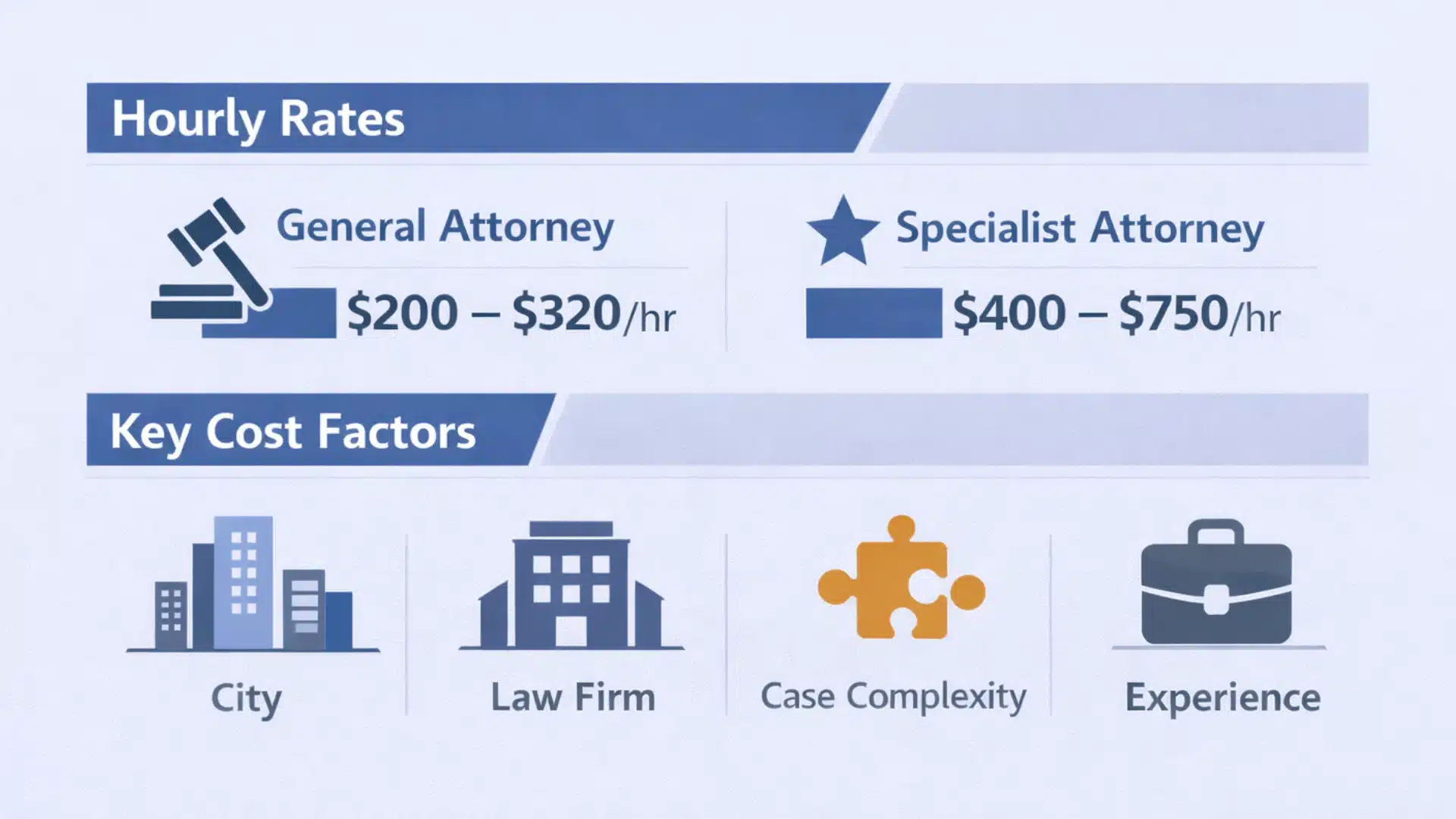
No two divorces cost the same, and that is not an accident. Whether your case stays simple or turns expensive usually comes down to a handful of variables. The level of conflict between you and your spouse is the biggest one.
Contested issues, especially custody and property, require more attorney hours and often court hearings.
The length of the marriage matters too, since longer marriages typically mean more shared assets to trace and divide. Having minor children adds mandatory steps.
Custody and support arrangements must be formally addressed, and courts apply a best-interest-of-the-child standard that can require evaluations, additional hearings, and documentation beyond what most people anticipate.
Business ownership, retirement accounts, or real estate each bring their own documentation and sometimes expert analysis.
Where you live in Texas affects filing fees, and the attorney you choose shapes the entire process.
Filing Fees: What You Pay Before Anything Else?
Before you can officially begin a divorce in Texas, you must pay a filing fee to the district clerk in your county. These fees are set at the county level, so the number varies depending on where you live.
| County | Approximate Filing Fee |
|---|---|
| Harris County (Houston) | ~$350 |
| Dallas County | ~$350–$400 |
| Bexar County (San Antonio) | ~$350–$400 |
| Travis County (Austin) | ~$350 |
| Statewide minimum | ~$213 |
On top of the base filing fee, expect to pay $50 to $100 to serve your spouse with papers, $10 to $25 for certified copies of the final decree, and $25 to $50 for a mandatory parenting class if you have minor children.
If cost is a genuine barrier, Texas courts allow fee waivers.
You may qualify if you receive government benefits, have income below the poverty threshold, or can demonstrate that paying court fees would prevent you from meeting basic household needs.
Ask the district clerk’s office for a Statement of Inability to Afford Payment of Court Costs form.
How Much is a Divorce Lawyer in Texas?
Attorney fees are where most of the money goes. How much is a divorce lawyer in Texas depends heavily on the firm, the city, and the complexity of your case.
The current average hourly rate for a Texas divorce attorney falls between $260/hour and $320/hour. General family law practitioners typically fall within this range and are the most common choice for standard cases.
For more complex matters, a board-certified family law specialist may charge significantly higher rates, ranging from $400 to $500 per hour, due to their advanced expertise.
In situations where the case is straightforward and uncontested, some attorneys offer flat-fee services, usually costing between $1,500 and $5,000 in total.
For the simplest qualifying cases, no children, no shared real property, no retirement accounts, some divorcing spouses use online document preparation services.
These platforms typically charge $300 to $1,000 for paperwork assistance and can work when the facts are genuinely uncomplicated.
They are not a substitute for legal counsel when property division, children, or any contested issue is in the picture.
Board certification in family law from the Texas Board of Legal Specialization costs more per hour but can actually reduce total fees in complex cases because experienced attorneys move faster and make fewer procedural errors.
In contested divorces involving real property or custody disputes, the wrong attorney choice can cost you more than the rate difference.
One thing I rarely see clients ask about upfront, but should: Texas law allows fee shifting in divorce cases.
A court can order your spouse to cover your reasonable legal fees, particularly when there is a significant income disparity or one party is acting in bad faith during proceedings.
It is not automatic, but it is absolutely worth raising in your first consultation with an attorney.
Uncontested vs. Contested: Cost Gap
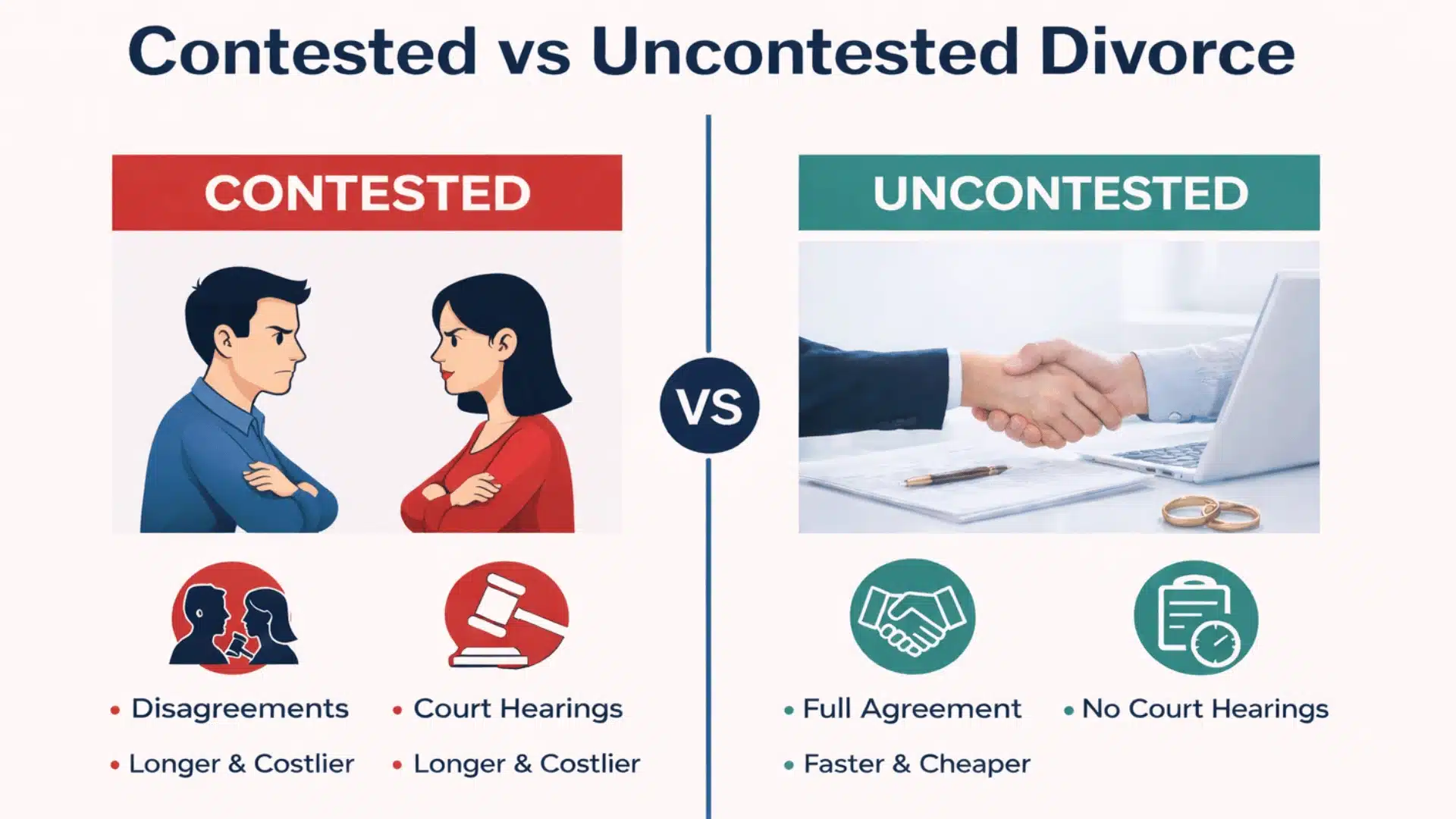
The single biggest cost factor in a Texas divorce is not who your lawyer is or which county you file in. It is how much you and your spouse agree on before the process starts.
An uncontested divorce means both parties have reached an agreement on property division, debt, custody, child support, and spousal maintenance before filing. As said above, with attorney assistance, these typically run $1,500 to $5,000.
Without an attorney, the court fees alone could bring it in under $500. But “without an attorney” only works when there are genuinely no assets, no children, and no complications. Most people are not in that situation.
A contested divorce is one where you go to court to resolve disputes that a judge must decide, often entering the litigation process in divorce cases. Every subpoena, deposition, or expert witness adds a line item.
Cases involving business valuations, retirement accounts (which require a QDRO, or Qualified Domestic Relations Order, to divide legally), or high-conflict custody fights can push total costs well past $30,000.
The cost spike nobody warns you about: when one party hires an aggressive litigator, the other is essentially forced to match pace and spend accordingly.
What begins as a property dispute can become a prolonged war of attrition when one side decides escalation is the strategy.
Attorneys who have worked long enough in family law call it plainly: “spend them into settlement.”
It is a real tactic, and understanding it early changes how you think about the attorney you choose and whether you are walking into a negotiation or a siege.
Mediation: The Cost-Reducer Most People Underuse
Texas courts often require mediation before a contested divorce goes to trial. Even when it is not required, it is worth considering.
A neutral mediator charges $150 to $600 per hour, and most sessions run 4 to 8 hours, putting the average total mediation cost at $1,000 to $5,000, depending on complexity.
That sounds like another bill. But couples who reach an agreement in mediation typically avoid trial entirely, saving tens of thousands in attorney time.
Under Texas Family Code Section 6.602, both parties can agree in writing to use mediation at any point in the process.
Hidden Costs That Catch People Off Guard
Beyond attorneys and filing fees, several expenses tend to surface mid-process without warning:
- Property appraisals: If you own a home or other real property, a professional appraisal is often required for equitable division. Residential appraisals in Texas run $300 to $600. Commercial property or investment portfolios cost significantly more.
- QDRO fees: Dividing a 401(k) or pension requires a Qualified Domestic Relations Order, a separate legal document prepared after the divorce decree. Attorneys or QDRO specialists typically charge $500 to $1,500 for this, and it is often missed until it is urgently needed.
- Expert witnesses: Contested custody cases may require a child psychologist or custody evaluator. Forensic accountants are brought in when finances are complex or assets may be hidden. Most experts charge $200 to $500 per hour, and preparation time adds up quickly.
- Temporary orders: If you need a judge to set temporary child support, spousal support, or home occupancy rules while the divorce is pending, that requires a separate hearing with its own legal fees, typically $1,000 to $5,000 or more, depending on how contested the hearing becomes.
The 60-Day Waiting Period
Texas law requires a minimum 60-day waiting period after filing before a divorce can be finalized. This applies even in completely uncontested cases.
If one spouse is a victim of family violence with an active protective order, the court can waive this requirement.
Here is something worth knowing that most people miss: the clock starts the day you file, not the day you finish negotiating. Filing early, even before every issue is resolved, buys you time you cannot get back.
Attorneys routinely advise clients to file first and use the waiting period to resolve remaining disputes, rather than waiting until everything is settled and then losing weeks to the mandatory clock.
What Does a Divorce Actually Cost at Each Level?
Costs shift significantly depending on the level of conflict and the complexity of your assets. A fully agreed case stays affordable. Once disputes enter the picture, attorney hours compound quickly.
Here is what real Texas divorce cases typically cost at each stage.
| Scenario | Estimated Total Cost |
|---|---|
| DIY, no children, no assets | $300–$500 |
| Uncontested, attorney-assisted | $1,500–$5,000 |
| Contested, no children | $10,000–$20,000 |
| Contested with children | $15,000–$30,000+ |
| High-conflict, trial, complex assets | $30,000–$100,000+ |
Practical Ways to Lower Your Divorce Costs
Managing costs in a Texas divorce is possible if you make the right decisions early in the process.
- Get organized early: Gather financial records like tax returns, bank statements, property papers, and retirement details before meeting your attorney
- Prepare for efficiency: Clients who come with organized documents move faster through the process and usually spend less on legal fees
- Communicate in batches: Combine questions into one message or call instead of sending multiple emails, as each response can add to your bill
- Limit emotional discussions: Use legal meetings for case progress, and rely on a therapist for emotional support to avoid higher legal costs
- Use attorney time wisely: Focus conversations on decisions and strategy rather than processing stress or frustration
- Consider collaborative divorce: If both sides can cooperate, resolving issues outside court can reduce costs significantly
- Understand the risk: If collaboration fails, both attorneys must withdraw, and the process starts again, so it works best when both parties are willing to cooperate
Conclusion
How much a divorce costs in Texas does not have one answer, but it does have a shape. The cases that cost the least are the ones where both parties made deliberate decisions before the court became necessary.
The cases that cost the most are the ones where conflict, not resolution, drove the timeline.
What this guide should make clear is that you have more control over that shape than it might feel like right now.
Knowing where the money goes, what triggers the biggest cost spikes, and what tools Texas law puts in your hands before trial means you can make decisions rather than just react to them as they come.
Ready to get a clearer picture of your case? The numbers in this guide are starting points, not guarantees. Every Texas divorce is shaped by its own facts.
If you want to understand what your specific situation might actually cost, a consultation with a licensed Texas family law attorney is the most useful next step you can take.
Frequently Asked Questions
Can My Spouse Be Ordered to Pay My Attorney Fees in a Texas Divorce?
Yes, under certain circumstances. Texas courts have discretion to award attorney fees when one party has significantly greater financial resources or when a party engages in conduct that unnecessarily prolongs the case.
It requires raising the issue with your attorney early enough to be addressed in the proceedings, not as an afterthought at the end.
Does Texas Require Both Spouses to Hire Separate Attorneys?
No. In a fully uncontested divorce, one attorney can prepare the paperwork for the filing spouse, and the other party can review and sign without independent counsel.
That said, when property, retirement accounts, or children are involved, having at least a one-time independent review before signing the final decree is worth the cost.
How is Marital Debt Handled in a Texas Divorce?
Texas treats debt the same way it treats assets. Debt acquired during the marriage is generally considered community debt, regardless of whose name is on the account.
A divorce decree can assign specific debts to one spouse, but creditors are not bound by that agreement, meaning they can still pursue either party. Refinancing or paying off joint accounts before or during the divorce is often the cleaner resolution.
What is the Cheapest Way to Get a Divorce in Texas?
The least expensive path is a DIY uncontested divorce with no children and no shared assets, where court filing fees alone can range from $213 to $350, depending on the county.
For cases involving children or any shared property, an uncontested attorney-assisted divorce, typically $1,500 to $5,000, is the most cost-effective option that still provides meaningful legal protection for both parties.