Every year, thousands of criminal cases hinge on two words: probable cause. It is the constitutional line between lawful and unlawful arrest, between evidence that holds up in court and evidence that gets thrown out entirely.
Yet most people could not define it if asked.
If you have wondered what probable cause actually means or why it matters to you personally, you are in the right place.
This guide breaks down the legal definition in plain English, traces its roots in the Fourth Amendment, and walks you through real-world scenarios: traffic stops, home searches, digital privacy, and more.
Understanding probable cause is not just for law students. It is for anyone who values knowing where government authority ends and personal freedom begins.
What Does Probable Cause Mean?
Probable cause is the legal threshold that must be met before law enforcement can arrest you, search your property, or obtain a warrant. It is not a hunch, a suspicion, or a gut feeling.
It is a standard rooted in objective, articulable facts, facts that would lead a reasonable person to believe a crime has been committed, or that evidence of a crime will be found in a specific location.
According to Cornell Law School, Probable cause exists when the facts and circumstances within an officer’s knowledge would lead a reasonable person to believe that a crime has been committed (for an arrest) or that evidence of a crime is present in a specific location (for a search).
Think of it as sitting on a spectrum: it requires more than a vague suspicion, but far less than what is needed to convict someone at trial.
To put it plainly: probable cause is not a high bar, but it is a real one. It is the point at which law enforcement moves from observing you to acting against you, and it must be documented and defensible before that line is crossed.
The Fourth Amendment and Probable Cause: The Constitutional Foundation
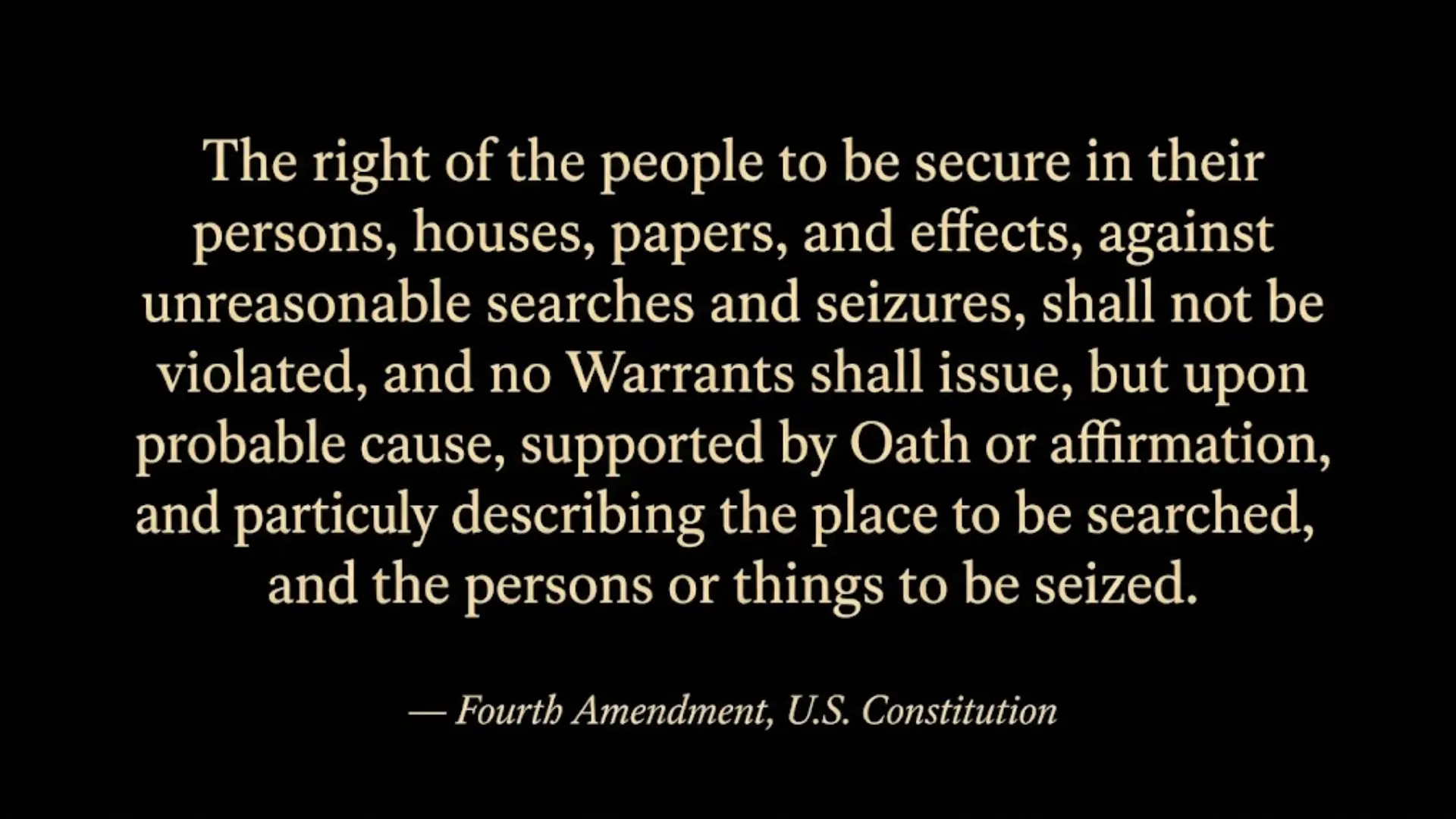
Probable cause does not exist in a vacuum. It is constitutionally anchored in the Fourth Amendment of the U.S. Constitution, the bedrock of every American’s right to privacy
The Fourth Amendment does two things at once: it bans unreasonable searches and seizures, and it requires that any warrant issued be supported by probable cause.
Courts have interpreted the purpose of the probable cause requirement as keeping the government out of constitutionally protected areas until it has a concrete reason to believe a specific crime is being or has been committed.
The standard is intentionally flexible, not a rigid checklist, but a reasoned judgment grounded in facts.
I have read hundreds of police reports and warrant affidavits. The Fourth Amendment is not just an abstract principle; it is the document that determines whether the evidence an officer gathered can be used against a defendant at all.
A Brief History: Where Did Probable Cause Come From?
To understand why probable cause matters so deeply to Americans, you need to go back to 18th-century Britain.
The King’s officials used instruments called writs of assistance, broad, open-ended warrants with no expiration date, to search colonists’ homes for untaxed goods whenever they pleased.
There was no requirement of evidence, no neutral judge to approve the search, and no limit on what could be seized. It was government power run unchecked.
In 1761, a Boston lawyer named James Otis challenged the legality of these writs in a Massachusetts court.
He lost the case, but his argument that such warrantless intrusions violated the fundamental rights of Englishmen lit a fuse. A young lawyer in the courtroom that day, John Adams, later credited that argument as a spark for the American Revolution.
When Adams and the Founders drafted the Constitution, they made sure no American would face what the colonists had endured. The result was the Fourth Amendment and, at its core, the requirement of probable cause.
When I explain this history to people unfamiliar with criminal law, something usually clicks for them. Probable cause is not a bureaucratic formality.
It was written by people who had personally experienced what happens when unchecked government searches occur.
How Probable Cause Works in Practice: The Three Key Scenarios
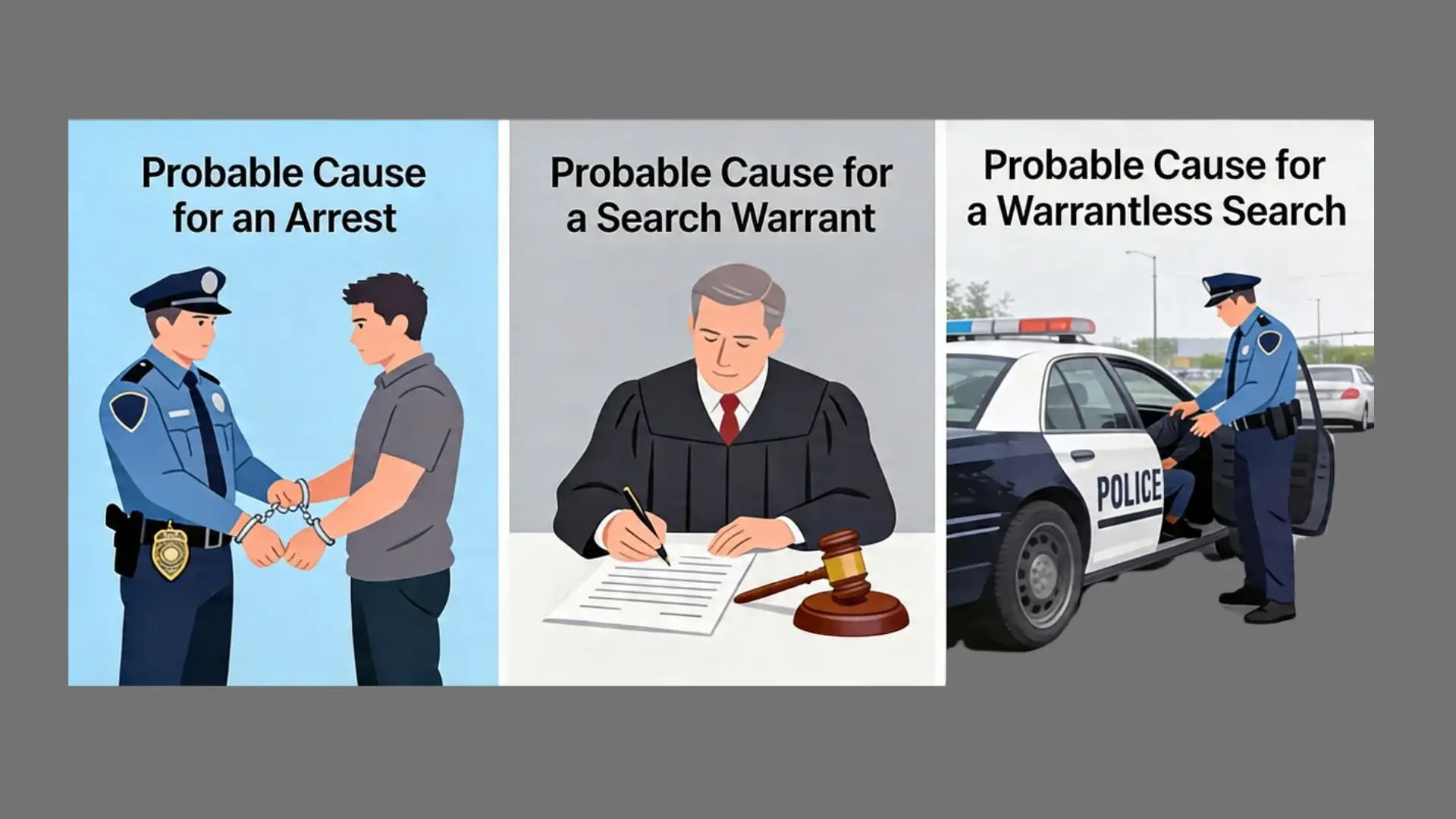
Probable cause does not operate the same way in every situation. The rules shift depending on whether an arrest, a warrant, or an emergency search is involved.
1. Probable Cause for an Arrest
For a lawful arrest, an officer must have a reasonable belief, grounded in concrete facts, that a specific person committed a crime.
Crucially, that probable cause must exist before the arrest is made. Evidence discovered after the fact cannot be used retroactively to justify it.
Example: An officer witnesses someone smash a car window, reach inside, and grab a bag. That direct observation alone, without any further investigation, constitutes probable cause for an arrest. The officer does not need to wait for a warrant.
It is important to understand the legal distinction between being briefly stopped by police and being formally arrested, two situations with very different rights and procedural consequences.
Being detained versus being arrested carries different obligations on both sides, and probable cause is precisely the threshold that separates a temporary investigative stop from a custodial arrest.
Courts can also issue bench warrants directing law enforcement to arrest individuals who fail to appear for scheduled court dates, representing another intersection of judicial authority and arrest powers.
2. Probable Cause for a Search Warrant
When police want to search a home, office, or private property, they must take an extra step: appear before a neutral judge or magistrate, present a sworn affidavit, and prove probable cause for warrant searches.
That affidavit must lay out specific, credible facts, not guesses, that support the belief that evidence of a crime will be found at the location.
Example: Police receive a credible tip about drug activity at a residence. Officers then conduct surveillance and observe a high volume of short-duration foot traffic at odd hours, a pattern consistent with drug distribution.
Under the totality-of-circumstances framework from Illinois v. Gates, the combination of the tip and corroborating surveillance can be sufficient to support a warrant application, even if neither element alone would clear the bar.
3. Probable Cause for a Warrantless Search
In emergency situations, officers may conduct a search without first obtaining a warrant if they have probable cause. The warrant requirement is bypassed, but the probable cause requirement is not.
Real-World Examples: Someone inside a home is in immediate danger; evidence is being actively destroyed; or a suspect is about to flee.
These emergencies allow officers to act without prior judicial approval, but they must still be able to articulate the facts that justified the search.
What Counts as Evidence of Probable Cause?
Probable cause is never based on a single factor in isolation. US Courts evaluate the totality of the circumstances, the complete picture of what an officer knew at the moment they acted.
The table below breaks down the most common categories of evidence and how each contributes to that analysis.
| Evidence Type | What It Means | How It Supports Probable Cause |
|---|---|---|
| Direct Observation | What the officer personally sees, hears, or smells | Visible drugs, contraband, or crime-related sounds can justify probable cause |
| Witness / Victim Statements | Firsthand accounts from people at the scene | Identification or a detailed description strengthens credibility |
| Informant Tips | Information from a source known to law enforcement | Reliable if the source is credible and the details are confirmed |
| Physical / Circumstantial Evidence | Indirect evidence based on behavior or facts | Matching descriptions or suspicious actions can build probable cause |
| K-9 Alerts | Alerts from trained narcotics dogs | Valid if the dog’s training and reliability are proven |
| Plain View Doctrine | Items visible from a lawful position | Clearly visible contraband can support probable cause |
Exceptions to the Warrant Requirement: When Police Can Act Without One
A common misconception is that police always need a warrant to conduct a search. Skipping the warrant does not mean skipping the constitutional standard; probable cause is still required in most cases.
- Exception 1 (The Automobile Exception): Because a vehicle is mobile, officers can search a car without a warrant if they have probable cause to believe it contains evidence of a crime.
- Exception 2 (Plain View Doctrine): If officers are lawfully present at a location and spot contraband in open sight, they can seize it without a warrant.
- Exception 3 (Exigent Circumstances): Emergency situations, including imminent danger or a fleeing suspect, allow officers to enter and search without waiting. for a warrant.
- Exception 4 (Search Incident to Arrest): A lawful arrest permits officers to search the person being arrested and the immediate surrounding area for weapons or evidence.
- Exception 5 (Consent): If a person voluntarily and knowingly agrees to a search, no warrant is required. The consent must be freely given, not coerced.
- Exception 6 (The Good Faith Exception): Established in United States v. Leon (1984), this exception prevents the exclusionary rule from being applied when officers relied in good faith on a warrant that later turned out to be technically defective.
The Court designed it to avoid situations where an entirely valid probable cause finding would be undermined solely because of a clerical or procedural flaw in the warrant itself, a flaw the officers had no reason to know existed.
Probable Cause vs. Reasonable Suspicion: The Real Difference?
Two legal concepts are more commonly confused or more consequential to get right.
Probable cause and reasonable suspicion are not interchangeable. They represent two distinct thresholds of evidence and authorize very different law enforcement actions.
| Basis | Reasonable Suspicion | Probable Cause |
|---|---|---|
| Strength of Evidence | Lower, articulable facts that criminal activity may be occurring | Firm, reasonable belief that a crime has been or is being committed |
| What It Authorizes | Brief investigative stop and pat-down for weapons (Terry stop) | Arrest, full search, or obtaining a warrant |
| Legal Origin | Terry v. Ohio (1968) | Fourth Amendment, Bill of Rights |
| Analogy | “Something seems off here.” | “I have real, fact-based reason to believe a crime occurred.” |
| Can It Lead to Arrest? | No, only brief detention | Yes, arrest, search, and warrant |
Landmark Supreme Court Cases That Shaped Probable Cause
The meaning of probable cause has been refined through Supreme Court rulings across more than two centuries. These five cases are essential for understanding how the standard actually works and how it has evolved to address modern life.
1. Illinois v. Gates (1983): The Landmark Totality Test
The Supreme Court scrapped the rigid two-part Aguilar-Spinelli test for evaluating informant tips and replaced it with a more flexible approach.
Courts must now look at the totality of the circumstances; no single factor is dispositive. Probable cause was described as a “fluid concept” that cannot be reduced to a neat set of legal rules.
Why It Matters: This remains the governing framework courts apply today when evaluating whether probable cause existed at the time of a search or arrest. It is the case most frequently cited in warrant challenges.
2. Brinegar v. United States (1949): Defining the Standard
The Court established the bedrock probable cause definition: facts and circumstances within officers’ knowledge, sufficient to warrant a belief by a person of reasonable caution, that a crime is being committed.
More than suspicion, less than certainty, this language still appears in court opinions today.
Why It Matters: The language courts have quoted for over 75 years.
3. Mapp v. Ohio (1961): The Exclusionary Rule Goes National
Police forcibly entered Dollree Mapp’s home without a valid warrant and found obscene materials that led to her conviction.
The Supreme Court ruled that any evidence obtained in violation of the Fourth Amendment, including through a lack of probable cause, must be excluded from trial. This ruling made the exclusionary rule binding on all state courts.
Why It Matters: Mapp v. Ohio is the foundation of the “fruit of the poisonous tree” doctrine. A search conducted without adequate probable cause does not just fail constitutionally; it can unravel an entire prosecution.
Attorneys file suppression motions based on this principle in courts across the country every day.
4. Riley v. California (2014): Phones Are Not Pockets
A unanimous Supreme Court held that police may not search digital information on a cell phone seized during an arrest, without a warrant supported by probable cause.
Chief Justice Roberts wrote that a modern cell phone is not simply a piece of technology but a device that stores a comprehensive record of a person’s life, making the privacy interests at stake far greater than those involved in searching a wallet or a jacket pocket.
Why It Matters: Extended full Fourth Amendment probable cause protections to digital devices
5. Carpenter v. United States (2018): Location History is Protected
The Court held that obtaining months of historical cell-site location data from a wireless carrier constitutes a Fourth Amendment search, requiring a warrant supported by probable cause.
The decision significantly limited the government’s ability to access digital data held by third parties without judicial oversight.
For a practical look at how these protections apply in everyday situations, understanding when and how police can track your phone covers the real-world limits of law enforcement’s digital reach in the wake of this ruling.
Why It Matters: A landmark ruling for the digital age, probable cause now governs access to location history.
Conclusion
Probable cause is one of the most consequential and most misunderstood concepts in American law. It is not a legal technicality buried in courtroom procedure.
It is the constitutional guardrail that stands between citizens and unchecked government power, deliberately written into the Bill of Rights by Founders who had lived under exactly the kind of arbitrary authority it was designed to stop.
When that guardrail is crossed without justification, the consequences are not abstract. Evidence gets suppressed, charges get dismissed, and convictions can be overturned.
The system depends on law enforcement meeting this standard, and on defendants and their attorneys knowing when it has not been met.
Whether you are a student, a curious reader, or someone navigating a real legal situation, knowing what probable cause means gives you the tools to recognize when your rights may have been violated.
If you believe a search or arrest was conducted without it, consult a qualified criminal defense attorney promptly; the difference could change the outcome of your case.
Frequently Asked Questions About Probable Cause
Does Probable Cause Mean I’m Guilty?
No. Probable cause is a threshold for investigation and arrest, not a finding of guilt. It means there is a reasonable factual basis to believe a crime occurred or evidence exists.
Proving guilt at trial requires a far higher standard: beyond a reasonable doubt.
Can a Judge Reject a Warrant Application for Lack of Probable Cause?
Yes, every warrant application must be reviewed by a neutral and detached judge or magistrate.
If the affidavit fails to establish a fair probability that evidence of a crime will be found, the judge can, and frequently does, deny the warrant.
Can Police Lie to Get a Search Warrant?
No, officers must prevent truthful information in their affidavits. Under Franks V. Delaware (1978), a defendant can challenge a search warrant if it was obtained through deliberate falsehoods or reckless disregard for the truth.
Does Probable Cause Apply to Digital Searches, Like My Phone or Email?
Yes. Law enforcement must generally obtain a warrant supported by probable cause before searching the contents of your phone, accessing your location history, or retrieving private digital communications from a third-party provider.
The Supreme Court confirmed this in both Riley v. California (2014) for device searches and Carpenter v. United States (2018) for cell-site location data.
Does Probable Cause Work the Same Way in Every State?
The Fourth Amendment sets the federal floor; every state must meet it at a minimum. However, some states impose stricter protections under their own constitutions.
New York, for example, provides additional privacy safeguards under Article I, Section 12 of the state constitution, which courts have interpreted to offer broader protection than the federal standard in certain circumstances.
If you have a question about how your state’s rules apply, a local criminal defense attorney is the right resource.