
There is a particular moment many families describe the same way. A parent who handled finances for decades starts missing bills.
An adult sibling with a disability turns 18, and suddenly the informal arrangements that worked through childhood carry no legal weight.
A grandparent’s health declines rapidly, and no power of attorney was ever signed.
That moment, when care and legal authority collide, is exactly when families start asking whether they need a guardianship attorney.
In this blog, you will understand what this process actually involves, what an attorney does throughout it, and how to decide whether guardianship is even the right tool for your situation.
What Does a Guardianship Attorney Do?
A guardianship attorney guides legal strategy, prepares the petition, represents the family in court, manages compliance, and helps resolve disputes through a process that can take months.
Before filing, the attorney reviews medical records, capacity assessments, and the proposed ward’s needs to confirm whether guardianship is legally justified.
Because legal guardianship limits personal rights, attorneys also consider less restrictive options first.
After filing, the attorney handles required notices, works with court-appointed evaluators, gathers documents, and prepares the proposed guardian for hearings.
In contested cases, they present evidence and answer objections. If guardianship is granted, they explain the guardian’s duties, reporting deadlines, and limits of authority.
In practice, many delays occur when families file alone with incomplete records or request the wrong type of guardianship.
For context on how legal decision-making authority is structured across similar instruments, the comparison between conservatorship vs guardianship is a useful place to start.
Types of Guardianship an Attorney Handles
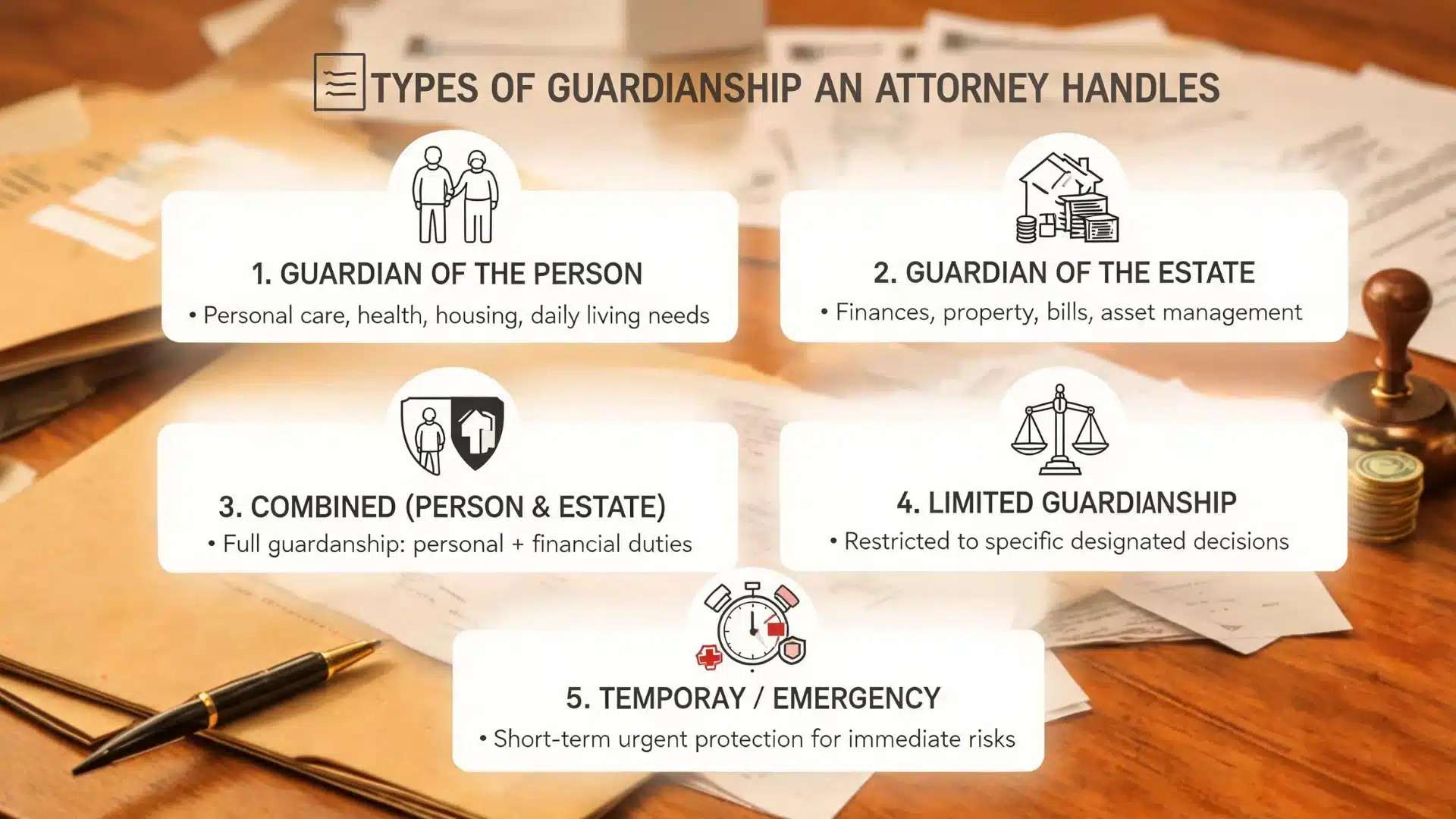
A guardianship attorney helps choose the right category, prepare the evidence, and request protective authority without going further than necessary.
1. Guardian of the Person
A guardian of the person is appointed when a minor or incapacitated adult needs help with personal care decisions.
This role can include choices about healthcare, housing, safety, education, daily routines, and general wellbeing.
An attorney helps show the court why this care authority is needed and whether the proposed guardian is suitable.
The goal is to protect the person’s health and stability while keeping the court order tied to real daily needs.
2. Guardian of the Estate
A guardian of the estate handles money, property, benefits, bills, and other financial matters for a minor or incapacitated adult.
This type of guardianship is often needed when the person owns assets, receives benefits, has settlement funds, or cannot manage financial duties safely.
An attorney helps prepare financial records, explains the need for oversight, and outlines how the assets will be managed.
Courts usually review these cases closely because financial control carries serious responsibility.
3. Guardian of the Person and Estate
A guardian of the person and estate has authority over both personal care and financial matters.
This arrangement may apply when someone needs help with healthcare, housing, daily decisions, and money management at the same time.
An attorney helps prove why combined authority is necessary instead of a narrower order.
Since this type gives wide control, courts often expect strong evidence that both personal and financial oversight are needed to protect the individual’s welfare.
4. Limited Guardianship
Limited guardianship applies when an adult can still make some decisions but needs help with others.
Instead of giving full control to a guardian, the court grants authority over defined matters only.
This may include medical care, finances, housing, or another limited area. Attorneys often use the least restrictive means standard to protect rights that the person can still exercise.
This approach can provide support without removing more independence than the situation truly requires.
5. Temporary or Emergency Guardianship
Temporary or emergency guardianship is used when a person faces immediate risk and cannot wait for a full guardianship hearing.
This may involve urgent medical needs, unsafe living conditions, financial exploitation, or another serious concern.
The court may grant short-term authority while the case receives fuller review.
An attorney helps present the emergency clearly, file the request quickly, and explain why immediate action is needed before a final guardianship decision is made.
When to Hire a Guardianship Attorney?
Guardianship issues can become harder when families wait too long to act. Early legal help can protect a vulnerable person, reduce court delays, and make sure the petition includes the records, facts, and authority the judge needs to review.
- Cognitive decline: Speak with an attorney when an older parent or relative shows decline, and no signed power of attorney or advance directive exists yet.
- Disability and adulthood: Contact counsel before a child with a disability turns 18 because parental authority over medical and financial decisions ends legally at adulthood.
- Unstable parental care: Hire an attorney when a minor’s parents are deceased, incapacitated, absent, or unable to provide safe care, consent, or support consistently.
- Financial exploitation: Call a guardianship attorney when suspicious spending, unpaid bills, missing funds, or outside pressure suggests urgent financial abuse or immediate risk.
- Contested petition: Get legal help when another person files for guardianship and the request may not protect the ward’s safety, rights, or needs.
- Changed circumstances: Talk to an attorney when recovery, improved capacity, family changes, or new care needs require modification or termination of guardianship.
What to Expect from the Guardianship Process?
Guardianship timing depends on urgency, evidence, and whether the case is contested. Simple cases may take two to three months, while emergency requests can move faster when serious harm is documented.
| Stage | What Happens | Key Point |
|---|---|---|
| Initial evaluation | Attorney reviews records and capacity concerns. | Confirms the legal guardianship type. |
| Petition filing | The petition and documents are filed in court. | Accurate paperwork helps avoid delays. |
| Notice and review | Relatives are notified, and an evaluator may be appointed. | The court checks the ward’s needs. |
| Court hearing | The judge reviews evidence and hears from the parties. | Uncontested cases are often brief. |
| Final order | A guardian is appointed if approved. | Legal authority begins after approval. |
| Ongoing duties | Guardian files reports and seeks approval for major choices. | Court oversight continues. |
Costs of Hiring a Guardianship Attorney
Hiring a guardianship attorney usually costs between $3,000 and $10,000 or more, depending on how simple or complicated the case is.
Straightforward cases with no family disputes often fall on the lower end, while contested ones with disagreements or complex issues can run much higher.
Attorneys may charge hourly rates of $200 or more, or offer flat fees for basic matters.
You will also face extra expenses like court filing fees ($250-$400), medical or psychological evaluations ($500-$1,500), guardian ad litem or court evaluator fees ($1,000-$3,000+), service of process, and possible bonds or annual reports.
To budget wisely, talk openly with your lawyer upfront about all expected costs, ask for a clear payment plan or retainer agreement, and explore options like sliding-scale fees or payment installments.
Plan for both initial and ongoing expenses to avoid surprises, and consider whether the person’s estate can help cover some costs. This way, you stay prepared and focused on what matters most.
How to Choose the Right Guardianship Attorney?
Guardianship involves probate, family, elder, and disability law, so the attorney should be licensed in your state and familiar with the court where the petition will be filed.
Local knowledge matters because forms, notice rules, evaluator requirements, and hearing expectations can differ by county.
A strong attorney should also review alternatives before recommending guardianship, including a power of attorney, advance directive, or supported decision-making arrangement when available.
If family conflict is possible, ask about experience with contested hearings, evidence, and objections from interested parties.
Fees should also be discussed clearly before work begins. Uncontested guardianship cases often cost less than disputed matters, but court costs, filing fees, and evaluator fees can add to the total.
If you want to understand how similar legal representation works in contested estate disputes, our overview of contesting a will illustrates how court proceedings for disputed legal authority are structured.
Conclusion
Choosing a guardianship attorney is not only about court forms; it is about protecting someone who can no longer safely manage care, money, or major decisions alone.
The right legal guidance helps families choose a suitable type of guardianship, prepare clear evidence, respect personal rights, and avoid delays that could place a vulnerable person at risk.
Whether the concern involves an aging parent, a disabled adult, a minor child, or a sudden emergency, early advice can make the process less confusing and more secure.
Every family situation deserves careful review before authority is requested from the court.
Need help understanding your next step or have a related experience to share? Leave your questions in the comments below.
Frequently Asked Questions
What Happens if No One Petitions for Guardianship and a Person Lacks Capacity?
Without guardianship, no one can legally make decisions. Public guardianship may help, but it varies by state. Planning documents prevent this gap while capacity remains intact.
How Much Does a Guardianship Attorney Cost in Las Vegas?
Guardianship attorney fees in Las Vegas vary by case complexity, contested issues, hearings, and paperwork. Free consultations can help estimate costs before hiring.
What Duties Does a Guardian Have After Appointment?
A guardian must follow court orders, protect the ward’s interests, manage care or finances responsibly, keep records, file reports, and seek approval for major decisions.
Can Guardianship Be Reversed or Modified?
Yes. Guardianship can be modified or terminated if circumstances change, such as improved capacity, recovery, or a significant change in the ward’s living situation.