
Pulled over by police and unsure what is really happening? In tense moments, many people cannot tell the difference between being detained and being arrested.
The terms are often used interchangeably in conversation, media reports, and even casual legal talk. However, “detained vs arrested” carry very different legal meanings.
One may involve a brief stop and questioning, while the other can lead to custody, formal charges, and a lasting criminal record.
The distinction affects personal rights, freedom of movement, and future consequences.
Misunderstanding these terms can create fear or false assumptions about what police are legally allowed to do.
This blog clearly explains what being detained means, how it differs from an arrest, and what each situation may involve in real-world settings, so readers can better understand their legal position.
What Does Being Detained Mean?
What does being detained mean in legal terms? Detention refers to a temporary restriction of a person’s freedom by law enforcement.
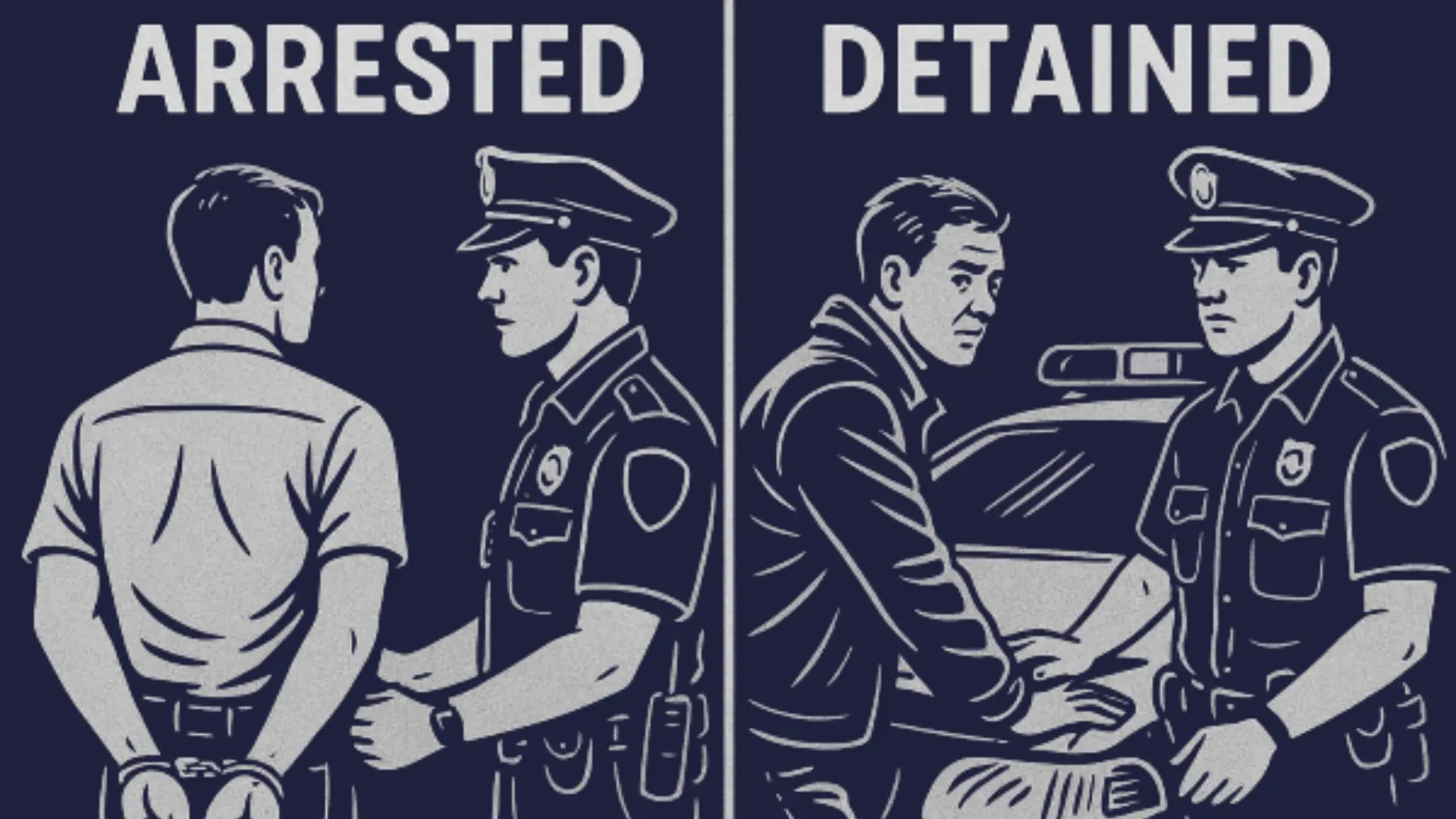
During a detention, an officer may stop someone, ask questions, and briefly limit their movement. The key point is that the person is not free to leave at that moment, but they are not formally under arrest.
In many situations, detention is based on reasonable suspicion.
This means an officer believes there are specific facts suggesting possible criminal activity, even if there is not enough evidence for an arrest.
It is worth noting that not every police interaction qualifies as a detention. If an officer approaches you on the street and you are free to walk away, that is considered a consensual encounter, not a detention.
No legal standard is required for a consensual encounter. The moment your movement is restricted, however, the legal threshold of reasonable suspicion must be met
Detention does not automatically lead to formal charges or a criminal record. Common examples include traffic stops, stop-and-frisk encounters, or brief questioning near a reported crime scene.
These situations are usually brief and focused on gathering information before deciding on the next steps.
In some cases, a detention can lead to the use of digital surveillance tools during an investigation. Understanding the limits of that authority is just as important as knowing your rights during the initial stop.
What Does it Mean to be Arrested?

An arrest occurs when law enforcement takes a person into formal custody because they believe a crime has been committed.
Unlike a temporary stop, an arrest involves a clear loss of freedom. The individual is not free to leave and is placed under the control of the authorities.
An arrest must generally be supported by probable cause. This means officers have sufficient facts or evidence to reasonably believe that a specific person committed a crime.
Probable cause is a higher legal standard than reasonable suspicion, which is used for detention.
After an arrest, the person is often transported to a police station for booking. This process may include fingerprinting, photographs, and recording personal information.
Arrests often result in formal charges and court proceedings. Miranda rights are read at or before the time of custodial interrogation, meaning when police intend to question you after placing you in custody.
It is important to understand that Miranda rights are triggered by custodial interrogation, not simply by an arrest.
If officers arrest you but do not question you, they are not required to read the warning at that moment, although your rights still apply and can be asserted at any time.
Detained Vs Arrested: Key Legal Differences
Understanding detained vs arrested becomes easier when the distinctions are placed side by side. While both involve police authority, the legal standards and consequences are not the same.
| Factor | Detained | Arrested |
|---|---|---|
| Duration of the Stop | Usually brief and limited to investigation. | Can last several hours or longer, depending on charges and processing. |
| Level of Police Authority | The officer may question and temporarily restrict movement. | The officer takes full custody and control of the individual. |
| Legal Standard Required | Based on reasonable suspicion of possible criminal activity. | Requires probable cause that a crime was committed. |
| Criminal Record Impact | Does not automatically create a criminal record. | Often results in booking and may lead to a criminal record. |
| Ability to Leave the Scene | Not free to leave during the stop, but may be released without charges. | Not free to leave; formally taken into custody. |
| Miranda warning | Not automatically triggered; it depends on whether custodial interrogation occurs. | Required before any custodial questioning. |
| Consensual encounter | Detention begins only when movement is restricted. A free-to-leave interaction is not a detention. | N/A, arrest requires probable cause, not mere consent. |
How does a Detention Become an Arrest?: Signs to watch for
One of the most practically important questions in any police encounter is: has this detention crossed into an arrest?
The line is not always obvious, and I have worked on cases where clients did not realize they were under arrest until well after the fact, which affected the evidence that could be challenged.
- Change in communication: If the officer tells you that you are under arrest, or begins reading your Miranda rights before questioning, the situation has formally shifted.
- Physical restraint: The use of handcuffs or placement into a police vehicle typically signals an arrest. However, handcuffing alone does not automatically constitute an arrest; courts have upheld temporary handcuffing during detentions for officer safety. The totality of the circumstances matters.
- Transport to another location: Investigative detentions are meant to occur at or near the location of the stop. If you are moved to a police station or a separate, isolated area, this strongly indicates an arrest has occurred, regardless of whether the officer used the word “arrest.”
- Duration: A detention that extends well beyond a brief investigation without new facts justifying continued restriction may cross into an unlawful detention or a de facto arrest. Courts assess whether a reasonable, innocent person in that situation would have felt free to leave.
Your Rights When You Are Detained
Being detained does not mean giving up constitutional protections. Even during a temporary stop, certain rights still apply.
First, there is the right to remain silent. In some states, a person generally does not have to answer questions beyond providing basic identifying information.
Politely stating that you choose to remain silent can help avoid misunderstandings.
It is also appropriate to calmly ask, “Am I free to leave?” If the officer says yes, you may leave. If the answer is no, the situation remains a detention, not necessarily an arrest.
You also have the right to refuse consent to a search. During a detention, officers may conduct a brief pat-down for weapons if they reasonably believe safety is at risk, but a broader search of your belongings, vehicle, or person requires either your consent or probable cause.
You are legally permitted to say, clearly and calmly, “I do not consent to a search.” This does not guarantee the search will stop, but it preserves your legal options later
Remaining calm and avoiding physical resistance is critical. Arguing or resisting can escalate the situation and may lead to additional charges.
Your Rights after an Arrest
An arrest triggers additional legal protections designed to safeguard constitutional rights. One of the most recognized is the Miranda warning.
Before custodial questioning, officers must inform the person of the right to remain silent and that anything said can be used in court.
The warning also includes the right to have an attorney present during questioning.
The right to an attorney is fundamental. A person may request legal counsel at any time after arrest, and questioning should stop once that request is clearly made.
If someone cannot afford an attorney, the court may appoint one.
An arrested individual also has the right to know the charges against them. Authorities must state the reason for the arrest.
In most jurisdictions, you are entitled to make a phone call within a reasonable time after booking, though exact procedures vary by state.
Under California Penal Code 849.5, for example, if you are arrested but released without charges, the arrest record must reflect that release, reclassifying the incident as a detention rather than an arrest, which prevents it from appearing as a formal arrest on background checks.
While this is a California-specific statute, many states have similar provisions worth knowing about.
Generally, law enforcement cannot hold you for more than 48 hours without formally charging you, excluding weekends and holidays.
If you are held beyond this without charges, this may constitute a violation of your Fourth Amendment rights.
Can Police Detain You Without Arresting?
Yes, police can detain a person without making an arrest. This typically occurs during an investigative stop, when an officer briefly restricts a person’s movement to ask questions and assess the situation.
The purpose is to confirm or rule out suspected criminal activity before deciding if further action is necessary.
A common example is a Terry stop, based on the U.S. Supreme Court case Terry v. Ohio.
Under this ruling, officers may stop and briefly question someone if they have a reasonable suspicion supported by specific facts.
In limited circumstances, they may also conduct a quick pat-down for weapons if safety is a concern. A detention must be temporary and last only as long as reasonably necessary to address the suspicion.
If it becomes prolonged without justification, it may cross into an arrest. Laws and time limits can vary by state, so local rules matter.
In situations where an officer’s authority is questioned or a stop leads to the use of force, understanding the distinction between assault charges can also become relevant to how a detention unfolds.
How State Laws May Affect Detained vs Arrested Cases?
Federal constitutional standards set the foundation; state laws play a major role in how detained vs arrested situations are handled.
Definitions, procedures, and enforcement practices can differ across jurisdictions.
What qualifies as lawful detention in one state may be interpreted slightly differently in another, especially regarding timelines and officer authority.
The length of a permissible detention, required documentation, and booking procedures after an arrest may also vary.
Some states have specific rules about identification requirements during a stop, while others place limits on how long a person may be held before charges are filed.
Rights advisements can differ as well. Although Miranda protections apply nationwide, state-level procedures for custody and processing may differ.
For accurate and current information, reviewing local statutes or consulting a qualified attorney in your state is strongly recommended.
Common Situations Where Confusion Happens
Certain everyday encounters with authorities often blur the line between detained vs arrested. Understanding the context can help clarify what is actually happening.
- Traffic Stops: During a traffic stop, a driver is not free to leave until the officer completes the stop. This is typically a detention based on reasonable suspicion of a traffic violation, not an automatic arrest.
- Airport Security Checks: Security screenings may temporarily restrict movement for safety purposes. Additional questioning by law enforcement can amount to detention, even if no arrest follows.
- Public Protests: Officers may briefly hold individuals to control crowds or investigate suspected unlawful conduct. Detention can occur without immediate charges.
- Questioning at a Crime Scene: Being asked to remain nearby for questioning may qualify as detention if movement is restricted, even when no arrest has been made.
What happens to your record after a detention?
This is a question many people don’t think to ask, but it matters. A detention, even one that felt serious in the moment, generally does not appear on a criminal background check as an arrest if no charges follow.
However, some law enforcement agencies maintain internal records of investigative stops, which may surface in certain types of background checks.
If you were arrested but later released without charges, in many states, the record must be updated to reflect that outcome.
In some jurisdictions, you may be eligible to have an arrest record expunged or sealed, particularly if charges were dropped or you were acquitted.
This is an area where consulting an attorney can have a real, long-term impact on employment and housing prospects.
When to Speak with a Criminal Defense Attorney?
Legal advice becomes important when a police encounter moves beyond a brief stop. If a detention turns into an arrest, the consequences become more serious.
Formal custody, booking, or questioning after arrest are strong signals that professional guidance may be necessary.
It is also wise to consult a criminal defense attorney if charges are filed. Even minor charges can affect employment, background checks, and future opportunities.
Early legal advice can help clarify options and explain possible outcomes. Another key situation involves potential rights violations.
If there are concerns about unlawful searches, prolonged detention, failure to provide Miranda warnings, or excessive force, an attorney can assess if legal protections were compromised.
Seeking counsel does not imply guilt. It ensures that constitutional rights are understood and properly protected during criminal proceedings.
Conclusion
Understanding detained vs arrested comes down to one core difference: purpose and level of custody.
Detention is typically temporary and investigative. It allows officers to ask questions and assess a situation based on reasonable suspicion.
An arrest, on the other hand, involves formal custody supported by probable cause and often leads to booking, charges, and court proceedings.
As a civil rights attorney who has handled cases where the turning point came down to a single moment in a roadside stop, my consistent advice is this: stay calm, assert your right to remain silent, and contact an attorney as soon as the situation becomes anything more than a brief exchange.
Knowing what detention means and how it differs from an arrest can help reduce confusion during stressful encounters.
Rights remain important in both situations, but the protections and procedures may change once formal custody begins.
Because state laws and local procedures can differ, reviewing applicable statutes or seeking legal advice is wise when facing a real situation.
Have you had a police encounter where you weren’t sure if you were being detained or arrested? Your experience might help someone else understand their rights. Share it in the comments.
Frequently Asked Questions
Can you be detained without being told why?
Yes, in many states, police are not legally required to immediately tell you the reason for a detention. The Fourth Amendment permits a brief stop based on reasonable suspicion alone, and courts have generally not imposed a duty to disclose the reason upfront.
Can you file a complaint or civil rights claim if you were unlawfully detained?
Yes. If an officer detained you without reasonable suspicion, two legal remedies may be available. First, if charges were filed, your attorney can file a motion to suppress any evidence obtained during the unlawful stop, meaning it cannot be used against you in court.
Second, you may have a civil rights claim under 42 U.S.C. § 1983, which allows individuals to sue government officers for violations of constitutional rights, including unlawful seizure under the Fourth Amendment.
Does being detained show up on a background check?
Generally, no, a detention that ends with release and no charges filed does not appear on standard employment background checks as an arrest.
However, the answer is not absolute. Law enforcement agencies may retain internal records of investigative stops, which can surface in government-level screenings, law enforcement hiring checks, or certain security clearance investigations.