
One word in a manslaughter charge can change the prison time, the felony level, and the whole case. That is why degrees of manslaughter can feel confusing when you are reading a charge, news story, or court update.
A label like voluntary, involuntary, or first degree may sound small, but it can shape how serious the charge becomes.
The same act may also be treated differently by state, which is why guessing from one headline can lead you wrong.
I will break down the charge in layman’s terms, including the felony question, state differences, and how manslaughter differs from murder.
By the end, you should understand why these labels matter before anyone talks about penalties, defenses, or court moves.
Before getting into the types, let us first make the base meaning of manslaughter clear.
What is Manslaughter?
Manslaughter is when one person unlawfully causes another person’s death, but the killing is not treated as planned murder. The law usually looks at what was in the person’s mind before and during the act.
Murder often involves malice, planning, or a clear choice to kill, while manslaughter does not need that same mental state.
That does not make it a minor charge. Someone still died, and the state takes that seriously. Under federal law, manslaughter falls into two categories: voluntary and involuntary.
Many states follow that same framework, while others use degree labels such as first-degree or second-degree manslaughter to describe the same conduct.
The Model Penal Code, which influenced how many states structured their criminal laws, treats manslaughter as either reckless homicide or extreme emotional disturbance killing, depending on the circumstances.
Understanding which framework your state uses is the first step to understanding any manslaughter charge.
Types of Manslaughter and How Degrees Fit in
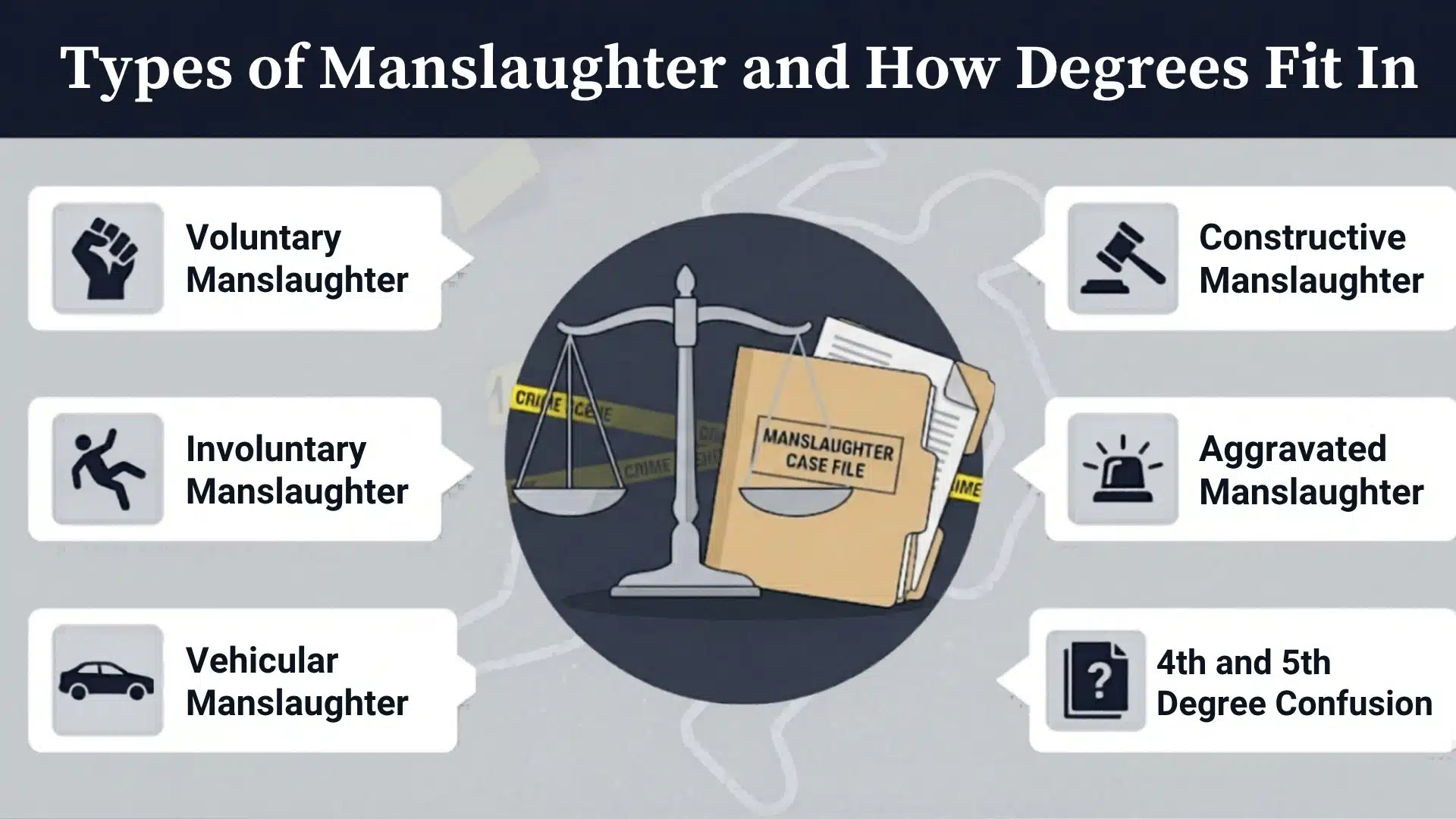
Manslaughter can be grouped by type or by degree, and both systems generally point to the same conduct. Here is how each category works.
1. Voluntary Manslaughter (First-Degree Manslaughter)
Voluntary manslaughter usually means someone killed another person on purpose, but it happened in a heated moment, not after planning.
Courts often call this the “heat of passion” because the person reacted after strong provocation or a sudden fight.
For the heat-of-passion defense to hold, courts generally require that the provocation was serious enough that a reasonable person could have been similarly overwhelmed, and that the defendant did not have enough time to “cool off” before acting.
That cooling-off window is often disputed in a trial. In states using degree labels, this is often called first-degree manslaughter, which still makes it a felony and a serious charge.
The line between voluntary manslaughter and second-degree murder often comes down to how courts interpret intent and provocation, which is why understanding the key differences between murder and manslaughter charges matters before any legal strategy is formed.
2. Involuntary Manslaughter (Second-Degree Manslaughter)
Involuntary manslaughter means someone caused another person’s death without meaning to kill them.
This usually happens through reckless behavior, criminal negligence, or acting without enough care in a dangerous situation.
The law still holds the person accountable because the risk of harm was obvious, and they ignored it. A useful distinction: recklessness means the person consciously ignored a known risk.
Criminal negligence means they should have recognized the risk but failed to. Courts treat recklessness as more culpable than negligence, and some states charge them at different felony levels.
In states using degree labels, this is often called second-degree manslaughter. Think of it like this: the death was not planned, but the conduct was still risky enough for criminal charges.
3. Vehicular Manslaughter
Vehicular manslaughter happens when someone causes another person’s death while driving in a reckless, careless, or impaired way.
This charge is often separate because driving deaths have their own fact patterns, like speeding, DUI, or gross negligence.
In some states, it can be a misdemeanor or felony, depending on how dangerous the driving was and whether gross negligence was involved.
In cases where an assault escalated into a fatal outcome, the charge can shift from assault to constructive or voluntary manslaughter depending on intent, which is why how aggravated assault differs from simple assault is worth understanding before a case reaches that point.
4. Constructive Manslaughter (Unlawful Act Manslaughter)
Constructive manslaughter happens when someone commits a dangerous unlawful act, and that act causes another person’s death.
The person may not have planned the death, but the first act was already illegal and unsafe. For example, if an assault leads to death, prosecutors may treat it as constructive manslaughter.
The main point is simple: the unlawful act started the chain that caused the fatal result.
5. Aggravated Manslaughter
Aggravated manslaughter usually means the charge becomes more serious because of the victim or the facts surrounding the death.
Some states raise the penalty when the victim is a child, an elderly person, or a law enforcement officer. The basic conduct may look similar to manslaughter, but the law treats it more harshly.
That means more prison time, bigger fines, and higher long-term risk.
6. 4th and 5th Degree Manslaughter
Many people search for fourth-degree manslaughter and fifth-degree manslaughter, but these terms are not used the same way everywhere.
Most states use voluntary manslaughter, involuntary manslaughter, vehicular manslaughter, or reckless homicide instead of extra degree levels.
New Mexico Statute Section 30-2-3 classifies involuntary manslaughter as a fourth-degree felony, which is different from fourth-degree manslaughter.
That label explains felony severity, not a separate manslaughter type. So, always check the state’s exact statute before assuming what the charge means.
Why Do States Define Manslaughter Differently?
Manslaughter laws change by state because the U.S. does not use a single criminal code for every homicide case, resulting in varying penalties and legal definitions.
- State control: Each state writes its own criminal laws, so the same act may get a different charge name.
- Different labels: Some states use voluntary and involuntary manslaughter, while others use first-degree and second-degree labels.
- Separate driving laws: Some states create vehicular manslaughter charges because fatal driving cases have different facts.
- Penalty differences: One state may treat conduct as a felony, while another may allow a lower charge.
- Federal limits: Federal manslaughter law applies only in federal or maritime cases, not every state case.
When a manslaughter case involves multiple charges or counts, how the court structures the sentences also matters, and whether sentences run consecutively or concurrently can significantly change the total time someone serves.
Is Manslaughter a Felony?

Manslaughter is usually a felony because the charge involves a person’s death, even when the killing was not planned.
Both voluntary manslaughter and involuntary manslaughter often carry prison time of more than one year, which usually places them in felony territory.
Federal law also treats manslaughter seriously, with voluntary manslaughter carrying up to 15 years and involuntary manslaughter carrying up to 8 years.
Some exceptions can happen with vehicular manslaughter, especially when there is no gross negligence involved. For example, some states may treat lower-level vehicular manslaughter as a misdemeanor instead of a felony.
Still, most manslaughter cases bring heavy risks, including prison time, fines, firearm restrictions, job problems, and a permanent criminal record.
Manslaughter vs Murder: Where the Line is Drawn
The main difference between murder and manslaughter is the person’s mental state before and during the killing.
| Charge | Intent | Planning | Malice | Common sentence range |
|---|---|---|---|---|
| First-degree murder | Intent to kill | Yes | Yes | 25 years to life |
| Second-degree murder | Intent or extreme disregard | No | Yes | 15 to 25 years |
| Voluntary manslaughter | Intent may exist | No | No | 3 to 15 years |
| Involuntary manslaughter | No intent to kill | No | No | 1 to 8 years |
That gap between voluntary manslaughter and second-degree murder, both involving an intentional killing without premeditation, is often where the real legal battle is fought.
The presence or absence of adequate provocation is not always obvious, and prosecutors and defense attorneys typically argue this point hard on both sides.
Note: Sentence ranges are general estimates. Actual penalties vary by state, criminal history, and case-specific factors.
When to Speak with a Criminal Defense Attorney?
A manslaughter charge can change a person’s life very quickly, so getting legal help early is often important. You should speak with a criminal defense attorney if:
- You have been arrested or questioned about a death investigation.
- Police officers ask for a statement about the incident.
- Prosecutors file manslaughter or murder charges against you.
- A plea deal is being offered, and you need to understand the risks.
- The case involves claims of negligence, reckless conduct, or self-defense.
The difference between murder and manslaughter often depends on intent, evidence, and how prosecutors interpret the facts.
An attorney can review the evidence, explain possible defenses, protect your rights, and help you understand the penalties you may face under state law.
Conclusion
Manslaughter labels can feel small at first, but they can change how serious a charge becomes in real life. That is why degrees of manslaughter should never be guessed from one headline, one state law, or one court story.
You now know why voluntary, involuntary, vehicular, constructive, and aggravated manslaughter can carry different risks by state.
I also want you to remember that felony status, intent, and state rules matter more than the label alone.
If a real charge is involved, the safest move is to speak with a licensed criminal defense attorney in that state. Legal names can look similar, but the facts behind them can change the whole case.
Confused about a manslaughter term you saw somewhere? Tell us, share with us in the comments below.
Frequently Asked Questions
Can a Manslaughter Charge Be Reduced or Dismissed Before Trial?
Yes, a manslaughter charge can sometimes be reduced or dismissed before trial. Prosecutors may lower the charge if the evidence is weak. A defense attorney may also ask the court to dismiss the case because of poor evidence or rights violations.
Does a Manslaughter Conviction Affect Your Right to Own a Firearm?
Yes, a felony manslaughter conviction can affect your firearm rights. Federal law generally bars people with felony convictions from owning guns. Some states may allow restoration later, but that process depends on the state and the exact conviction.
Can You Be Charged with Manslaughter if the Victim Survives?
No, manslaughter requires the death of another person. If the victim survives, the case may involve assault, aggravated assault, or attempted murder instead. The charge depends on the injury, intent, and facts around the incident.
Is There a Statute of Limitations on Manslaughter Charges?
Many states do not set a time limit for serious felony manslaughter charges. Some lower-level homicide charges may have a deadline, depending on state law. Because these rules vary, the exact statute of limitations should always be checked by jurisdiction.
Can a Manslaughter Conviction Be Expunged from a Criminal Record?
Sometimes, but expungement for manslaughter is usually difficult. Some states block record clearing for homicide-related crimes. Other states may allow limited relief after the sentence is finished, but it depends on the conviction, waiting period, and state rules.