

A criminal charge can look like a few words on paper, but those words can change the rest of a person’s life. The difference between a felony and a misdemeanor is not just about jail time.
It can affect where a sentence is served, what rights are lost, how future employers see the record, and whether one mistake follows someone for years.
That is why this distinction matters before a plea, court date, or rushed decision. Some charges may seem minor until prior convictions, state rules, or aggravating factors raise the stakes.
Others may look serious but carry options that are not obvious at first. Felonies, misdemeanors, and infractions each carry different risks, and knowing those differences can change what happens next.
Felony vs. Misdemeanor: What is the Difference?
Felonies and misdemeanors are distinguished primarily by the severity of punishment, with felonies carrying longer incarceration periods and more significant long-term consequences.
| Category | Felony | Misdemeanor |
|---|---|---|
| Potential sentence | More than 1 year of incarceration | 1 year or less of incarceration |
| Sentence location | State or federal prison | County or local jail |
| Federal definition | Punishable by death or imprisonment exceeding 1 year | Generally punishable by 1 year or less |
| Severity | More serious offense | Less serious offense |
| Long-term consequences | Greater impact on civil rights, housing, employment, licensing, and firearm ownership | Usually, fewer long-term consequences |
While state laws may vary, most jurisdictions follow this framework, making the length and place of incarceration key factors in distinguishing felonies from misdemeanors.
How Felony and Misdemeanor Charges Are Classified
Most states divide felonies into classes or degrees, such as Class A through E or First Degree through Third Degree. The highest class or degree carries the longest prison term.
Misdemeanors are usually ranked the same way, with Class A as the most serious and lower classes carrying shorter jail sentences.
Some states also use a middle category, often called a gross misdemeanor or aggravated misdemeanor.
These offenses are more serious than standard misdemeanors but still usually carry local jail time rather than prison time.
Wobbler offenses can be charged as either felonies or misdemeanors, depending on the facts and the prosecutor’s decision.
Federal law also classifies crimes by severity, with felony classes A through E and misdemeanor classes A through C.
Felony Classes and Common Examples
Felony classes help show how serious a charge may be and what prison range could apply. Exact labels, penalties, and examples vary by state, so this table provides only a general comparison.
| Felony Class | Typical Prison Range | Common Examples |
|---|---|---|
| Class A / First Degree | Life or death penalty | First-degree murder, rape with aggravating factors |
| Class B / Second Degree | 10 to 25 years | Robbery, kidnapping, major drug trafficking |
| Class C / Third Degree | 5 to 10 years | Aggravated assault, grand theft over threshold |
| Class D / Fourth Degree | 2 to 5 years | Lower-level drug offenses, some property crimes |
| Class E / Fifth Degree | 1 to 2 years | Possession charges, minor fraud, check forgery |
Always check the specific state statute, as the same offense can fall into different classes depending on jurisdiction and the facts of the case.
Infraction vs. Misdemeanor and Felony: The Three Tiers Explained

Criminal charges are not limited to felonies and misdemeanors. Infractions sit below both, and the difference affects jail time, court appearances, records, and long-term consequences.
What is an Infraction?
An infraction is the lowest level of violation and is usually not a criminal offense. It carries no jail time and does not create a criminal record.
Most infractions involve fines, license points, or online payment without a court appearance.
Common examples include speeding tickets, parking violations, jaywalking, littering, and vehicle equipment violations. In traffic cases, points can still affect driving privileges.
What is a Misdemeanor?
A misdemeanor is a criminal offense, but it is less serious than a felony. It can carry up to one year in county or local jail, plus fines, probation, community service, or court-ordered classes.
Examples include shoplifting, first-offense DUI, simple assault, reckless driving, and some drug possession cases. A serious or repeat traffic citation may be charged as a misdemeanor.
What is a Felony?
A felony is the most serious category of criminal offense and usually carries a sentence of more than 1 year in state or federal prison.
Felonies create a criminal record and can affect voting rights, firearm ownership, housing, employment, immigration status, and licensing.
Common examples include robbery, murder, drug trafficking, rape, burglary, arson, aggravated assault, and DUI causing injury. Penalties depend on state law, prior record, and facts.
Felony and Misdemeanor Penalties in the United States
Penalties vary by state, but this table shows common ranges for incarceration and fines, as well as where each sentence is typically served.
| Crime Class | Typical Incarceration | Typical Fine Range | Where Served |
|---|---|---|---|
| Infraction | None | $25 to $500 | N/A |
| Class C Misdemeanor | Up to 30 days | Up to $500 | County jail |
| Class B Misdemeanor | Up to 6 months | Up to $2,000 | County jail |
| Class A Misdemeanor | Up to 1 year | $4,000 to $5,000 | County jail |
| Gross Misdemeanor | Up to 364 days | $2,000 to $3,000 | County jail |
| Class E / Fifth-Degree Felony | 1 to 2 years | Up to $10,000 | State prison |
| Class C / Third-Degree Felony | 5 to 10 years | $15,000 to $25,000 | State prison |
| Class A / First-Degree Felony | 10 years to life | $50,000 or more | State prison |
Prior record, offense facts, sentencing guidelines, and judicial discretion can change the final penalty.
Federal vs. State Felony and Misdemeanor Charges
Most crimes are prosecuted at the state level, but federal charges apply when an offense violates federal law, crosses state lines, occurs on federal property, or involves a federal agency.
Federal cases often carry stricter sentencing rules and fewer early release options.
Common federal felonies include drug trafficking, wire fraud, mail fraud, weapons trafficking, bank robbery, tax evasion, immigration offenses, securities fraud, and money laundering.
Federal misdemeanors usually involve regulatory violations, minor drug possession on federal property, or traffic offenses in national parks or federal buildings.
A case may move to federal court when agencies like the FBI, DEA, ATF, or IRS lead the investigation. Some conduct can violate both state and federal law, meaning charges may be filed in either system or, in limited cases, both.
Felony vs. Misdemeanor Consequences

A prison sentence can end, but a felony record can affect daily life for years after release.
- Voting rights: Rules vary by state. Some restore rights after release, while others require parole, probation, waiting periods, or petitions.
- Firearm ownership: Federal law generally bars people with felony convictions from possessing firearms unless rights are legally restored.
- Employment: Felony records can limit job options, especially in healthcare, finance, education, law, and other fields that conduct extensive background checks.
- Professional licensing: Many licensed trades may deny or restrict applicants with felony records, even years later.
- Housing: Landlords and public housing programs may consider criminal history during screening.
- Immigration: Non-citizens may face deportation, denial of naturalization, or reentry bars.
Misdemeanors can still appear on background checks, but felonies usually carry stronger civil and economic consequences
Whether assault is a felony in a particular case, for example, may determine whether a person can ever hold a nursing license again.
Can a Felony or Misdemeanor Record Be Cleared?
Yes, in many cases, but eligibility depends on the offense, the state, and how much time has passed since the sentence ended.
1. Expungement vs. Record Sealing
These two terms are often used interchangeably, but they work differently.
Expungement removes a conviction from the public record entirely, as if it never occurred. Record sealing hides the conviction from public view but does not erase it.
Law enforcement and certain government agencies can still access sealed records. For misdemeanors, expungement is available in most states after a waiting period, typically two to five years from the date the sentence is completed.
Some states also allow expungement after a first felony offense, particularly for non-violent crimes. Serious violent offenses, sex crimes, and crimes against children are almost universally ineligible.
2. What Affects Eligibility
Eligibility for record sealing or expungement depends on several factors. Common considerations include the following:
- Type of offense: Misdemeanors are more commonly eligible than felonies. First-degree felonies are rarely eligible.
- Time since sentence: Most states require a waiting period after probation, parole, and fines are fully completed.
- No new convictions: Any new arrest or conviction during the waiting period typically restarts the clock or disqualifies the petition.
- State law: Rules vary widely. Some states have automatic sealing programs; others require a formal petition to the court.
An attorney who handles record-clearing cases can assess eligibility, file the appropriate petition, and represent the individual in court. Acting before a background check becomes an issue is usually more effective than acting after.
Note: This section is for general informational purposes. Eligibility for expungement or record sealing varies significantly by state and offense type. Consult a licensed criminal defense attorney for guidance specific to your situation.
Can a Misdemeanor Become a Felony?
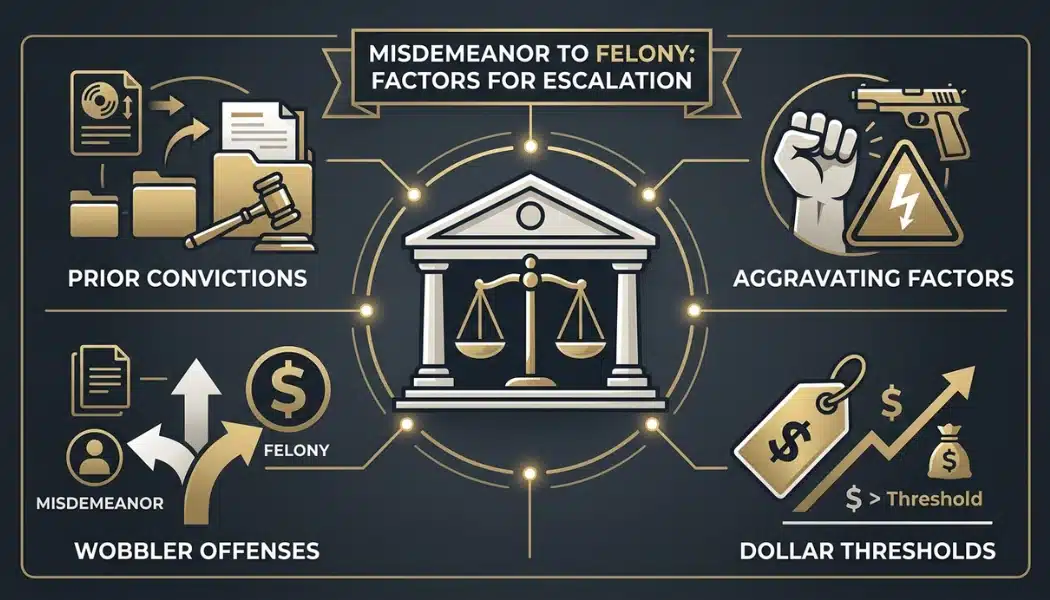
Yes. A misdemeanor can become a felony when prior convictions, case facts, dollar value, or prosecutor discretion raise the seriousness of the charge.
1. Prior Convictions
Prior convictions are the most common reason a misdemeanor becomes a felony. Many states use repeat-offender rules that increase penalties after multiple similar offenses.
DUI laws often work this way: a first offense may be a misdemeanor, but a third offense within a set period can become a felony, with harsher penalties, license consequences, and possible jail time.
2. Aggravating Factors
Aggravating factors can elevate a misdemeanor to felony status when the facts make the conduct more serious.
Common triggers include using a weapon, causing serious bodily harm, targeting a protected person, or committing the act around a child.
For example, simple assault may become aggravated assault if a weapon was used or the victim suffered major injury during the incident.
3. Dollar Amount Thresholds
Dollar-amount thresholds matter most for theft, fraud, and property crimes. Each state sets a cutoff that separates misdemeanor theft from felony theft.
The limit often falls between $500 and $1,500, but it varies widely.
A low-value shoplifting case may remain a misdemeanor, while a higher-value loss can result in felony grand theft or fraud, with larger penalties and lasting records.
4. Wobbler Offenses
Wobbler offenses give prosecutors charging discretion.
If the facts support either a misdemeanor or a felony, the prosecutor decides based on criminal history, cooperation, the strength of the evidence, and the circumstances.
A defense attorney may seek misdemeanor treatment before charges are elevated.
If someone is detained or arrested, asking for counsel immediately can affect how prosecutors ultimately file the charge and pursue penalties in court later.
When is Legal Help Needed?
A charge is not final just because it appears on an arrest report. Prosecutors can raise, reduce, or change charges before trial, and early defense work can affect that decision.
In misdemeanor cases, an attorney may seek diversion, deferred prosecution, community service, or another outcome that avoids a conviction.
In felony cases, the charge level can change the sentencing range by years.
Legal help is especially important for wobbler offenses, repeat charges, DUI cases, and allegations involving weapons, injury, or high-dollar amounts.
Evidence may be challenged, witness accounts reviewed, and facts reframed before negotiations begin.
This matters because early strategy can shape whether a case stays a misdemeanor or a felony. If a criminal charge is pending, waiting too long can limit possible defenses.
Conclusion
A criminal charge should never be judged by its name alone. The real risk is often found in the classification, the facts behind the arrest, and the choices made before the next court date.
A seemingly minor charge can carry lasting consequences, while a serious charge may still have defenses, negotiation options, or reduction options.
The safest move is to act before the process moves without you.
Review the charge, understand what is at stake, and get legal guidance before making statements, entering a plea, or missing a deadline.
When the outcome can affect freedom, rights, work, and reputation, early action is not optional. It is protection.
Frequently Asked Questions
Can You Travel Internationally With a Felony Conviction?
Yes. International travel is possible with a felony conviction, but some countries may deny entry or require a waiver, especially for serious offenses. Check the destination country’s entry rules before traveling.
What Should You Do Immediately After Being Charged With a Crime?
Remain silent and ask for an attorney. Do not discuss the case with police, prosecutors, or others without legal counsel. Avoid posting about the case online or contacting witnesses.
How Long Does a Felony Stay on Your Record?
A felony typically remains on your criminal record permanently unless it is sealed, expunged, or otherwise removed under state law. Eligibility depends on the offense and state-specific requirements.