
When an HOA dispute escalates, it can feel like the rules are always tilted against homeowners, especially when fines, restrictions, or approvals start piling up.
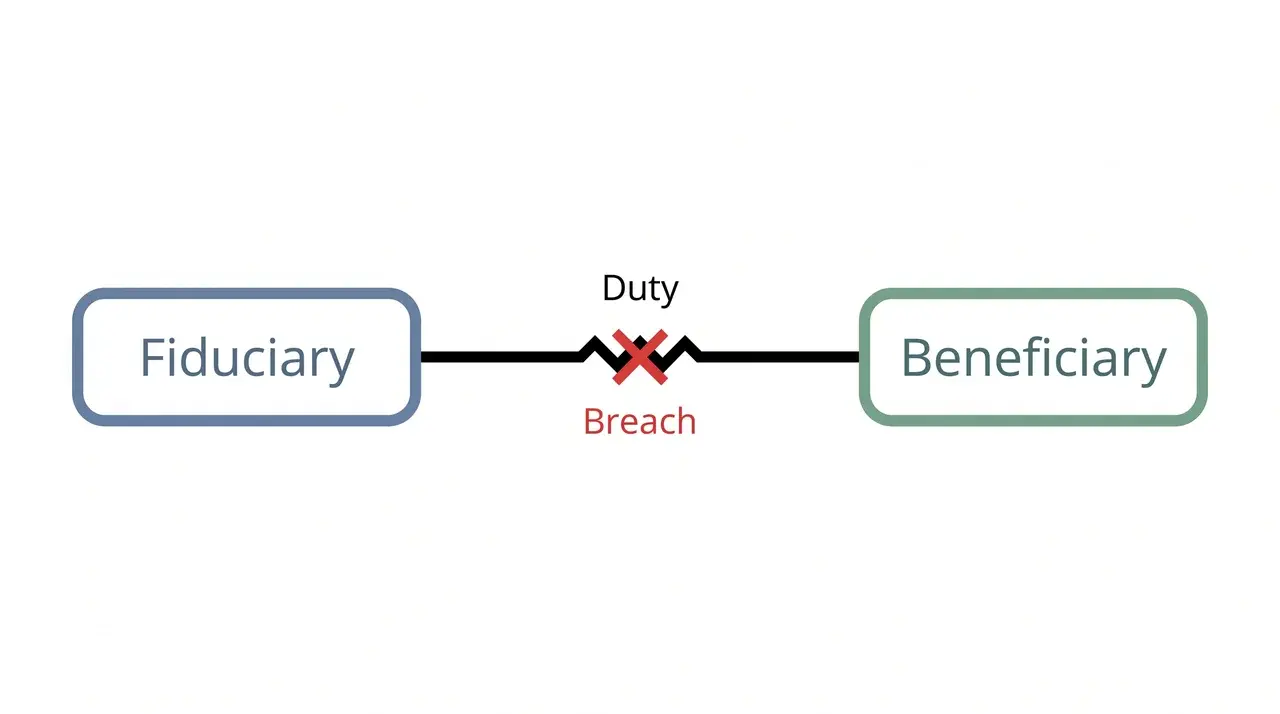
Many people are surprised to learn that HOA decisions are not final and can be challenged in court when rules or laws are broken.
A closer look at real cases shows that outcomes often depend on evidence, procedure, and fairness rather than authority alone.
In many situations, a homeowner wins a lawsuit against the HOA because the association fails to follow its own governing documents or state regulations.
Understanding how these disputes begin and are resolved can help homeowners make smarter decisions before taking legal action.
Can a Homeowner Really Win Against an HOA?
Yes, a homeowner can win against an HOA when there is clear proof that the association acted outside its legal authority or failed to follow proper procedures.
Courts do not favor either side automatically and rely strictly on evidence and compliance with governing documents and state laws.
- Homeowners succeed when they prove the HOA violated CC&Rs, bylaws, or community rules
- Cases are often won when the HOA fails to provide proper notice, hearings, or due process before issuing fines
- Courts side with homeowners in situations of selective enforcement where similar violations are treated differently
- Legal wins also happen when the HOA imposes unlawful fines, wrongful liens, or ignores statutory requirements
- Strong documentation such as emails, notices, photos, and meeting records plays a key role in supporting the claim
In most disputes, success depends less on conflict and more on clear evidence and procedural fairness.
Real-World Situations Where Homeowners Have Won
Every HOA dispute is different, but many successful homeowner lawsuits follow similar patterns. In most cases, homeowners win because they can show that the HOA acted unfairly, ignored its own rules, or failed to follow the proper legal process.
1. The HOA Enforced Rules Selectively
Selective enforcement is one of the most common reasons homeowners win against HOAs.
Homeowners succeed by proving the association applied rules unevenly, such as fining one owner for a backyard structure while ignoring identical ones on neighboring properties. Courts require fair application across the community.
In Florida’s White Egret Condominium v. Franklin, courts ruled restrictions must be enforced uniformly.
In a Florida arbitration case, a homeowner kept new flooring after proving the HOA had ignored the same violation by another owner, and won on arbitrary enforcement grounds.
2. The HOA Ignored Its Own Procedures
Homeowners win when HOAs bypass required procedures such as proper notice, hearings, quorum votes, or access to the record before fining or taking action.
In California, courts void enforcement if the HOA skips its architectural review process. Virginia’s Supreme Court in Sainani v. Belmont Glen (2019) sided with a family fined $884 over holiday lights, ruling the HOA lacked authority for the rule.
Homeowners have overturned fines and liens by documenting procedural failures, such as unnotified board decisions or missing hearings.
3. Architectural Requests Were Denied Without Reason
Homeowners prevail when architectural committees deny requests without objective reasons or fail to meet response deadlines.
In North Carolina, Sherry Loeffler won a five-year fight: her HOA approved vinyl windows, then fined her $12,000 and placed a lien on her home after reneging.
She settled for $75,000 and kept the windows. In Colorado, a disabled veteran defended his approved wheelchair-accessible driveway; courts upheld it after the HOA failed to prove property line violations on appeal
4. Wrongful Liens or Collection Actions
HOAs incur losses due to improper liens when they skip legal notices, pursue disputed charges, or act too quickly.
In Georgia, Michelle Bernard settled for $40,000 after challenging a $3,000 lien tied to allegedly fraudulent fees and improper covenant changes.
Courts have removed liens and awarded damages for incomplete notices or bad-faith collections.
In multiple states, homeowners successfully quieted title or halted foreclosures by proving procedural violations under state lien statutes.
What Courts Can Order When Homeowners Win
Winning doesn’t always mean a check shows up. Courts have several tools, and which one applies depends on what you’re actually asking for.
| Remedy | What it does |
|---|---|
| Compensatory damages | Covers your actual financial losses |
| Punitive damages | Extra money meant to punish willful misconduct is awarded less often |
| Injunctive relief | A court order forcing the HOA to stop a specific action |
| Declaratory judgment | A ruling that a specific rule or action was illegal |
| Attorney’s fee award | The HOA pays some or all of your legal costs, where state law or the CC&Rs allow it |
What are People Saying Online?
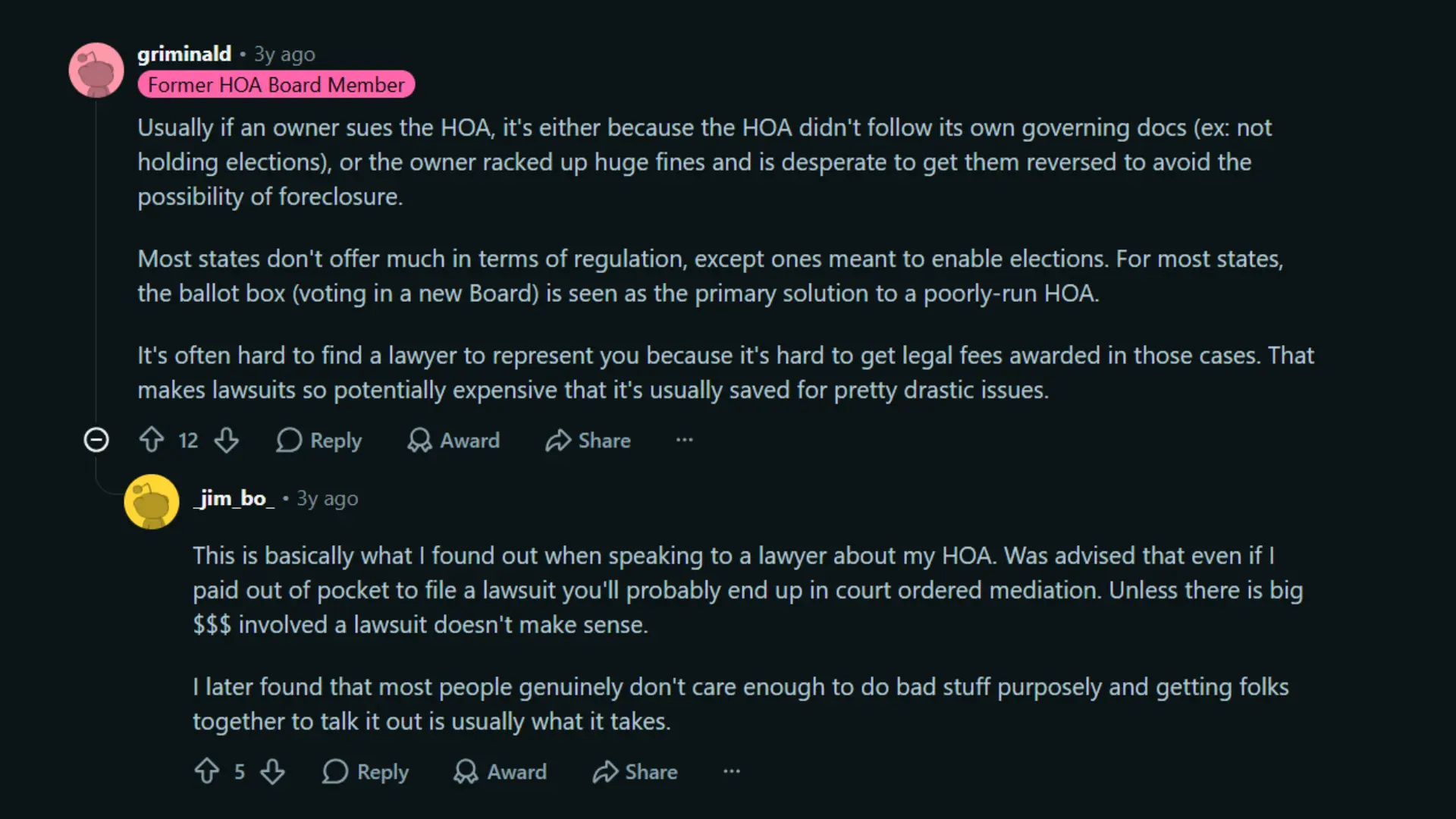
A Reddit discussion about suing an HOA suggests that lawsuits are usually successful only when the HOA fails to follow its governing documents or legal procedures.
A former HOA board member explained that many disputes involve election issues or large fines, but lawsuits can be expensive and difficult because legal fees are rarely recovered.
Another homeowner shared that an attorney recommended mediation rather than litigation, noting that most conflicts are resolved more effectively through discussion and cooperation, unless significant financial or legal issues are involved.
Why Do Some HOA Lawsuits Succeed?
HOA lawsuits succeed when homeowners prove the association failed to follow its rules, legal procedures, or made unfair and inconsistent decisions affecting property rights.
- Violation of governing documents: HOAs often lose cases when they ignore or misapply CC&Rs, bylaws, or architectural rules that govern decision-making.
- Breaking state HOA laws: Lawsuits succeed when boards fail to follow legal requirements such as notice rules, open meetings, election procedures, or homeowner access rights.
- Selective enforcement of rules: Homeowners win when similar violations are treated differently, showing unfair or biased enforcement across the community.
- Unreasonable or arbitrary decisions: Courts may rule against HOAs when approvals are denied without valid reasons or when actions appear inconsistent or biased.
- Strong documented evidence: Success often depends on records like emails, notices, photos, meeting minutes, and timelines that clearly support the homeowner’s claim.
When Homeowners Lose HOA Lawsuits

Not every case goes the homeowner’s way. Courts expect both sides to follow the law and the community’s governing documents, and judges generally won’t overturn an HOA rule just because a homeowner disagrees with it.
Common reasons homeowners lose include:
- Clearly violating HOA rules or community restrictions
- The HOA followed all required legal procedures correctly
- Lack of solid evidence or documentation
- Missing the legal deadline to file a claim
- Skipping the HOA’s internal appeal or dispute resolution process before going to court
Instead of second-guessing the rules themselves, judges focus on whether the HOA applied them fairly and followed the law throughout the dispute.
Is Filing a Lawsuit Always the Best Option?
No, filing a lawsuit is not always the best first step in an HOA dispute.
Many conflicts can be resolved earlier through structured internal processes such as board meetings, violation hearings, and written appeals, where both sides present their concerns and supporting documents.
These steps often help correct misunderstandings or procedural errors without escalating the issue.
If the dispute continues, mediation offers a formal yet less adversarial option in which a neutral third party helps both sides reach a practical agreement.
In some cases, attorney-led negotiation can also resolve issues involving fines, approvals, or enforcement actions before court involvement becomes necessary.
These alternatives usually save time and reduce legal costs compared to litigation.
How to Legally Annoy Your HOA?
Homeowners can use legal rights such as meetings, access to records, and group action to hold HOAs accountable and push for faster responses without going to court.
- Attend meetings: Homeowners can speak during HOA board meetings where allowed, making concerns public and requiring formal responses from the board.
- Request records: Laws usually allow access to financial records, minutes, and contracts, helping homeowners identify delays, errors, or mismanagement.
- Write everything: Putting all communication in writing forces official responses and prevents verbal claims from being ignored or misrepresented later.
- Group complaints: When multiple homeowners raise the same issue together, it becomes harder for the HOA to ignore or delay action.
- Join the board: Running for election gives homeowners direct control over decisions, enforcement, and the interpretation of community rules.
Do You Need an HOA Litigation Lawyer?
Sometimes. An HOA litigation lawyer earns their fee when your dispute involves significant fines, property rights, liens, a foreclosure threat, major construction issues, or a discrimination claim.
For smaller disagreements, a single consultation may be enough to understand your options without committing to a full case.
An attorney who focuses on real estate law can review your facts, explain what your state requires, and tell you honestly whether the board actually exceeded its authority or simply made a decision you don’t like.
Conclusion
Disputes with an HOA are often resolved based on clear evidence, proper procedure, and how well each side follows the governing rules.
Courts do not decide cases based on opinions or personal disagreements but on documented facts and legal compliance. Homeowners who stay organized, understand their rights, and follow the correct process usually have a stronger position when conflicts escalate.
In some situations, issues are resolved through negotiation or mediation before reaching court, which saves both time and cost.
A homeowner wins a lawsuit against an HOA only when the association has clearly overstepped its authority or failed to apply rules fairly.
If you’ve faced an HOA dispute or seen one in your community, share your experience in the comment section and help others understand what really works.
Frequently Asked Questions
Can an HOA Legally Foreclose on My Home over Unpaid Fines?
Yes, in many states, an HOA can place a lien on your property and eventually pursue foreclosure if dues or fines remain unpaid for long enough.
What is the Difference Between HOA Mediation and Going to Court?
Mediation is a private, informal process where a neutral third party helps both sides reach a voluntary agreement, usually faster and cheaper than litigation. Going to court means a judge reviews the evidence and issues a legally binding ruling.
Can an HOA Change Its Rules After I’ve Already Been Fined?
An HOA can amend its rules, but it generally cannot apply new rules retroactively to penalize you for something that was permitted when you did it.
Do I Have the Right to Attend HOA Board Meetings?
In most states, homeowners have a legal right to attend open HOA board meetings, though executive or closed sessions covering legal matters or personnel issues may be restricted.