One court notice can change an ordinary day into weeks of stress, unanswered questions, and constant waiting.
Many people facing legal action suddenly start searching for answers, like how long does a lawsuit take, because the process feels confusing from the very beginning.
The paperwork, deadlines, court hearings, and legal terms can quickly become overwhelming, especially for someone unfamiliar with what a civil suit is or how the system actually works.
Some cases move quickly, while others seem to drag on endlessly with no clear finish line in sight. That uncertainty often becomes the hardest part.
Knowing the typical civil lawsuit timeline can bring a sense of control during an already frustrating situation.
Whether the case involves a personal dispute, accident claim, or business issue, understanding the legal process early can help reduce fear and make each stage feel far less intimidating.
What is a Civil Suit?
A civil suit is a legal case between people, businesses, organizations, or government bodies.
One side claims that the other side caused harm or failed to meet a legal duty.
The person or party bringing the case is called the plaintiff. The person or party being sued is called the defendant.
Civil cases are different from criminal cases. A criminal case is brought by the government to punish a crime.
Common civil suits include personal injury claims, contract disputes, property disputes, employment claims, etc.
A civil case begins when the plaintiff files a complaint with the court. The complaint explains what happened, how the defendant caused the harm, and the relief the plaintiff seeks.
That relief may include money damages or a court order.
One important note before diving in: every state has a statute of limitations, a legal deadline to file your lawsuit.
If you miss it, and the court will bar your claim regardless of its merits. In my practice, I have seen otherwise strong cases become unwinnable simply because the deadline passed.
Civil Lawsuit Timeline: Stage by Stage
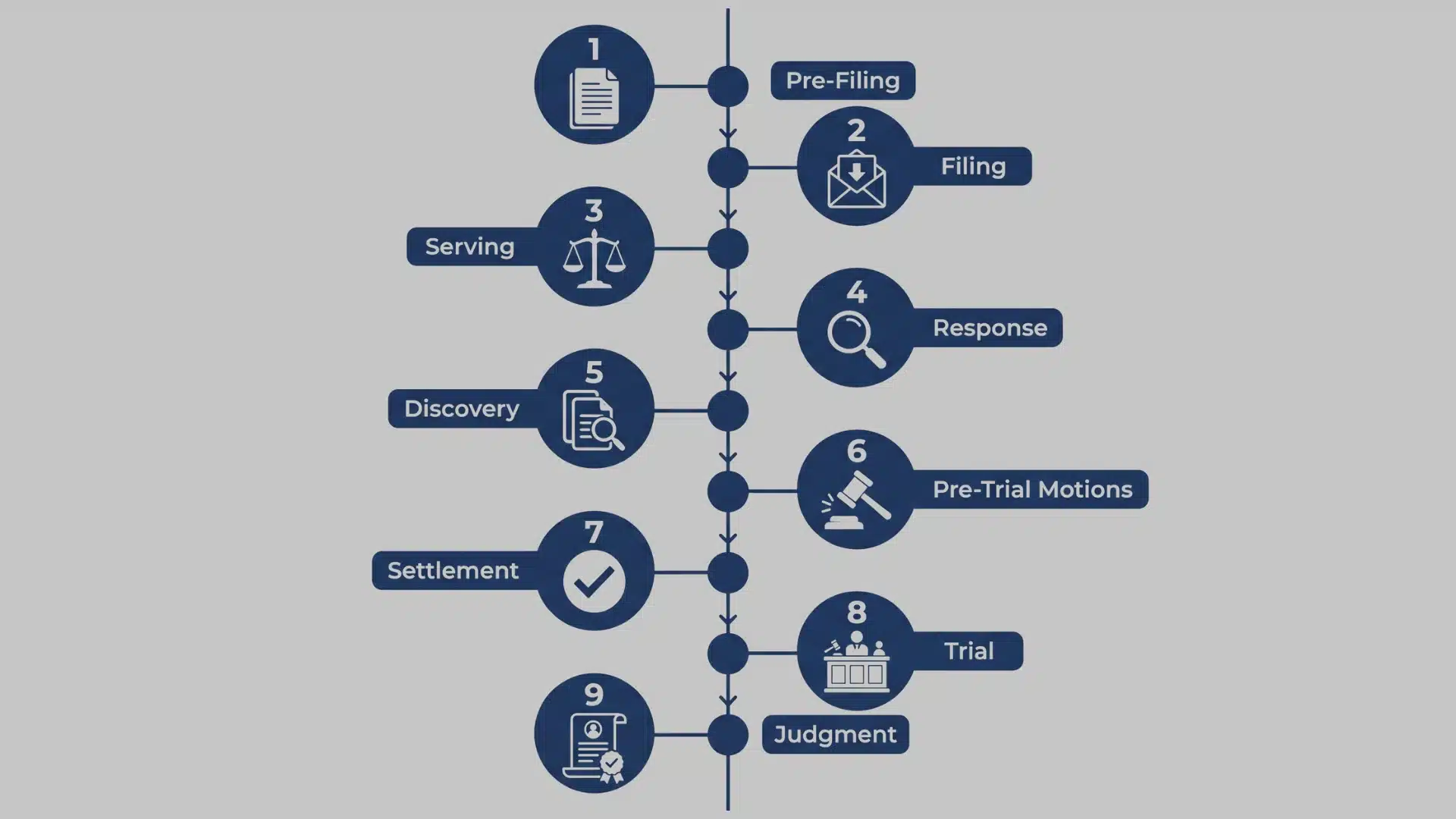
This civil lawsuit timeline shows the typical path, but some cases settle before reaching every stage. Others go through every stage and may even continue after trial.
Stage 1: Pre-Filing (Weeks to Months)
Before any complaint is filed, there is usually a pre-filing period.
Your attorney investigates the facts, gathers records, and may send a demand letter to the opposing party.
That letter describes the harm, states what compensation you’re seeking, and invites resolution without court involvement.
Sometimes the other side responds, and a settlement is reached here, before any lawsuit is ever filed. If no agreement comes, the next step is filing.
This stage is often skipped in discussions of lawsuit timelines.
Stage 2: Filing the Complaint
The lawsuit begins when the plaintiff files a complaint. This document explains the dispute to the court. It names the defendant, explains the facts, and asks the court for relief.
The complaint does not prove the case. It only starts the case. The plaintiff still has to support the claims with evidence later.
A lawyer may need records, photos, contracts, medical files, witness names, or other proof before filing.
Stage 3: Serving the Defendant
After filing, the defendant must be served. Service means the defendant receives formal notice of the lawsuit.
This step is important because the court usually cannot proceed until the defendant has been properly notified. Under the Federal Rules of Civil Procedure, plaintiffs in federal court generally have 90 days to serve the defendant after filing.
Service can be simple if the defendant is easy to find. It can take longer if the defendant has moved, avoids service, lives in another state, or is a business with several possible addresses.
Once service is complete, the clock starts for the defendant’s response.
Stage 4: The Defendant’s Response
The defendant usually files an answer or an early motion. An answer responds to the claims in the complaint. The defendant may admit some points, deny others, and raise defenses.
Sometimes the defendant files a motion to dismiss the case before it goes further.
The judge may grant it or deny it, or allow the plaintiff to fix the complaint. This stage can add time, especially if the court asks for written arguments or holds a hearing.
Stage 5: The Discovery Phase
Discovery is often the longest part of a civil lawsuit. During this process, both sides exchange information about the case.
This may include documents, written questions, witness names, photos, emails, records, and depositions.
A deposition is when a witness answers questions under oath before trial. A court reporter records the testimony. Discovery helps both sides understand the evidence and prepare for trial.
In auto accident settlement cases, the discovery phase often hinges on medical records and accident reconstruction reports, which can take time to obtain and review.
Stage 6: Pre-Trial Motions
After or during discovery, either side may file motions asking the judge to rule before trial.
A common motion is summary judgment, where the court decides part or all of the case without trial if there is no real dispute over key facts.
If granted, the case may end. If denied, it continues. These motions can narrow issues, but may also add delays.
Stage 7: Settlement Negotiations
Settlement can occur at almost any stage, from before filing to during trial.
Many civil cases end this way instead of going to court, as trials can be costly and time-consuming.
Courts often encourage settlement, and methods like mediation or arbitration can help.
Talks may resolve quickly if both sides agree on value, but can take longer when facts are disputed or expectations differ.
Knowing how civil settlements work before negotiations begin gives you a clearer sense of what to expect and when to push back.
Stage 8: The Trial
If the case does not settle, it may go to trial before a judge or jury, depending on the case.
Each side presents evidence, calls witnesses, and makes arguments. The judge controls what evidence is allowed under legal rules.
Trials may last a day or several weeks. The wait for trial can be longer due to court schedules, judge availability, and case priority.
State courts vary widely; some move faster, others significantly slower, depending on local docket congestion.
Stage 9: The Verdict and Judgment
After the trial, the judge or jury makes a decision. In a jury trial, the jury delivers the verdict, while in a bench trial, the judge decides.
The court then enters a judgment stating who won and what must happen next, such as payment, dismissal, or other orders.
The case may not end here, as the losing party can request changes or file an appeal if legal grounds exist.
How Long Does a Lawsuit Take?
Most civil lawsuits take anywhere from several months to 2 or more years, depending on case complexity, court backlog, evidence gathering, settlement negotiations, motions, trial scheduling, and appeals.
| Stage | Typical Duration | What Can Extend It |
|---|---|---|
| Pre-Filing / Demand Letter | 2-8 weeks | Missing records, unresponsive opposing party |
| Filing the Complaint | A few days to several weeks | Complex facts, incomplete evidence |
| Serving the Defendant | Days to a few weeks | Defendant avoids service, out-of-state party |
| Defendant’s Response | 20-30 days (court deadline) | Motions to dismiss, extension requests |
| Discovery | 3-12 months (up to 2+ years in complex cases) | Expert witnesses, document disputes, depositions |
| Pre-Trial Motions | 1-4 months | Number of motions, court schedule |
| Settlement Negotiations | Weeks to months (can happen at any stage) | Disputed facts, insurance review |
| Trial | 1 day to several weeks | Court backlog, witness availability |
| Post-Trial Motions / Appeal | Several months to 2+ years | Multiple appellate levels, legal complexity |
Factors that Affect How Long a Lawsuit Takes
Several factors can affect how long a lawsuit takes from start to finish. The complexity of the case, the amount of evidence involved, and the willingness of both parties to settle all play a major role in the overall timeline.
1. Court Backlog and Jurisdiction
Some courts have crowded calendars. Others move cases faster. A case in one county or state may move at a different pace than a similar case in another county or state.
Jurisdiction also matters. Federal courts follow the Federal Rules of Civil Procedure in U.S. district courts. State courts have their own rules and timelines.
Court holidays, judge availability, emergency orders, and local procedures may also affect scheduling.
2. Complexity of the Case
Simple cases usually move faster. A case with one plaintiff, one defendant, clear evidence, and limited damages may not need much discovery.
Complex cases take longer. This may include cases with several defendants, large losses, expert witnesses, medical records, business records, accident reconstruction, or disputed facts.
A personal injury case may also stall if the injured person is still receiving treatment.
I have seen clients eager to settle early, only to discover months later that their medical condition required further care, which significantly changed the settlement value.
3. Willingness to Settle
A case moves faster when both sides are open to a fair settlement. It slows when one side refuses to negotiate, denies responsibility, or disagrees on damages.
Insurance companies can also affect timing, as they may need time to review records, assess liability, and approve payment.
If a claim is disputed, the case may move further into litigation. In some cases, discovery is needed before settlement becomes realistic.
What Happens After the Trial?

After the trial, the court enters judgment. It may require one party to pay money, follow a court order, or take another action.
The losing side may file post-trial motions to change the result, reduce damages, order a new trial, or correct an error.
An appeal may also follow, it is not a new trial. The appeals court reviews legal errors from the trial court rather than hearing the case again.
In many federal civil cases, a notice of appeal must be filed within 30 days of judgment or order as required under FRAP Rule 4 .
If the United States or its agencies are involved, the deadline is usually 60 days.
The same time-sensitive thinking applies at the start of any case; missing the deadline to file your claim can bar you from court entirely, no matter how strong your case is.
Conclusion
How long a lawsuit takes depends on the facts, the court, the evidence, and whether both sides are willing to settle.
One would think of the process as a series of steps rather than one fixed countdown.
A case may end early through settlement, or it may move through discovery, motions, trial, judgment, and appeal.
You do not need to know every court rule to understand the basic path.
The main point is simple: civil lawsuits take time because both sides must get notice, exchange evidence, argue legal issues, and prepare for trial if a settlement does not happen.
If you are involved in a case, a lawyer can review the facts and give a more realistic timeline.
Have you ever been involved in a civil lawsuit or settlement case? Share your experience or questions in the comments below.
Frequently Asked Questions
Can a Civil Lawsuit Settle before Trial?
Yes. Many civil lawsuits settle before trial. Settlement can happen before filing, during discovery, after motions, right before trial, or even while the trial is underway.
What if the Defendant Does Not Have Enough Money to Pay a Judgment?
Winning a judgment does not guarantee immediate payment. If the losing party lacks assets, collection can take additional time and may require a separate legal process.
Does Every Civil Lawsuit Go to Trial?
No. Many civil lawsuits end through settlement or court rulings before trial. A judge may also decide part or all of a case through motions.
Can an Appeal Make a Lawsuit Take Longer?
Yes. An appeal can add months or even years. The appeals court reviews legal issues from the trial court rather than starting the entire case over.