

After an accident, uncertainty around financial recovery becomes a major concern.
Many individuals start searching for examples of personal injury settlement amounts to understand what others have received and how their own situation might compare.
However, settlement figures are influenced by multiple legal and financial factors that may not be immediately apparent.
This is why two cases that seem similar on the surface can lead to very different results.
That gap between what insurers offer and what a case is actually worth is exactly why I put this guide together. The numbers you see online are ranges.
What you actually recover depends on how well your case is built, documented, and supported by a strong legal strategy and clear evidence.
What is the Average Personal Injury Settlement?
A personal injury settlement is a financial agreement between an injured party and the at-fault party or insurer, resolving a claim without trial.
The average personal injury settlement typically ranges from $40,000 to $55,000.
Most cases settle out of court, and amounts vary widely: minor soft-tissue injuries often resolve for $3,000-$25,000, while moderate cases fall between $25,000-$100,000.
Catastrophic injuries, such as traumatic brain injuries or spinal damage, can exceed $500,000 or reach millions.
Each case is unique, so consulting a qualified personal injury lawyer is essential for an accurate valuation tailored to your situation.
Most examples of personal injury settlement amounts involve ordinary injuries, limited insurance coverage, and pre-trial negotiation.
Personal Injury Settlement Amounts Examples by Case Type

The section below presents general settlement ranges by case type, derived from published verdict data and institutional sources. These ranges reflect general trends, not guarantees. A personal injury settlement can go beyond these numbers in some cases.
1. Car Accident (Minor)
Typical Settlement Range: $5,000 – $20,000
Minor car accident settlements are usually based on soft tissue injuries such as whiplash, minor back strain, or bruising.
These cases often involve limited medical treatment, like a few doctor visits or physical therapy sessions. Recovery is typically short, and there is no long-term disability or permanent damage.
Insurance companies tend to resolve these claims faster since liability is often clear and damages are easier to calculate based on medical bills and short-term impact.
Understanding the average car accident settlement value in your jurisdiction provides a helpful baseline when deciding whether an insurer’s offer is fair.
2. Car Accident (Severe / TBI)
Typical Settlement Range: $75,000 – $500,000+
Severe car accidents involving traumatic brain injuries or long-term disability result in significantly higher settlements.
These cases consider future medical care, lost earning capacity, and reduced quality of life. Long-term rehabilitation, cognitive impairment, and inability to work all increase claim value.
In high-impact cases, liability and evidence play a major role. Large verdicts, like the Tesla Autopilot case, show how advanced factors like technology failure can also influence outcomes.
3. Slip and Fall
Typical Settlement Range: $15,000 – $50,000
Slip and fall settlements depend on premises liability and how serious the injury is. Key factors include whether the property owner knew about the hazard and failed to fix it.
Injuries can range from minor sprains to fractures, which directly impact compensation. Documentation like incident reports, surveillance footage, and medical records strengthens claims.
Cases with clear negligence and visible injuries tend to settle higher, especially when recovery involves extended treatment or mobility limitations.
4. Dog Bite
Typical Settlement Range: $25,000 – $70,000
Dog bite settlements consider both physical and emotional harm. Visible injuries, especially on the face or hands, increase claim value due to permanent scarring.
Emotional trauma, particularly in children, is also a key factor. Medical treatment, risk of infection, and possible reconstructive surgery all influence the final amount.
Liability laws vary by state, but cases involving aggressive behavior history or lack of control by the owner often result in higher compensation outcomes.
5. Truck Accident
Typical Settlement Range: $100,000 – $500,000+
Truck accident cases often lead to higher settlements because they involve severe injuries and multiple liable parties. These can include the truck driver, trucking company, maintenance providers, and cargo handlers.
The scale of damage is usually greater due to the size and weight of commercial trucks. Federal regulations, driver logs, and safety violations also play a role in determining liability.
Complex investigations and high medical costs contribute to larger settlement values.
6. Medical Malpractice
Typical Settlement Range: $250,000 – $1,000,000+
Medical malpractice settlements are typically high due to the serious nature of harm and the complexity of proving negligence.
These cases require expert testimony to establish that a healthcare provider failed to meet the standard of care.
Long-term consequences such as disability, chronic illness, or surgical errors increase compensation. Legal costs are also higher, which affects settlement negotiations. Strong medical evidence and expert analysis are essential to support these claims.
7. Wrongful Death
Typical Settlement Range: $500,000 – $2,000,000+
Wrongful death settlements are calculated based on the financial and emotional impact on surviving family members. Factors include lost income, future earning potential, and dependency of loved ones.
Compensation may also reflect loss of companionship and support. The age, health, and occupation of the deceased play a major role in determining value.
Strong evidence of liability and economic loss can significantly increase settlement amounts in these cases.
8. Pedestrian Accident
Typical Settlement Range: $75,000 – $500,000+
Pedestrian accidents often result in serious injuries due to direct impact with vehicles.
Settlements are influenced by the severity of physical trauma, including fractures, head injuries, or long-term disability. Liability is frequently clear, especially when drivers violate traffic laws.
Medical expenses, recovery time, and permanent effects all contribute to the claim value. Cases involving severe injuries or long-term care needs tend to fall at the higher end of the range.
Riders involved in two-wheeled vehicle crashes face similar risks, and the factors that influence bike accident compensation closely align with those in pedestrian and serious car accident cases.
9. Workplace Injury
Typical Settlement Range: $20,000 – $150,000+
Workplace injury settlements depend on lost wages, medical treatment, and the level of disability caused. Most cases fall under workers’ compensation, which has set limits.
However, if a third party is involved, such as faulty equipment or contractor negligence, settlements can increase significantly.
Long-term injuries, reduced earning capacity, and ongoing treatment needs all impact compensation. Proper documentation and legal evaluation are key to maximizing recovery in these cases.
Factors That Affect Personal Injury Settlement Amounts
No two personal injury claims are identical. The following are the key variables that drive settlement value, in order of the impact I’ve seen them have in practice.
- Injury severity: Minor injuries, such as sprains or soft-tissue damage, usually result in lower settlements. Severe injuries such as fractures, surgeries, or permanent disability significantly increase the value.
- Medical expenses: This includes hospital bills, medications, and therapy costs. Future medical needs, like rehabilitation or long-term care, can further raise the personal injury settlement amount.
- Lost income: If the injury leads to missed work, those wages are added to the claim. Reduced earning capacity over time can also increase compensation.
- Liability: Clear fault strengthens the case and improves settlement value. If responsibility is shared, the final payout may be reduced based on the percentage of fault.
- Insurance limits: Even strong cases are often limited by the at-fault party’s insurance coverage. Policy limits can cap the maximum settlement amount.
- Pain and suffering: This includes physical pain and the emotional impact of the injury. It is usually calculated separately and can significantly increase total compensation.
- Evidence strength: Medical records, accident reports, and witness statements support the claim. Strong documentation leads to better personal injury settlement amounts.
- Legal strategy: Proper negotiation and case handling improve outcomes. Well-prepared claims often result in higher settlements compared to poorly managed cases.
How Personal Injury Settlements Are Calculated?
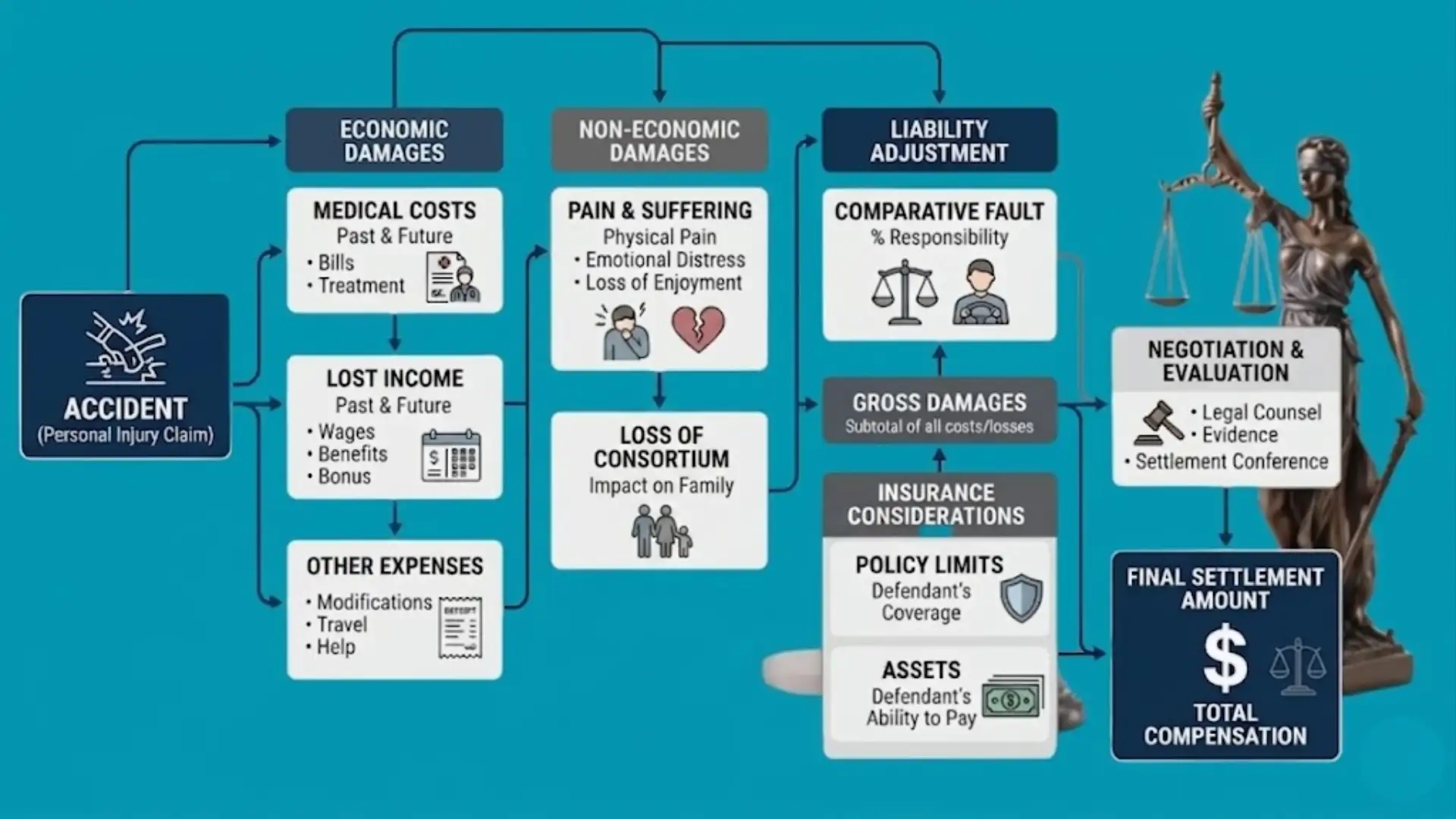
A personal injury settlement is calculated using a structured approach that combines financial losses with the overall impact of the injury. While no exact formula applies to every case, the process starts with measurable costs and then adjusts based on injury.
The first step is identifying economic damages, which are direct financial losses such as hospital bills, doctor visits, medications, rehabilitation costs, and future medical expenses.
Lost wages are also included, covering both current income loss and reduced earning capacity. This typically forms the base value of the claim.
Next, non-economic damages are added. These account for pain, emotional distress, and the overall effect on daily life.
Since these do not have fixed costs, they are estimated based on injury severity and recovery time, often increasing the total personal injury settlement significantly.
Insurance companies then apply the multiplier method, using a number between 1.5 and 5 on medical costs. Minor injuries receive a lower multiplier, while serious, long-term injuries get a higher one.
Finally, the settlement is adjusted based on liability and evidence. If the injured person shares fault, the amount is reduced by their percentage of fault.
Strong proof like medical records, accident reports, and witness statements can increase the final amount, which is why similar cases can have different personal injury settlement outcomes.
How Long Does a Personal Injury Settlement Take?
The timeline for a personal injury settlement varies depending on the complexity of the case. Most claims are resolved within 6 to 18 months, but some may settle faster or take longer based on specific factors. When reviewing amount examples, longer timelines often correlate with higher-value cases, driven by more detailed evaluation and negotiation.
- Faster settlements (a few months): Cases with clear fault, minor injuries, and limited medical treatment tend to resolve quickly.
- Average timeline (6–12 months): Medical treatment is completed, documentation is reviewed, and negotiations take place before reaching a final personal injury settlement.
- Longer cases (12–18+ months): Severe injuries, disputed liability, or cases requiring expert testimony take more time. High-value claims often involve extended negotiations
One of the most common mistakes I see: a client accepts a $25,000 offer within 60 days of the accident, thinking treatment is over. Six weeks later, an MRI shows a herniated disc that requires surgery.
That surgery alone can cost $40,000–$80,000, and once you’ve signed the release, there’s no going back. I always advise clients to reach maximum medical improvement (MMI) before entering final settlement negotiations. The insurer’s urgency is not your urgency.
When is Settling Not the Right Move?
Settlement may not be the right move when the at-fault party’s actions go beyond simple negligence. In cases involving reckless or intentional behavior, additional damages may apply, but these are typically awarded only through a court decision.
Another situation is when liability is not clearly established. If the fault is disputed, further investigation and evidence gathering may be required. Settling before facts are fully developed can weaken the claim and lead to a lower personal injury settlement.
Medical recovery status also matters. If maximum medical improvement has not been reached, future treatment needs may still be unknown.
In cases involving reckless or intentional behavior, additional damages may apply, but they are typically awarded only by a court.
In these situations, delaying settlement allows more time to build evidence, clarify liability, and fully assess damages. A well-timed decision often leads to a stronger, more accurate personal injury settlement.
What Reduces vs Improve Personal Injury Settlement?
When comparing personal injury settlement amounts, higher payouts are usually linked to strong documentation and careful handling of the claim. On the other hand, avoidable mistakes such as accepting low offers or delaying treatment can reduce the final outcome.
| Situation | What Reduces Settlement | What Improves Settlement |
|---|---|---|
| Early Decisions | Accepting the first offer leads to a lower personal injury settlement | Reviewing and negotiating offers increases value |
| Medical Treatment | Delayed or inconsistent treatment weakens the claim | Immediate and consistent treatment builds strong records |
| Documentation | Missing bills, reports, or proof reduces claim value | Keeping all records strengthens personal injury settlement amounts |
| Legal Approach | Handling a claim without guidance lowers negotiation power | Consulting a professional improves settlement outcome |
| Communication | Giving unprepared statements to insurance can harm the case | Careful and limited communication protects claim value |
| Case Behavior | Posting on social media can reduce credibility | Avoiding public discussion maintains a strong case position |
| Follow-Up | Ignoring treatment plans reduces compensation | Following medical advice supports a higher settlement |
Conclusion
While examples of personal injury settlement amounts offer a general reference point, they do not define the outcome of an individual claim.
The final value depends on factors such as documentation, financial impact, liability strength, and available insurance coverage.
Small differences in evidence or timing can lead to noticeable changes in results.
Understanding how settlements are evaluated helps better prepare for negotiations and reduces the risk of accepting less than the case supports.
Instead of focusing solely on averages, attention should be placed on building a strong, well-documented claim.
If your situation feels unclear or you’re unsure what your case might be worth, share your questions or experience in the comments below.
Getting the right perspective early can make a real difference.
Frequently Asked Questions
Can a Personal Injury Settlement Include Future Financial Losses?
Yes, settlements may include future medical expenses, rehabilitation costs, and reduced earning capacity if the injury affects long-term work ability.
How Much Does a Personal Injury Attorney Cost?
The attorney receives a percentage of the final settlement, typically 33%–40%, plus reimbursement for case expenses. If the case does not settle, you generally owe nothing.
Are Personal Injury Settlements Taxed in The U.S.?
Most settlements for physical injuries are not taxable, but portions related to lost wages, interest, or punitive damages may be taxed.
Can Multiple Parties Increase the Total Settlement Amount?
Yes, if multiple parties are responsible, compensation may come from different insurance policies, increasing the total recovery for personal injuries.