

Over 5,000 riders walk away from crashes each year, facing bills that wreck their finances.
Yet insurance companies hand out bare-minimum $50K checks, while some claimants receive much higher compensation for identical injuries.
That difference isn’t due to luck. It comes from knowing exactly how motorcycle accident compensation works today under U.S. law.
This blog clarifies all the things you need to know about motorcycle accident compensation.
You will get to know the situations in which you are eligible to file a claim, the types of damages you get compensated for, and the step-by-step claim tactics to boost your settlements.
What is Motorcycle Accident Compensation?
Motorcycle accident compensation is the legal term for the full financial recovery available to riders injured by someone else’s negligence under U.S. personal injury law.
It forces the at-fault party (or their insurer) to restore you, in terms of monetary compensation, to the position you were in before the crash.
This compensation is divided into three main categories, including economic damages for your medical bills, lost wages, and motorcycle repairs, all easily proven with receipts.
The others are for non-economic damages, such as pain and suffering or loss of enjoyment of life, and for punitive damages, which are awarded only when the defendant’s conduct was reckless.
According to the NHTSA, motorcyclists are 28 times more likely to die in a crash than car occupants.
This level of physical vulnerability is a key reason courts and juries often award more serious non-economic damages in motorcycle accident cases than in standard car accident claims.
Who Can Be Held Liable for a Motorcycle Crash?
Most riders assume the only defendant in a motorcycle accident claim is the driver who hit them. In practice, liability can extend to several parties, and identifying all of them is one of the first things an experienced attorney will do.
- The at-fault driver. The most common defendant is the motorist who failed to yield, changed lanes without checking, ran a red light, or was distracted or impaired at the time of the crash.
- A government entity. If road debris, a pothole, missing signage, or a defective traffic signal contributed to the crash, the city, county, or state agency responsible for that road may share liability. These claims carry strict notice deadlines. In California, a government tort claim must be filed within six months of the incident under the Government Claims Act (Gov. Code Section 911.2). Missing that window bars the claim entirely.
- A construction company. When debris or unsafe road conditions result from active construction work, the contractor responsible for maintaining a safe work zone can be held liable. Photographs of the debris and the crash report officer’s observations are particularly valuable in these cases.
- A motorcycle or parts manufacturer. If a mechanical defect, such as a brake failure, tire blowout, or throttle malfunction, contributed to the crash, a product liability claim against the manufacturer may be available alongside or instead of a negligence claim against a driver.
Identifying every potentially liable party matters because each one may carry separate insurance coverage. A claim limited to a single underinsured driver may leave significant compensation unreached.
Types of Motorcycle Accident Compensation
Every valid motorcycle accident claim can include five core damage categories, each backed by federal and state law.
- Medical Expenses & Future Care Costs: It covers all past, current, and future medical treatment, including surgery, hospitalization, and rehabilitation, as well as physical therapy and lifelong nursing care when needed.
- Lost Wages & Loss of Earning Capacity: Reimburses income lost while you recover and, in permanent injury cases, the reduction in your lifetime earning potential.
- Pain and Suffering Compensation: It compensates for physical pain, emotional distress, PTSD, anxiety, depression, and loss of enjoyment of life.
- Property Damage & Motorcycle Repair: Pays fair market value for your totaled motorcycle plus gear, custom parts, and aftermarket upgrades. Also includes rental costs.
- Wrongful Death Benefits for Families: Financial support is granted to the surviving family members of the deceased. The National Safety Council helps calculate the economic value of a human life for settlement and trial purposes.
How to Get Motorcycle Accident Compensation
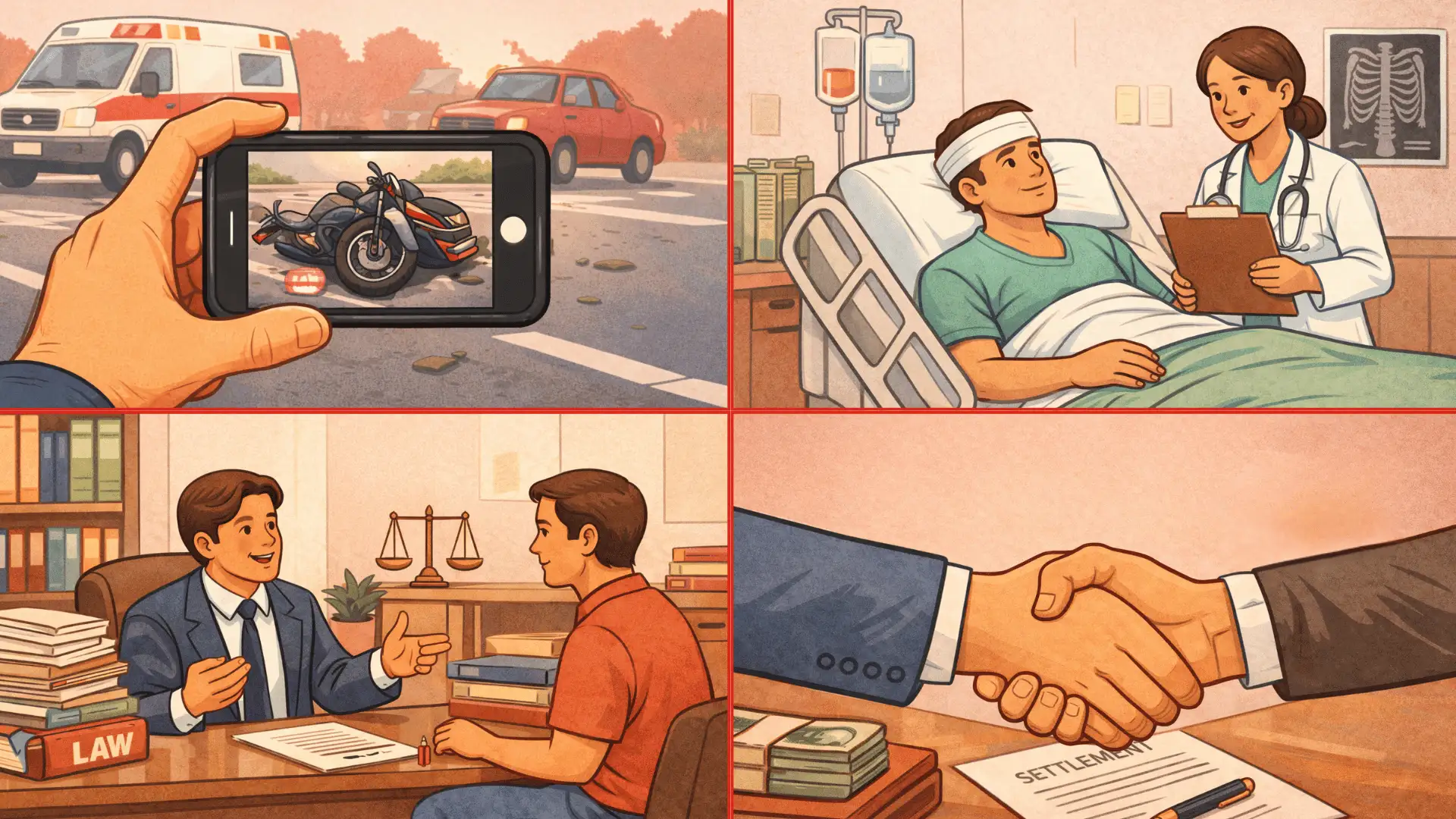
The way you handle the accident right after it takes place influences how smoothly your motorcycle accident compensation claim moves from the crash scene to the final settlement.
Step 1: Call an Ambulance, Report the Crash, and Lock in Early Evidence
Never leave without a police report. It is the single strongest piece of evidence for liability. It also becomes a key reference point for insurers and attorneys.
Take photos of everything, from vehicle positions, skid marks, road conditions, license plates, and all injuries immediately at the scene of the accident.
Get names and numbers of witnesses before they disappear. Refuse to give any statement to the other driver’s insurance on-site.
Documentation habits early on often influence the entire motorcycle accident compensation outcome. Empirical statistics show that crashes with proper police documentation settle for 40% more on average.
Step 2: Get Proper Medical Treatment & Build Your Damage File
Go to the emergency room by ambulance, even if you “feel okay.” Adrenaline hides serious injuries for hours.
Follow up with appropriate specialists, such as orthopedic, neurological, or pain management. Every visit, test, prescription, and therapy session becomes evidence later on.
Maintain a daily pain journal. Missing treatment creates gaps that the insurance company will use to claim you weren’t really hurt.
The American Medical Association emphasizes that continuity of care dramatically increases settlement value.
Step 3: Hire an Attorney and Open insurance claims early
Contact a lawyer who actually rides or specializes in motorcycle cases within the first 7 to 14 days. They send a “letter of representation” that stops adjusters from contacting you directly.
Your attorney obtains the full police report, orders the ECM (black box) data from both vehicles, and hires accident reconstruction experts when needed.
The Insurance Information Institute outlines common claim steps and emphasizes monitoring deadlines and required paperwork, since policies often include time limits.
Expect questions about injuries, prior conditions, treatment plans, and work status. The adjuster may request photos, a recorded statement, and access to repair estimates.
Delays are common when medical treatment is ongoing, since insurers often wait for a clearer picture of recovery or permanency before discussing final numbers.
Step 4: The Demand, Negotiation & Settlement (or Trial) Phase
Once you have reached Maximum Medical Improvement, the point at which your treating physician determines your condition has stabilized, your attorney compiles all medical records, billing, wage loss documentation, and expert reports into a formal demand package with a specific dollar amount supported by evidence.
The insurer responds, typically with a lower counteroffer, and negotiations proceed.
The large majority of motorcycle accident claims resolve at this stage without requiring a trial.
When negotiations stall, the next step is typically mediation, a structured session with a neutral third party who facilitates a resolution.
If mediation does not produce an agreement, filing suit becomes the appropriate path.
Understanding the full automobile accident lawsuit process before that decision is made helps you and your attorney evaluate whether the insurer’s final offer is worth accepting or taking to a jury
How is Motorcycle Accident Compensation Calculated?
Insurance companies do not assign compensation randomly. They rely on established methods, and understanding these can give you a clear edge during negotiations.
Economic damages are based on concrete evidence, including medical bills, lost wages, repair costs, and expert estimates for future care. These are straightforward and document-driven.
Non-economic damages, such as pain, suffering, and emotional distress, are usually calculated using the multiplier method. In this approach, total medical expenses are multiplied by a number that reflects the severity of the injury.
Minor injuries may use a multiplier of 1.5 to 2, while severe or permanent injuries, such as traumatic brain damage, can raise that figure to 4 or 5.
Another approach is the per diem method, which assigns a daily value to your pain, often based on your daily earnings, and multiplies it by the number of recovery days.
What Are the Average Motorcycle Accident Settlement Amounts?
Motorcycle accident compensation often varies by injury severity, with settlements ranging from tens of thousands for minor harm to several million dollars in wrongful death claims, according to a study by TheInjuryLawyers.
| Injury Severity | Average Settlement Range |
|---|---|
| Minor injuries (soft tissue, minor fractures, road rash) | $15,000-$65,000 |
| Moderate injuries (broken bones, surgery, 1–3 months off work) | $70,000-$225,000 |
| Severe injuries (multiple surgeries, permanent hardware, long-term disability) | $250,000-$900,000 |
| Catastrophic/Traumatic Brain Injury | $1,000,000-$4.8 million+ |
| Wrongful Death | $950,000-$6.5 million+ |
These figures can be affected sharply by the at-fault driver’s policy limits. If the at-fault driver carries only $25,000 in bodily injury liability coverage, that ceiling may represent the practical limit of what their insurer will pay regardless of the actual damages.
This is where your own Uninsured and Underinsured Motorist (UM/UIM) coverage becomes critical. Reviewing your policy limits before a crash, not after, is one of the most financially protective steps a rider can take.
The dynamics of motorcycle accident compensation follow many of the same principles as other vehicle injury claims.
For a broader overview of how settlements are structured, valued, and negotiated across vehicle accident cases, theauto accident settlement frameworkapplies the same economic and non-economic damages analysis to comparable fact patterns.
Factors That Affect Your Motorcycle Accident Compensation
Motorcycle accident compensation can range from modest to substantial, depending on factors that directly influence how insurers calculate risk and value.
- Liability Clarity: A clear fault supported by detailed police reports strengthens negotiating power.
- Your Fault Percentage: A higher fault percentage directly lowers recovery. Every 10% of comparative negligence reduces compensation by 10-25% in most states.
- Policy Limits: Insurance coverage frequently caps recovery. If the at-fault driver carries limited coverage, payout may stop at that limit.
- Venue and Jury Pool: Settlement values vary by location. Urban counties with historically higher verdicts often produce stronger offers than rural venues.
- Injury Severity & Permanence: Long-term disability, permanent scarring, chronic pain, or traumatic brain injury significantly increase non-economic damages.
- Pre-Existing Conditions: Defense exploits old injuries. Updated medical evaluations and documented symptom changes after the crash help protect claim value.
- Attorney Reputation: Experienced trial attorneys often secure stronger claims. They often secure settlements 40 to 60% higher than pre-suit.
How Long Does a Motorcycle Accident Claim Take to Resolve?
Most straightforward motorcycle accident claims, where liability is clear, injuries are documented, and the rider has reached MMI, resolve within three to six months of submitting the demand package.
Cases involving disputed fault, serious injuries requiring extended treatment, multiple defendants, or government entities typically take twelve months or longer.
Cases that proceed to trial can extend two to three years from the date of the crash.
The most common reason for delays or undervalued settlements is agreeing to resolve a claim before reaching Maximum Medical Improvement (MMI).
Once a settlement is accepted, the claim is closed. If future treatment or surgery is needed and not accounted for, the cost falls on you.
A qualified attorney will not recommend settling until your medical condition has fully stabilized and all long-term implications are clear.
Conclusion
Most riders accept the first offer for their motorcycle accident compensation and later regret it.
The amount you receive depends on how well liability is documented, the severity of your injuries, available insurance coverage, and how your claim is handled from the beginning.
You don’t have to settle for a meager amount when you can get the right amount of money for your recoveries and losses. It becomes possible with the right information and strategy.
Careful documentation, consistent medical care, and awareness of deadlines all help protect the full value of your claim.
The smart ones use this information and walk away with life-changing money that covers medical bills, replaces their income, and lets them ride again without financial fear.
Each case is different, and results vary based on state law and individual circumstances. Taking informed steps early can reduce delays and prevent unnecessary disputes later.
Have you made a claim for motorcycle accident compensation?
Share your story or questions in the comments! Let’s help fellow riders ride stronger and safer.
Frequently Asked Questions
Will Health Insurance Pay First Before a Settlement?
Yes, via subrogation. Good lawyers negotiate those liens down 40-70%.
What if the At-Fault Driver Has No Insurance?
Uninsured motorist coverage from your policy steps in. File promptly; your attorney can pursue the driver personally, too.
Do Accident Claims Cover Custom Parts and Aftermarket Exhausts?
Yes, when properly documented with receipts and photos before the crash.