

Hiring a lawyer often comes with one unexpected question before any legal work begins: “Can you pay the retainer?”
That single word leaves many people wondering whether it’s the full legal fee, a refundable deposit, or simply the cost of getting started. Since every law firm can structure retainers differently, the answer isn’t always straightforward.
When I first tried to understand what is a retainer for a lawyer, I assumed it was just another name for paying a lawyer upfront.
I soon realized it wasn’t payment for a finished service but money set aside for future legal work. Knowing how a retainer works before you sign can help you avoid surprises, understand what you’re paying for, and review a fee agreement with confidence.
What is a Retainer for a Lawyer?
A retainer for a lawyer is money paid in advance to secure legal representation, either for a specific matter or for ongoing access to an attorney’s time.
In practice, the lawyer begins representing you, and the retainer is applied toward legal work as it is performed.
This is different from other fee structures. An hourly fee bills you for time spent; a flat fee covers a defined task for a set price; and a contingency fee is paid only if you win or settle.
A retainer typically involves an upfront payment that covers future legal work billed by the hour or at agreed milestones. That’s why it’s often mistaken for a starting fee when it’s actually a prepayment for services that are still to be performed.
Retainer vs. Other Legal Fee Structures
A side-by-side view makes the difference between a retainer and other billing models easier to spot:
| Fee Type | How It Works | Best For |
|---|---|---|
| Retainer (advance) | Upfront deposit held in trust, billed down as work is done | Cases with ongoing or unpredictable hours |
| Hourly Fee | Billed for actual time spent, often without an upfront deposit | Matters with uncertain scope |
| Flat Fee | One fixed price for a defined task | Simple, well-defined matters like an uncontested will |
| Contingency Fee | Paid only as a percentage of a settlement or verdict | Personal injury and similar claims |
| General (True) Retainer | Pays for availability, not tied to specific hours worked | Ongoing business or recurring legal needs |
Different Types of Lawyer Retainers
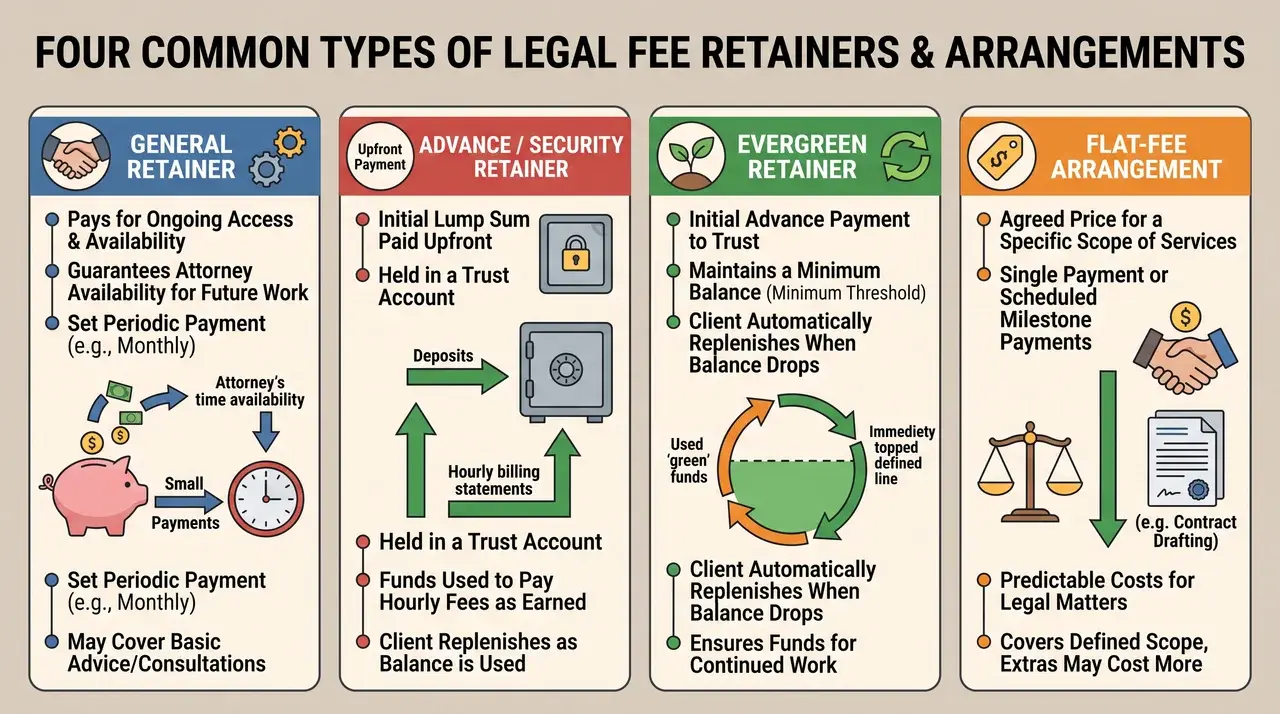
Not all retainers work the same way. Before you sign, make sure your agreement clearly states which type of retainer you’re paying.
- General (True) Retainer: Pays for the lawyer’s availability during a specific period, even if no legal work is performed. Most common in ongoing business relationships.
- Advance (Security) Retainer: The most common option. You deposit funds into a trust account, and the lawyer bills against that balance as work is completed.
- Evergreen Retainer: Works like an advance retainer but must be replenished whenever the balance falls below a set amount, keeping funds available throughout the case.
- Flat-Fee Arrangement: Covers a specific legal service for a fixed price, such as preparing a will or handling an uncontested legal matter, instead of hourly billing.
How Much Does a Retainer Cost
Retainer amounts vary widely because they are tied to how much work the attorney expects during the first stretch of representation, rather than to a fixed industry rate.
Location, the lawyer’s experience, and case complexity all move the number, a solo practitioner in a small town handling an uncontested will typically quotes far less than a firm in a major metro area handling the same matter.
| Matter type | Typical retainer range |
|---|---|
| Simple legal matters (wills, uncontested filings) | $500 to $3,000 |
| Family law or civil litigation | $2,500 to $10,000 |
| Criminal defense (misdemeanor) | $1,500 to $5,000 |
| Complex litigation or felony defense | $5,000 to $25,000 or more |
Some firms also require the retainer to be replenished if your case lasts longer than expected, so ask whether the quoted amount is the total initial retainer or only the starting balance.
These figures are general planning ranges pulled from common industry reporting, not confirmed averages for any specific market. Ask your attorney for a written estimate tied to your own case before assuming any number applies to you.
What Does a Lawyer’s Retainer Cover?
A lawyer’s retainer doesn’t pay for one specific task. Instead, it covers the legal work performed as your case moves forward until the retainer balance is used.
Exactly what is included depends on your Retainer Agreement, but it commonly covers:
- Legal Advice & Consultations: Meetings, phone calls, and emails related to your case.
- Legal Research: Time spent reviewing laws, regulations, and court decisions.
- Document Preparation: Drafting contracts, pleadings, motions, wills, or other legal paperwork.
- Negotiations: Communicating with the opposing party, insurance companies, or other attorneys.
- Court Appearances: Hearings, conferences, depositions, and other billable court-related work.
- Case Management: Reviewing evidence, organizing case files, and preparing legal strategy.
Keep in mind that court filing fees, expert witness costs, travel expenses, and other third-party charges are often billed separately unless your Retainer Agreement specifically states they’re included.
How Retainer Payments are Applied
After you pay a retainer, the money usually goes into a client trust account, not the lawyer’s operating account. As the attorney earns fees, those charges are billed against the retainer, and only the earned amount is transferred from the trust account.
For example, if you pay a $2,000 retainer and your lawyer bills 8 hours at $250 per hour, the retainer is exhausted, and you may need to replenish it before further work can proceed.
If the lawyer bills only 4 hours, $1,000 remains in the trust account for future work or is refunded if the case ends. More complex stages, such as depositions or extensive court preparation, can reduce a retainer much faster because they require additional billable time.
What Happens to Unused Retainer Funds

Even if an agreement states “nonrefundable,” the American Bar Association’s Model Rules 1.15 and 1.16(d) require that any unearned advance fee be returned to the client, a standard reaffirmed in ABA Formal Opinion 505 (2023), which makes clear that labeling a fee “nonrefundable” or “earned on receipt” doesn’t change that obligation.
You may be entitled to a refund if:
- Your Case Ends Early: Part of the retainer remains unused.
- You Switch Lawyers: Unearned funds should generally be returned.
- The Agreed Work Never Happens: The lawyer cannot retain payment for services not performed.
A true general retainer is different. It pays for the lawyer’s availability rather than specific legal work, so different refund rules may apply under state law.
Note: This section is for informational purposes only and is not legal advice. Always review your fee agreement and consult an attorney about your specific situation.
What if You Can’t Afford the Retainer?
You may have more room to negotiate than you think. A lawyer’s retainer isn’t always set in stone.
If your legal matter is relatively straightforward or has a clearly defined scope, some attorneys may be willing to lower the initial retainer, offer a payment plan, or adjust how and when you’ll need to replenish the balance.
That said, flexibility depends on the law firm, the complexity of your case, and the lawyer’s billing policies. The best time to discuss fees is during your initial consultation.
Asking whether there are alternative payment options or a different fee arrangement can help you find an agreement that fits both your legal needs and your budget.
For example, some attorneys will accept half the standard retainer upfront with the remainder due in 30 days, rather than requiring the full amount before any work begins.
What Should a Retainer Agreement Include?
A written Retainer Agreement document sets clear expectations before legal work begins. Read every section carefully and make sure it clearly explains the following:
- Scope of Representation: The legal services the lawyer will and will not provide.
- Fee Structure: whether you’ll be billed hourly, charged a flat fee, or on another arrangement, and how the retainer is applied.
- Trust Account Details: Where your funds will be held and how you’ll receive billing statements or account updates.
- Replenishment Terms: When you’ll need to add more money if the retainer balance gets too low.
- Client Responsibilities: When payments are due, how communication works, and what could end the representation.
- Termination and Refund Policy: What happens to any unused funds if you or the lawyer ends the representation?
No two Retainer Agreements are exactly alike. The terms can vary by state, law firm, and type of legal matter, so never assume every agreement follows the same format. If anything is unclear, ask for an explanation before signing.
When You’d Actually Need a Lawyer on Retainer

Most people only need a lawyer for a single legal matter, such as a lawsuit, contract review, or one-time filing. In these situations, an advance retainer is usually enough rather than an ongoing arrangement.
Businesses with recurring legal needs, landlords managing multiple properties, or people involved in long-running legal matters are more likely to benefit from retaining a lawyer for ongoing advice and representation.
If you’re unsure which category you fall into, bring it up during your initial consultation. A good attorney should explain whether an ongoing retainer makes sense or whether your case is better handled as a one-time engagement.
By contrast, many personal injury lawyers work on a contingency fee basis, meaning they typically don’t require a retainer at all.
Conclusion
When I first tried to understand what a lawyer’s retainer is, I assumed it was just another legal fee. It wasn’t until I learned how retainers are billed, when funds are withdrawn, and what happens to any unused balance that everything started to make sense.
Once I understood what a lawyer’s retainer actually covered, reviewing a fee agreement felt much less intimidating.
Knowing what questions to ask before signing can help you avoid surprises, compare attorneys more confidently, and make informed decisions about your legal representation.
Have a question about what a retainer is for a lawyer or an experience with a lawyer’s retainer fee? Leave a comment below. I’d love to hear your thoughts and help if I can.
Frequently Asked Questions
Is a Retainer the Same as a Down Payment?
No. A retainer is an upfront deposit used to pay for future legal work, while a down payment is part of a fixed purchase price.
Can a Lawyer Ask for More Money After the Retainer is Used?
Yes. If the retainer balance is exhausted, many fee agreements require you to replenish it before any additional legal work can continue.
Do All Lawyers Require a Retainer?
No. It depends on the practice area and billing model. For example, many personal injury lawyers work on a contingency fee basis and don’t require an upfront retainer.
Can I Get My Retainer Back if I Fire My Lawyer?
Usually, yes. Any unearned portion of an advance retainer is generally refundable, although the exact amount depends on your fee agreement and state rules.