
Understanding the statute of limitations in Georgia is essential for anyone considering legal action or facing potential legal claims.
These laws establish strict deadlines for filing lawsuits and prosecuting criminal offenses, varying based on the type of case involved.
Missing a deadline can result in the loss of the right to pursue compensation or legal remedies.
Whether you’re dealing with personal injury claims, property disputes, contract issues, or criminal matters, knowing the applicable time limits is critical.
This guide explains Georgia’s statute of limitations for both civil and criminal cases, helping you understand your legal rights and obligations.
What is a Statute of Limitations?
A statute of limitations is a law that sets a fixed time window for initiating legal action.
Once that window closes, Georgia courts will dismiss the case even if the underlying claim is valid and well-documented.
The purpose is practical: evidence degrades, witnesses forget details, and documents get lost.
Time limits exist to keep litigation anchored to events that can still be fairly reconstructed.
Georgia enforces these deadlines strictly. There is no grace period for being close.
A lawsuit filed one day after the deadline runs the same risk of dismissal as one filed three years late.
Note: This section is for informational purposes only and does not constitute legal advice. Consult a qualified attorney to determine which deadlines apply to your specific situation.
Statute of Limitations in Georgia for Civil Cases
Georgia’s civil deadlines vary by the type of claim. The table below covers the most common categories.
| Claim type | Time limit | Key statute |
|---|---|---|
| Personal injury | 2 years from the date of injury | O.C.G.A. § 9-3-33 |
| Wrongful death | 2 years from the date of death | O.C.G.A. § 9-3-33 |
| Medical malpractice | 2 years from act; 5-year repose cap | O.C.G.A. § 9-3-71 |
| Property damage | 4 years | O.C.G.A. § 9-3-32 |
| Breach of written contract | 6 years from the date of breach | O.C.G.A. § 9-3-24 |
| Breach of oral contract | 4 years from the date of breach | O.C.G.A. § 9-3-26 |
| Debt collection (open accounts) | 4 years | O.C.G.A. § 9-3-25 |
| Defamation (libel/slander) | 1 year from the date of the statement | O.C.G.A. § 9-3-33 |
| Trespass | 4 years | O.C.G.A. § 9-3-30 |
| Workers’ compensation | 1 year (employer must be notified within 30 days) | O.C.G.A. § 34-9-80 |
1. Personal Injury and Wrongful Death
Georgia gives injury victims two years from the date the injury occurred to file a personal injury lawsuit.
For a car accident, that clock starts the day of the crash, not the day a diagnosis is confirmed.
The same two-year limit applies to wrongful death claims, though the clock there runs from the date of death, not the date of the underlying accident.
A wrongful death settlement depends significantly on whether the family files within this window.
You can review how courts calculate average wrongful death settlement amounts in Georgia to better understand what these claims typically involve.
2. Medical Malpractice
Medical malpractice follows a two-year statute of limitations from the date of the negligent act, combined with a five-year statute of repose under O.C.G.A. § 9-3-71.
The repose cap means no claim can proceed more than five years after the act of negligence, even if the injury was discovered later.
There is one exception: if a foreign object was left inside a patient’s body during surgery, the patient has one year from the date of discovery to file.
The rules around medical malpractice cases in Georgia are layered, so early legal consultation is almost always necessary.
3. Contract Claims
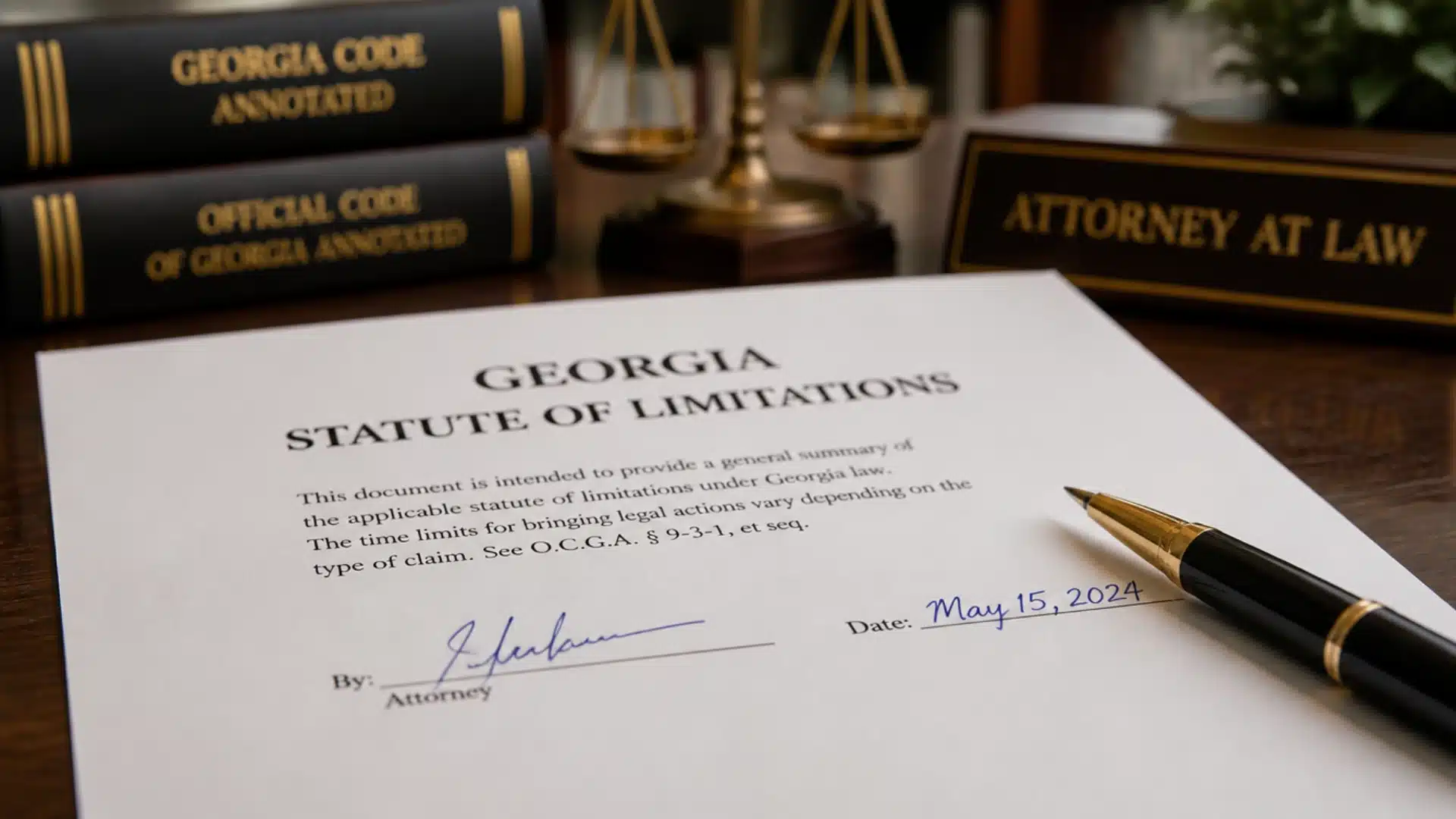
Georgia draws a clear line between written and oral agreements. Written contracts carry a six-year filing window under O.C.G.A. § 9-3-24, measured from the date of the breach.
Oral contracts are governed by O.C.G.A. § 9-3-26 for 4 years.
One notable variation: contracts signed “under seal” are subject to a 20-year limit under O.C.G.A. § 9-3-23, though this is rare in standard commercial practice.
For debt matters, credit card balances and open accounts follow the four-year rule, while debts on written agreements follow the six-year timeline.
Statute of Limitations in Georgia for Criminal Cases
Georgia’s criminal deadlines protect defendants from prosecution long after an alleged offense occurred.
These limits run from the date the crime was committed, not the date of arrest.
| Offense type | Time limit |
|---|---|
| Murder | No limit |
| Rape | 15 years |
| Felonies punishable by death or life imprisonment | 7 years |
| Felonies against child victims | 7 years |
| All other felonies | 4 years |
| Misdemeanors | 2 years |
Murder carries no statute of limitations in Georgia. Prosecutors can pursue murder charges regardless of how much time has passed. Rape charges must be brought within 15 years under Georgia law.
Felonies punishable by death or life imprisonment have a seven-year window, while most other felonies are subject to a four-year limit.
Misdemeanors must be charged within two years of the alleged offense.
If the prosecution misses that window and you have not yet been formally charged, the case is barred.
Criminal DNA Exception
When DNA evidence is used to identify the accused, Georgia law removes the statute of limitations entirely for certain serious offenses, including armed robbery, kidnapping, rape, and aggravated child molestation.
This exception applies regardless of when the crime occurred, provided DNA analysis is central to establishing identity.
Crimes Involving Minor Victims

For felonies committed against victims under 18, the standard four-year limit extends to seven years.
For certain sex offenses involving victims under 16, the clock does not begin running until the victim turns 16 or reports the crime, whichever comes first.
Crimes committed after July 1, 2012, against victims under 16 (including rape, cruelty to children, and aggravated child molestation) may be prosecuted at any time.
When the Clock Can Be Paused: Tolling Provisions
Tolling refers to the legal pausing of the statute of limitations clock. Georgia courts apply tolling narrowly, but several conditions can extend your filing window.
- Minor plaintiffs: Under O.C.G.A. § 9-3-90, the statute of limitations does not begin for a minor until their 18th birthday. A child injured at age 10 typically has until age 20 to file a personal injury claim.
- Mental incapacity: If the plaintiff is legally incapacitated at the time of injury, the clock is paused for the duration of that incapacity.
- Discovery rule: In limited cases, the statute of limitations begins when the injured party knew or reasonably should have known about the harm, rather than the date of the incident. Georgia courts apply this rule narrowly, primarily in medical malpractice and latent-exposure cases.
- Defendant’s absence: If the defendant leaves Georgia after the injury occurs, the time they spend out of state typically does not count toward the limitations period.
- Fraudulent concealment: If the at-fault party actively concealed the cause of action, courts may toll the deadline from the date of discovery.
The discovery rule is frequently misunderstood. Relying on it without legal guidance is risky.
Georgia courts strictly scrutinize timing, and the burden is on the plaintiff to show that discovery was genuinely unavailable earlier.
Whether you have a personal injury case and whether tolling applies are questions that depend heavily on the specific facts.
Understanding personal injury settlement amounts can also help frame what is at stake if you do have a valid claim.
Suing a Government Entity in Georgia

Claims against government entities in Georgia are subject to a separate set of deadlines called ante litem notice requirements.
An ante litem notice is a formal, written notification that must be served before filing suit.
- Municipalities: Written notice is required within six months of the incident under O.C.G.A. § 36-33-5.
- Counties: Written notice required within 12 months under Georgia Code § 36-11-1.
- State agencies: Written notice is required within 12 months under O.C.G.A. § 50-21-26 and must be served on the Risk Management Division of the Department of Administrative Services.
Missing Georgia’s ante litem notice deadline can bar a claim even before the two-year statute of limitations expires.
Courts strictly require written notice that names the government entity, explains what happened, states when and where the injury occurred, and quantifies the loss.
Informal contact with an adjuster is not enough. For claims involving a government vehicle, understanding the automobile accident lawsuit process in Georgia can help clarify the next steps.
When to Contact a Lawyer
The moment you are aware of a potential claim, the clock is already running.
Two years feels like a long window, but between medical treatment, insurance negotiations, and gathering evidence, it closes faster than most people expect. Insurance companies are aware of this.
Some will intentionally extend settlement discussions past the deadline.
A few situations call for immediate legal consultation regardless of how much time seems to remain:
- The injury involved a government vehicle, property, or employee (ante litem notice deadlines are far shorter than two years)
- The injured person is a minor or was incapacitated at the time of the incident
- The harm was not immediately apparent (latent injuries, surgical errors, toxic exposure)
- The defendant lives out of state or has relocated
- You are unsure which entity, government or private, is responsible
Waiting to “see how things develop” is one of the most common reasons valid claims get dismissed on procedural grounds rather than on the merits.
What Happens if You Miss the Deadline
If the Georgia statute of limitations expires before filing, the court will usually dismiss the case permanently.
A serious injury or clear negligence will not revive a time-barred claim.
One narrow exception is Georgia’s renewal statute, which may allow a timely-filed case dismissed without prejudice to be refiled within six months or within the original deadline, whichever is later.
Conclusion
Missing a deadline doesn’t mean the harm didn’t happen. It means Georgia law can no longer address it through the courts.
If your situation involves overlapping claims or a government defendant, deadlines can stack in ways that considerably shorten your effective window.
Before assuming you have time, get the timeline confirmed by an attorney.
Not sure which Georgia deadline applies to your case? Comment below, and we’ll help point you in the right direction.
Frequently Asked Questions
What is the Statute of Limitations for a Car Accident in Georgia?
Georgia generally gives car accident victims 2 years from the date of the accident to file a personal injury lawsuit. If the crash results in a death, families have two years from the date of death to file a wrongful death claim.
Does the statute of limitations restart if new evidence is found?
Generally, no. The statute of limitations usually starts on the date of the injury or breach. New evidence typically does not restart the deadline.
Can a defendant raise the statute of limitations as a defense in Georgia?
Yes. The statute of limitations is an affirmative defense, meaning the defendant must raise it. If the deadline has passed, the court will usually dismiss the case.
Is there a statute of limitations for murder in Georgia?
No. Georgia has no statute of limitations for murder, so charges can be filed at any time. Certain child sex crimes involving DNA evidence may also have no time limit.