

Most drivers know they need car insurance. Far fewer understand what their liability coverage actually protects when an accident happens.
A single crash can create two very different financial problems at the same time. One involves injuries suffered by another person. The other involves damage to a vehicle, home, fence, business, or other property.
Although both losses may come from the same collision, insurance companies handle them separately, apply different limits, and evaluate them in very different ways.
That distinction becomes important when medical costs rise, repair bills grow, or a claim exceeds available coverage. What looks like a straightforward accident can quickly become a question of financial exposure.
Understanding where bodily injury liability ends and property damage liability begins is one of the most important parts of understanding auto insurance.
What is Bodily Injury Liability Coverage?
Bodily injury liability is insurance that pays for physical injuries you cause to another person when you are at fault in an accident.
It does not cover your own injuries or medical bills. Instead, it applies to the other party’s losses, including claims filed by another driver, passenger, pedestrian, cyclist, or injured person.
This coverage can apply after car crashes, truck collisions, rideshare accidents, pedestrian incidents, and other situations where your vehicle causes harm.
It is required in nearly every state, but each state sets its own minimum limits.
Because injury claims can include medical bills, lost wages, and legal demands, carrying only the minimum may not always provide enough protection.
What Bodily Injury Liability Covers
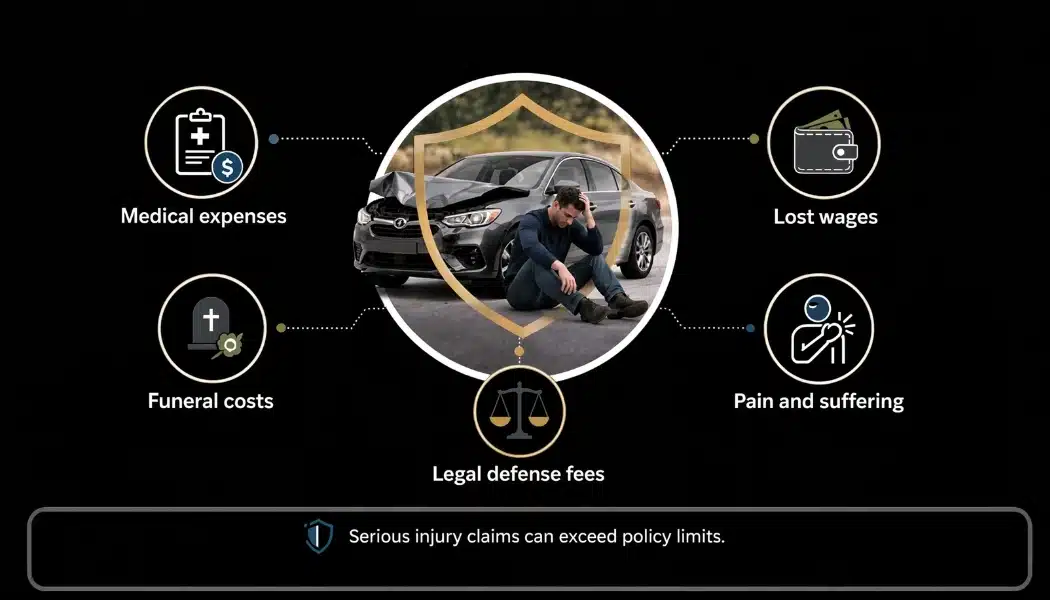
Bodily injury liability covers injury-related losses when another person is hurt in an accident you caused.
These claims often take longer than vehicle damage claims because treatment, recovery, and settlement value must be reviewed first.
- Medical expenses: Hospital care, surgery, rehab, prescriptions, and follow-up treatment.
- Lost wages: Income the injured person missed while recovering.
- Pain and suffering: Physical pain and emotional impact from the injury.
- Funeral costs: Burial-related expenses after a fatal accident.
- Legal defense fees: Defense costs if the injured party files a lawsuit.
Serious injury claims can exceed policy limits, especially when surgery or long-term care is involved.
Reviewing injury settlement amounts from past cases gives a clearer sense of how quickly these costs can grow.
1. Common Examples of Bodily Injury Claims
Bodily injury claims can come from many accident types, not only severe highway crashes. The key issue is whether another person suffered physical harm because of the at-fault driver.
- Rear-end crashes causing neck, back, or shoulder injuries.
- Intersection collisions leading to broken bones or head injuries.
- Pedestrian accidents involving serious impact injuries.
- Motorcycle crashes have high medical costs.
- Rideshare or multi-vehicle accidents involving several injured people.
These claims may include medical care, physical therapy, lost wages, pain and suffering, and legal defense costs if a lawsuit follows.
2. Factors That Increase Bodily Injury Settlement Amounts
Bodily injury settlements usually rise when the injury is serious, treatment is lengthy, or the long-term impact is clear. Strong evidence and clear fault can also affect the value of a claim.
- Surgery, hospitalization, or emergency treatment.
- Permanent impairment, scarring, or disability.
- Long-term physical therapy or future medical care.
- Lost earning capacity or extended time away from work.
- Multiple injured people in the same accident.
- Clear proof that the other driver was at fault.
Low policy limits may not cover a serious injury claim when medical costs and legal damages continue to grow.
What is Property Damage Liability?
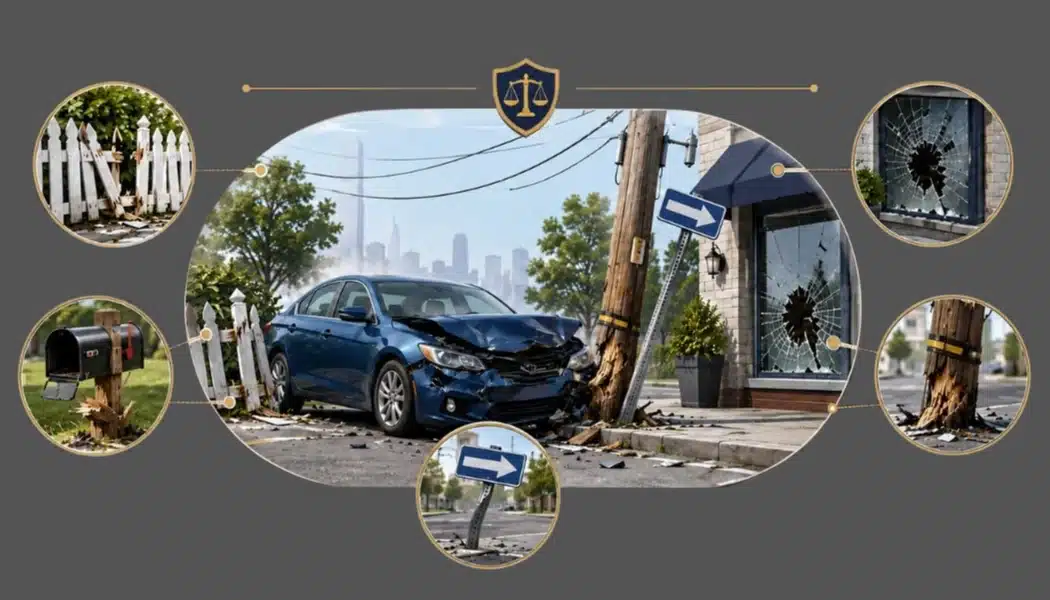
Property damage liability is insurance that pays for physical damage you cause to someone else’s property when you are at fault in an accident.
It does not pay for your own vehicle, belongings, or repair costs.
Instead, it applies to the other party’s losses, including damage to cars, trucks, motorcycles, buildings, fences, signs, utility poles, storefronts, or other physical property.
Most drivers think this coverage only applies to the other vehicle, but it is broader than that. Any property damaged in an at-fault accident can become part of a property damage claim.
Because repair and replacement costs can rise quickly, low policy limits may not cover the full loss after a serious crash.
What Property Damage Liability Covers
Property damage liability pays for damage you cause to another person’s property when you are at fault. It does not cover your own vehicle, which usually requires separate collision coverage.
- Other vehicles: Repair or replacement costs for a car, truck, motorcycle, or other damaged vehicle.
- Structures: Fences, walls, garage doors, storefronts, and buildings hit in an accident.
- Personal belongings: Items inside a damaged vehicle may qualify in some claims.
- Public property: Traffic signals, utility poles, guardrails, signs, or other infrastructure.
These claims often resolve faster than injury claims because repair or replacement costs are easier to calculate, though fault or value disputes can still delay payment.
Understanding how car accident settlements work can help you anticipate what the insurer will review and what documentation to prepare.
1. Common Examples of Property Damage Claims
Property damage claims can involve more than the other driver’s vehicle. Any physical property damaged in an at-fault accident may become part of the claim.
- Repair costs for another car, truck, motorcycle, or SUV.
- Replacement value for a totaled vehicle.
- Damage to fences, garage doors, walls, or storefronts.
- Damage to utility poles, guardrails, signs, or traffic signals.
- Personal items were damaged inside another vehicle.
- Loss of use when the damaged vehicle cannot be driven.
These claims are usually based on repair estimates, replacement costs, photos, appraisals, and evidence of fault.
2. When Property Damage Claims Become Complicated
Bodily injury settlements usually increase when injuries are serious, treatment is lengthy, or long-term effects are clear.
Strong evidence and clear fault also matter. RAND research found that the severity of bodily injury claims rose from 2014 to 2019, driven by higher medical costs and larger jury awards.
- The insurer says the vehicle is repairable, but the owner believes it is totaled.
- The total loss offer seems lower than the market value.
- The fault is disputed or shared.
- The vehicle had custom parts, upgrades, or prior damage.
- Multiple vehicles or structures were damaged.
- Diminished value is claimed after repairs.
Good documentation can help resolve these disputes before the claim becomes drawn out.
Bodily Injury vs Property Damage: Key Difference
The table below compares both coverage types across the key factors that affect an accident claim.
| Factor | Bodily Injury Liability | Property Damage Liability |
|---|---|---|
| What it covers | Physical harm to another person | Damage to another person’s property |
| Who does it protect financially | The at-fault driver (from claims) | The at-fault driver (from claims) |
| What it pays for | Medical bills, lost wages, pain and suffering, legal fees | Repairs, replacement costs, loss of use |
| Claim timeline | 6 months to several years | Days to weeks for straightforward cases |
| Average claim value | Higher – often $20,000 to $200,000+ | Lower – typically $5,000 to $15,000 |
| Legal exposure | High -injury victims can sue beyond policy limits | Lower damages are more objectively calculated |
| Covers your own losses | No | No |
| U.S. minimum required | Varies by state (most common: $25k per person / $50k per accident) | Varies by state (most common: $10k–$25k per accident) |
Bodily injury claims usually carry higher legal risk because medical costs can grow quickly. Property damage claims are easier to price, but can still exceed low limits.
Both coverages protect against claims from others, not your own losses.
What Happens when Both Claims Arise from One Accident?
Most at-fault accidents generate both a bodily injury claim and a property damage claim at the same time. The insurance company handles them as separate tracks, with separate adjusters and separate limits.
This matters because the two claims do not share a combined pool of money.
If your policy carries $25,000 in property damage coverage and $50,000 per accident in bodily injury coverage, those limits are independent. A $40,000 vehicle repair and a $60,000 injury claim both require separate coverage. Neither claim dips into the other’s limit.
It also means the timelines differ. Property damage claims often close in weeks. Bodily injury claims may stay open for months or years while the injured person finishes treatment.
During that time, the at-fault driver’s insurer is handling two separate files, and the injured party may not settle the injury portion until medical costs are fully established.
If either claim exceeds its respective limit, the at-fault driver may be personally liable for the difference. That is why reviewing both limits together matters, not just one in isolation.
Nevada Minimum Liability Requirements
Nevada sets minimum liability insurance requirements under NRS 485.185. All drivers in Nevada must carry at least:
- $25,000 per person in bodily injury liability
- $50,000 per accident in bodily injury liability (when multiple people are injured)
- $20,000 per accident in property damage liability
These minimums are shown as 25/50/20 on a policy.
In Las Vegas and Clark County, where traffic is heavy and vehicle values are often high, these floors may not cover the cost of a serious crash. A single injury involving hospitalization can exceed $25,000. A newer SUV or truck can exceed $20,000 in property damage alone.
Many Nevada drivers and insurance professionals recommend limits of at least 100/300/100 as a more practical baseline, though the right number depends on your specific financial exposure.
You can verify current Nevada minimums at the Nevada DMV or through the NRS 485 statutes.
Notes: This section covers Nevada state law. Laws vary by state. If you were in an accident outside Nevada, requirements in your state may differ.
Real-World Cost Scenarios: When Minimums Fail
State minimums protect you up to their dollar limit. Once a claim goes beyond that limit, the unpaid balance can become your personal financial responsibility. These scenarios show how quickly that can happen.
1. Bodily Injury Scenario
You rear-end a vehicle on I-15 in Las Vegas. The other driver is hospitalized with a back injury, has surgery, and misses three months of work.
Total damages, including medical bills, lost wages, and pain and suffering, come to $85,000. Your policy carries $25,000 per person in bodily injury coverage. Your insurer pays $25,000. You may personally owe the remaining $60,000.
2. Property Damage Scenario
You run a red light and hit a $58,000 pickup truck. The vehicle is totaled.
Your property damage limit is $20,000. Your insurer pays $20,000. The other driver may pursue you personally for the remaining $38,000 through a lawsuit or judgment.
3. Combined Scenario
The same accident injures two people and totals a newer vehicle. Bodily injury claims total $95,000 between the two injured parties.
Property damage totals $45,000. With a 25/50/20 policy, your insurer pays $50,000 toward injuries and $20,000 toward property. You may be personally exposed to $70,000 in uncovered damages.
For a broader look at how settlements play out, see our guide on the average settlement for a car accident in Nevada.
Liability Coverage Options for Better Protection
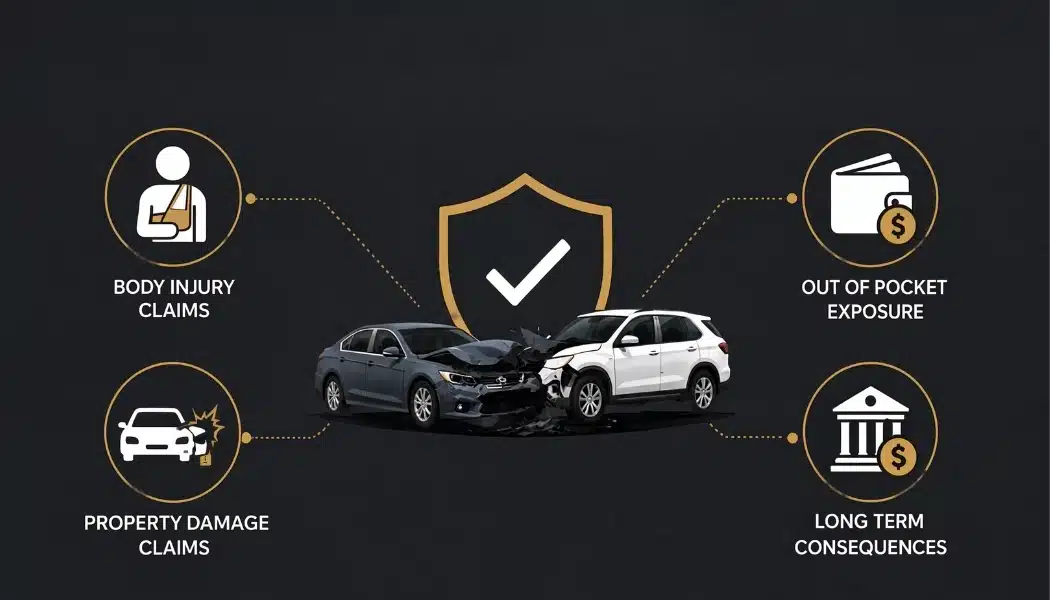
Carrying only minimum liability coverage can leave a serious financial gap after an at-fault accident.
If injury or property damage costs exceed your policy limits, the remaining balance may become your personal responsibility.
Common risks include:
- Bodily injury claims: Medical bills, lost wages, future care, and pain and suffering can quickly exceed low limits.
- Property damage claims involving newer vehicles, luxury cars, commercial equipment, or multiple damaged properties can exceed what basic coverage allows.
- Out-of-pocket exposure: A $50,000 policy limit will not cover an $185,000 injury claim or a $72,000 vehicle loss.
- Long-term consequences: Court judgments may lead to wage garnishment, liens, credit damage, or other financial strain.
State minimums meet legal requirements, but they may not provide enough protection for a serious crash.
Filing Bodily Injury and Property Damage Claims
The claim process works differently for bodily injury and property damage. Understanding what each involves helps you know what documentation to gather and what timeline to expect.
1. Filing a Property Damage Claim
After an accident, a property damage claim is usually filed with the at-fault driver’s insurer.
The company may send an adjuster to inspect the vehicle or ask for repair estimates from approved shops. If repairs cost more than the vehicle is worth, the insurer may declare it a total loss and offer actual cash value.
Common disputes involve fault, repair costs, total-loss decisions, or vehicle value. Most property damage claims resolve within weeks.
2. Filing a Bodily Injury Claim
Bodily injury claims need more proof and usually take longer.
After treatment ends or the injury stabilizes, the injured party’s attorney may send a demand package with medical records, bills, lost wage proof, and details about pain and suffering.
The insurer reviews the claim and makes an offer. Negotiations often follow, and lawsuits may be filed if liability or value is disputed. State deadlines matter because missing the filing window can result in dismissal of the claim.
When Coverage Limits Are Too Low
State minimums are a floor, not a recommendation.
When accident damages exceed your policy limits, the unpaid amount can become your personal financial obligation.
For bodily injury, the risk can be significant. If two people in another vehicle suffer serious injuries and their combined losses reach $200,000, a $50,000 per-accident limit leaves a $150,000 gap.
That amount may be pursued through a lawsuit, depending on state law. Property damage can create the same problem. If you total a $65,000 SUV but carry only $25,000 in property damage coverage, insurance pays up to the limit.
The remaining $40,000 may still be your responsibility. This is why minimum coverage often fails in serious accidents.
Ways to Reduce Liability Risk After an Accident
Carrying only minimum liability coverage leaves a serious financial gap after an at-fault accident.
If injury or property damage costs exceed your policy limits, the remaining balance may become your personal responsibility. Court judgments can result in wage garnishment, liens on property, or long-term credit damage.
Three options help most:
- Higher liability limits: Moving to 100/300/100 gives substantially stronger protection than the Nevada minimum of 25/50/20
- Umbrella insurance: Adds extra liability coverage above the auto policy for large injury or property damage claims
- UM/UIM coverage: Pays when the at-fault driver carries no insurance or insufficient coverage to cover your losses
These options matter because serious crashes can impose costs far beyond what a basic policy covers. Underinsurance creates real exposure in catastrophic injury cases, major property damage, or wrongful death.
This section covers general insurance guidance. For advice specific to your situation, consult a licensed insurance professional or attorney.
When a Liability Claim May Require Legal Help
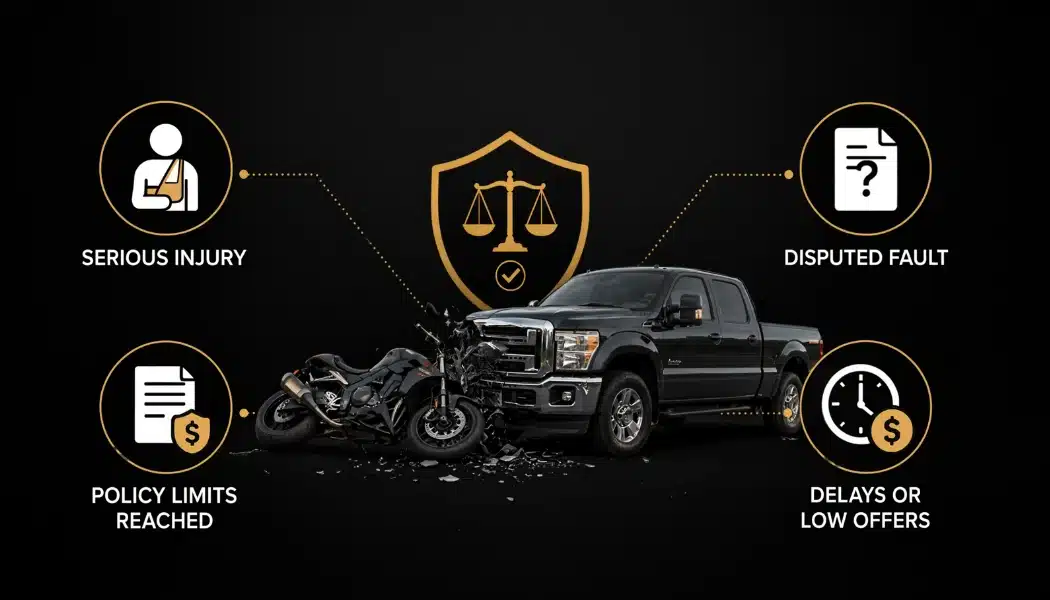
Not every accident needs a lawyer. A minor crash with clear fault and simple property damage may be handled directly with the insurer.
Legal help becomes more important when the claim involves risk, delay, or serious financial exposure.
- Serious injury: Surgery, hospitalization, or lasting symptoms can increase future medical costs.
- Disputed fault: If the insurer questions responsibility, legal support can protect the claim.
- Policy limits reached: If insurance is not enough, other recovery options may need to be reviewed.
- Delays or low offers: Insurers may undervalue claims or slow the process.
A personal injury attorney working on contingency usually charges no upfront fee.
For serious injuries or disputed claims, early legal guidance can prevent costly mistakes during settlement negotiations.
How to Choose the Right Liability Limits for Your Situation
Choosing liability limits should start with what you could lose after a serious crash. Review your income, savings, home equity, vehicle use, and daily driving risk before relying on state minimum coverage.
Drivers with assets, long commutes, teen drivers, business use, or regular highway driving may need higher limits because a single serious claim can quickly exceed basic insurance limits.
Many drivers use 100/300/100 as a stronger starting point, but the right limit depends on personal financial risk.
Umbrella coverage can add extra protection if savings, property, or future income could be exposed.
The goal is to carry enough coverage so one accident does not leave unpaid damages, personal debt, or pressure on assets beyond what insurance pays.
Conclusion
Bodily injury and property damage liability are easy to overlook until a crash turns into bills, claims, and legal pressure.
One follows the people hurt in the accident. The other follows the property damaged by it. Both can protect a driver, but only up to the limits purchased.
That is the part that matters most. Minimum coverage may satisfy the law, but it may not survive a serious accident.
Medical bills, lost wages, repair costs, and lawsuits can move fast. The smarter move is to understand the limits before they are tested. Coverage is not just paperwork. It is the financial line between an accident and a personal loss.
Have you ever reviewed your liability limits, or are you still carrying the minimum required coverage? Share your thoughts in the comments.
Frequently Asked Questions
Can a Property Damage Claim Affect My Credit Score?
A standard property damage insurance claim does not directly affect your credit. However, if damages exceed your policy limits and an unpaid court judgment is entered against you, it can create credit problems. Depending on state law, creditors may also seek wage garnishment or liens.
What Is the Difference Between a Split Limit and a Combined Single Limit Policy?
A split limit policy sets separate limits for bodily injury per person, bodily injury per accident, and property damage. A combined single limit policy provides a single limit that can be used for injury or property damage claims as needed.
Does Bodily Injury Liability Cover Emotional or Psychological Injuries?
It can. Bodily injury claims may include documented emotional distress, anxiety, or psychological trauma as part of pain and suffering damages. These claims depend on the severity, treatment records, and the quality of the injury documentation.





