Most people assume that being named executor in a will automatically gives them the power to handle an estate.
Then a bank, title company, or government office asks for a document they have never heard of, bringing everything to a halt.
If you’re navigating probate after losing a loved one, that moment can be confusing and frustrating, especially when important financial and legal matters are waiting to be addressed.
One of the most commonly requested probate documents is letters of testamentary. Yet many executors do not know what the document looks like, why institutions require it, or how it fits into the probate process.
Understanding these details early can help you avoid delays, confusion, and unnecessary setbacks during estate administration.
In this blog, we cover their appearance, contents, purpose, issuance process, state differences, authority, limitations, and common mistakes.
What are Letters of Testamentary?
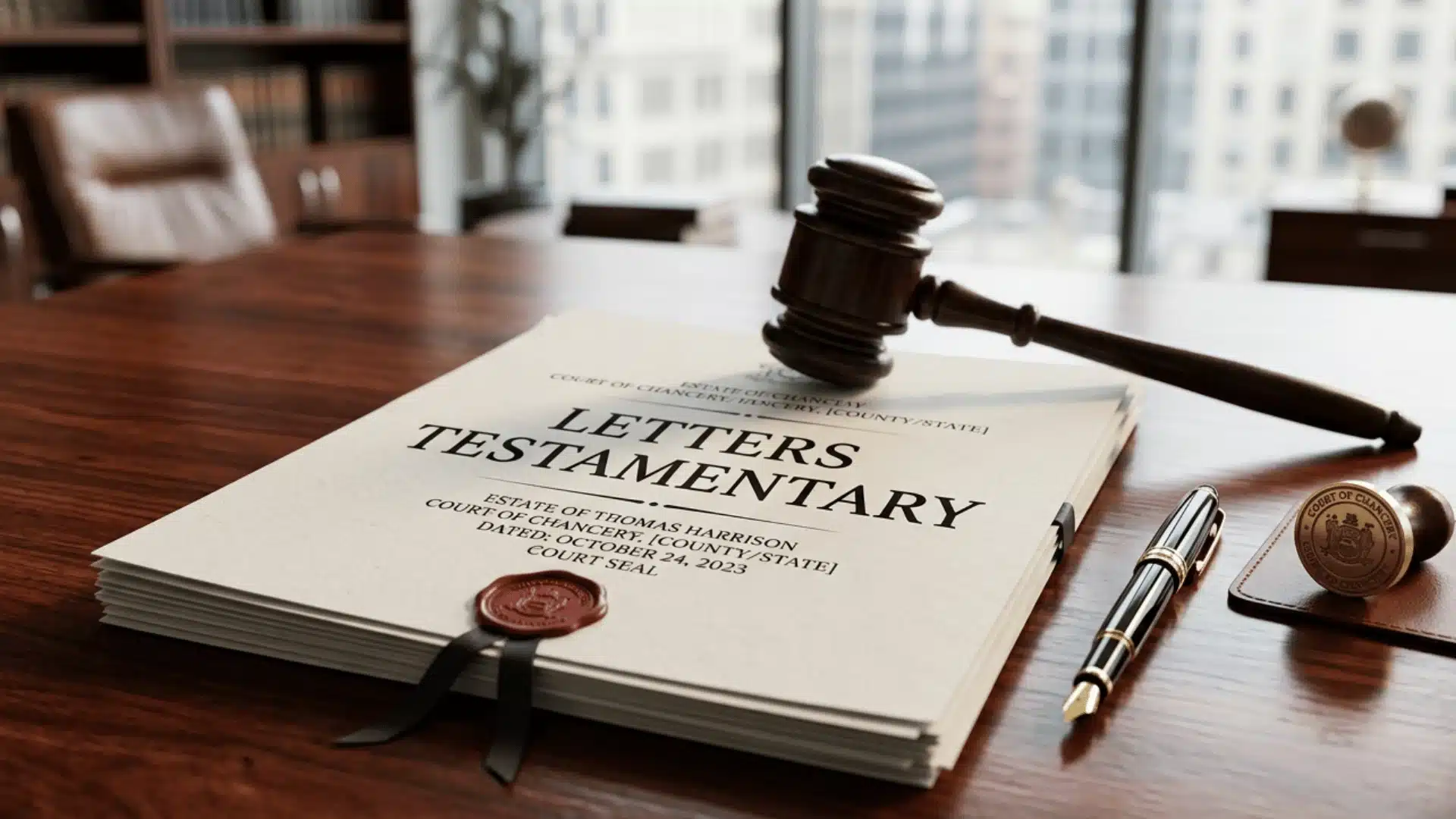
Letters of testamentary are official court documents issued during probate that confirm a will is valid and formally appoint the executor of an estate.
Rather than being a personal letter, they resemble a court order, carrying the court seal, official letterhead, and the clerk’s signature.
Their primary purpose is to prove that the executor has legal authority to act on behalf of the estate.
Banks, insurance companies, brokerage firms, and government offices often require certified copies before allowing access to accounts, property transfers, or other estate-related matters.
Letters of the Testamentary are not the will itself. The will names the executor and outlines asset distribution, while the letters grant legal authority to carry out those instructions.
They are issued only after court approval and must be obtained from the probate court. Certified copies are generally required, as ordinary photocopies are not accepted.
If a person dies without a will, the court typically issues letters of administration instead.
What Do Letters of Testamentary Look Like?
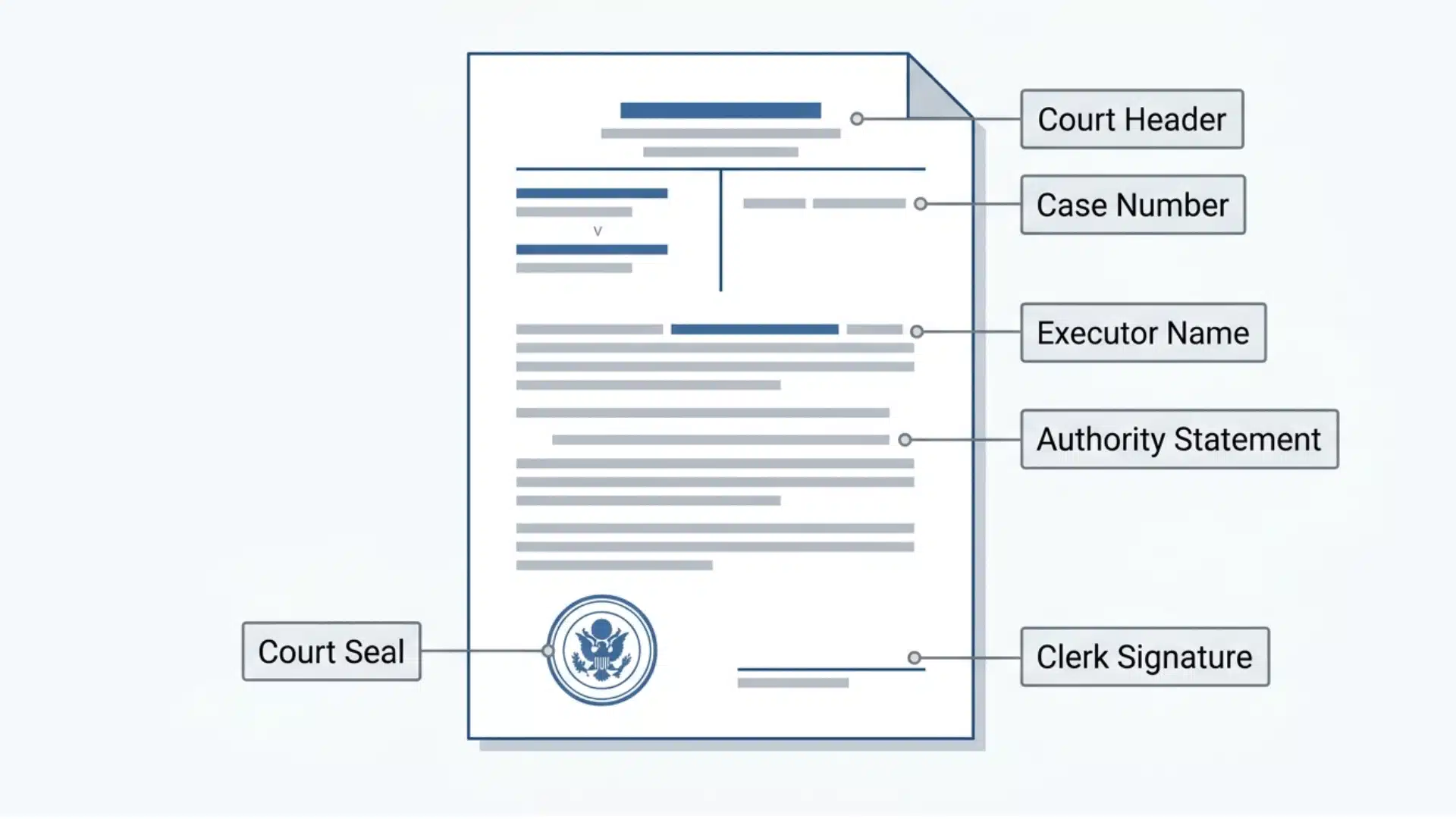
The physical document is more formal than most people expect. It does not read like a personal letter or a simple form. It looks like an official court order because, legally, that is exactly what it is.
Most letters of testamentary contain the following components:
- Court name and address: The full name of the probate court, including the county and state where it was issued.
- Case or file number: A unique identifier tied to the estate file in that court.
- Name of the decedent: The full legal name of the person who died.
- Name of the executor: The full legal name of the person appointed to manage the estate.
- Date of appointment: The date the court formally appointed the executor.
- Grant of authority: A statement confirming the executor has legal authority to administer the estate in accordance with the will and applicable state law.
- Court seal: An embossed or stamped official seal from the probate court.
- Clerk’s signature: The signature of the court clerk, which makes the document legally valid.
- Certification language: A statement from the clerk certifying that the document is a true and accurate copy of the original court record.
Different states may use terms like “letters testamentary,” “letters of testamentary,” or “testamentary letters,” but they all refer to the same court-issued document authorizing an executor to manage an estate.
Some versions also specify powers such as accessing accounts, transferring property, and filing taxes.
How Letters of Testamentary Vary by State
The core content is consistent across the country, but courts format and label the document differently. Knowing this matters if you are presenting letters to an institution that is unfamiliar with your state’s version.
| State | Term used | Court that issues it | Notable variation |
|---|---|---|---|
| Texas | Letters Testamentary | County Probate Court or County Court at Law | 4-year filing deadline; attorney typically required |
| New York | Letters Testamentary | Surrogate’s Court | File No. uses decedent’s full name in header |
| California | Letters Testamentary | Superior Court, Probate Division | Case Number labeled “Estate of [name]” |
| Florida | Letters of Administration | Circuit Court, Probate Division | Uses “personal representative” instead of “executor” |
| Illinois | Letters Testamentary | Circuit Court, Probate Division | May include expiration date on the face of the document |
If you need to manage real property or assets in a different state, you may need to open an ancillary probate proceeding there and obtain a separate set of letters from that state’s court.
What Information is Included in Letters of Testamentary?
Looking at the document section by section helps you understand what you are reading, especially if you are presenting it to a bank or institution for the first time.
- Header section: Lists the court name, mailing address, and case number. This tells the reader which court issued the authority and where to verify it.
- Estate identification: States the full legal name of the deceased and usually includes the date of death.
- Executor identification: States the full legal name of the appointed executor and confirms they have taken the required oath before the court.
- Authority statement: This is the core of the document. It typically reads something like: “The above-named executor is hereby authorized to administer the estate of the decedent in accordance with the laws of [State] and the terms of the decedent’s last will and testament.”
- Scope of authority: Some courts list specific powers granted to the executor. Others rely on state statute to define those powers by default.
- Issuance date and expiration date (if applicable): The date the letters were issued and, in some jurisdictions, a date after which the letters are no longer considered current. Some financial institutions reject letters older than a certain number of days.
- Clerk’s certification block: The final section, which includes the clerk’s signature, the court seal, and a statement that the document is a certified copy of the original court record.
If the estate includes real property, most states require the executor to present the letters to county property offices before any transfer of title can take place.
The letters authorize that process, but the actual transfer still requires additional filings at the county level.
You can also find information on how to contest a will if you believe there is a problem with the document’s validity before letters are issued.
Sample Letters of Testamentary: Example and Format
Many executors want to see a sample of letters of testamentary before starting probate.
While the exact format varies by state and court, most documents contain the same core information, including the name of the probate court, case number, decedent’s name, executor’s name, date of appointment, statement of authority, court seal, and clerk’s signature.
Sample 1: Letters testamentary (with a valid will)
PROBATE COURT OF [COUNTY NAME]
[STATE]
Estate of: John A. Smith, Deceased
Case No. 2026-PR-12345
LETTERS TESTAMENTARY
The Court finds that the Last Will and Testament of John A. Smith
has been admitted to probate.
Jane M. Smith is hereby appointed Executor of the Estate of
John A. Smith and is authorized to administer the estate according
to the laws of the State of [State] and the terms of the decedent’s
Last Will and Testament.
Issued this 15th day of June, 2026.
_________________________
Clerk of the Probate Court
[Official Court Seal]
Note: This is not an official court form. Actual letters of testamentary are issued by the probate court. Only certified court-issued documents are legally valid. Online templates carry no legal authority and cannot substitute for court-issued letters.
Sample 2: Letters of administration (no valid will)
PROBATE COURT OF [COUNTY NAME]
[STATE]
Estate of: John A. Smith, Deceased
Case No. 2026-PR-67890
LETTERS OF ADMINISTRATION
The Court finds that John A. Smith died intestate (without a valid will).
Robert T. Smith is hereby appointed Administrator of the Estate of
John A. Smith and is authorized to administer the estate according
to the intestacy laws of the State of [State].
Issued this 15th day of June, 2026.
_________________________
Clerk of the Probate Court
[Official Court Seal]
Note: This sample shows the general format for letters of administration. The authority statement references state intestacy law rather than a will. Actual documents reflect your state’s specific terminology.
Sample 3: Texas letters testamentary format
IN THE MATTER OF THE ESTATE OF
JOHN A. SMITH, DECEASED
IN THE PROBATE COURT NO. [X]
[COUNTY NAME] COUNTY, TEXAS
Cause No. 2026-PR-12345
LETTERS TESTAMENTARY
THE STATE OF TEXAS
To all persons interested in the Estate of John A. Smith, Deceased:
Know ye that on this date, the Court having found that the Last Will
and Testament of John A. Smith has been admitted to probate, Jane M.
Smith is hereby appointed Independent Executor of the Estate of
John A. Smith, Deceased, and is authorized to administer the estate
independently, without further action of this Court, except where
required by law.
Issued under the seal of said Court this 15th day of June, 2026.
_________________________
Clerk, Probate Court No. [X]
[County Name] County, Texas
[Official Court Seal]
Note: Texas courts use distinctive header language and may designate the executor as “Independent Executor” when independent administration is authorized by the will. This sample reflects the general format only. Always use documents issued by the actual probate court.
Letters of Testamentary vs. Letters of Administration
The difference between these two documents comes down to one question: did the person die with or without a valid will?
| Criteria | Letters of Testamentary | Letters of Administration |
|---|---|---|
| When issued | Decedent died with a valid will | Decedent died without a will (intestate) |
| Who receives them | A person named as executor in the will | Person appointed by the court |
| Who chooses the representative | The decedent, through the will | The court, based on state intestacy law |
| Authority granted | To carry out the will’s instructions | To distribute assets per state law |
| Probate oversight | Varies by state and will terms | Often requires more court supervision |
Both documents authorize someone to manage and distribute an estate. Executors with letters testamentary follow the will, while administrators with letters of administration follow state inheritance laws.
In some states, a valid will may allow independent administration with less court oversight. If no valid will exists, a different probate process applies.
Anyone in that situation may also want to understand what happens to a house in trust after death and whether probate is even required for all assets.
How to Get Letters of Testamentary?
The process runs through the probate court in the county where the deceased person lived. The steps are largely consistent across the United States, though some details, like filing fees and attorney requirements, vary by state.
- Gather the required documents. You will need the original will, a certified copy of the death certificate, personal identification, and, in most jurisdictions, a list of heirs and beneficiaries.
- File a petition for probate. Submit the petition, the will, and the death certificate to the probate court in the county where the deceased lived. Most courts charge a filing fee. In some states, like Nevada, probate is generally required if the estate contains real property or assets over a certain value.
- Notify interested parties. State law requires that heirs, beneficiaries, and sometimes creditors receive formal notice of the probate proceeding. This gives them a chance to raise objections before the court acts.
- Attend the probate hearing. A judge reviews the will, confirms its validity, and evaluates whether the named executor is qualified to serve.
- Take the executor’s oath. Once the court approves the appointment, the executor swears an oath to carry out their duties faithfully.
- Receive the letters. The court clerk issues the letters testamentary after the oath is taken. You can request multiple certified copies at this point. The per-copy cost is typically between $5 and $20, depending on the county.
In straightforward cases, the full process from filing to receiving letters takes about 4 to 8 weeks. Contested estates or complex situations can take a year or more.
Understanding how a family trust is structured is also worth knowing, since trust assets generally pass outside of probate and do not require letters testamentary.
How to Get Letters Testamentary in Texas?
Texas follows the same general probate framework as other states, but a few rules make its process distinct.
Texas law generally requires executors and administrators to have legal representation in probate court, making the use of a licensed attorney mandatory in most cases.
Another important requirement is the four-year filing deadline, which means a will must typically be filed with the county court within four years of the decedent’s death to be admitted to probate.
Texas strongly favors independent administration when the will authorizes it (or when all distributees consent).
This allows the executor to manage and distribute assets with minimal ongoing court supervision, often saving significant time and expense.
If a person dies without a valid will, the court appoints an administrator and issues letters of administration, with the estate distributed under Texas intestacy laws.
Regardless of being named in a will, no one may legally access or transfer estate assets until the appropriate letters are issued.
Do Letters of Testamentary Expire?
This is one of the most overlooked details during estate administration, and it causes real delays.
Some states issue letters with an explicit expiration date printed on the document. Others issue letters with no printed expiration, but require the executor to recertify periodically.
Many financial institutions have their own internal policies, often refusing letters older than 60 or 90 days, even when the state considers them valid indefinitely.
Before presenting letters testamentary to any institution, call ahead and ask whether they have a recency requirement.
If your letters are more than 60 days old, request a new certified copy from the probate court before your appointment. The cost is minimal, and it avoids a wasted trip.
Courts issue new certified copies on request. The letters themselves are not reissued. The court simply certifies a new copy with the current date, which satisfies most institutional requirements.
What Can an Executor Do With Letters of Testamentary?

Once you have letters testamentary in hand, there is a defined range of things you are authorized to do. Understanding those boundaries matters, both for moving through the process correctly and for avoiding personal liability.
Executor Powers Granted by Letters of Testamentary
Letters testamentary authorize an executor to manage estate affairs on behalf of the deceased.
This authority typically includes accessing financial accounts, selling or transferring real estate, filing tax returns, representing the estate in legal proceedings, and handling unexpected assets such as insurance proceeds or refunds.
While the letters establish the executor’s legal authority, additional documentation may still be required to complete specific transactions or transfers.
Executor Limitations and Legal Responsibilities
Letters testamentary do not give an executor unlimited control over estate assets.
Executors must follow the instructions in the will, address valid creditor claims before distributing assets, and avoid using estate property for personal benefit.
They are also required to act within the period covered by their appointment. Failing to meet these obligations can result in delays, court intervention, or personal liability.
Common Mistakes to Avoid
Many executors run into avoidable problems because probate is unfamiliar territory. These are the mistakes that come up most often:
- Assuming the will alone gives authority. It does not. A will is a set of instructions. Letters testamentary are the legal permission to carry them out. No bank or title company will accept the will as a substitute.
- Using an unofficial template. Online templates labeled “letter of testamentary” carry no legal authority. Only a document issued and certified by the probate court is valid. Using anything else wastes time and can delay the estate significantly.
- Filing in the wrong county. Probate must be filed in the county where the deceased lived at the time of death. Filing elsewhere can result in the case being dismissed or transferred, adding weeks to the process.
- Not requesting enough certified copies. Each institution you deal with, including banks, brokerage firms, real estate offices, and the IRS, may require its own certified copy. Requesting three to five copies at the time of issuance is a safe starting point. Going back to the court for more later costs time and money.
- Confusing letters testamentary with letters of administration. If the deceased had a valid will, the process leads to letters testamentary. If there was no will, the result is letters of administration. Applying for the wrong one delays everything.
- Waiting too long to begin probate. Most states have filing deadlines or practical time limits. In Texas, for example, a will must generally be filed within four years of the date of death. Delays also create problems with frozen accounts and missed tax deadlines.
- Managing estate assets before court appointment. Taking any action with the deceased’s accounts, property, or assets before receiving letters testamentary is unauthorized. This creates legal exposure for the executor and can complicate the entire probate proceeding.
When Should You Hire a Probate Attorney?
Some estates are straightforward. A surviving spouse may be named executor, the assets are simple, and the court can issue letters within a few weeks.
In these cases, having a basic understanding of probate often helps the process move smoothly. Other situations benefit from legal guidance from the beginning.
An attorney can be especially helpful when a will is contested, the estate includes property in multiple states, there are significant debts or creditor claims, or the estate may trigger state or federal estate taxes.
Legal assistance is also valuable when heirs disagree about asset distribution, including disputes involving jointly owned real estate or property with multiple owners.
Executors who are unsure about their responsibilities or potential personal liability should also consider professional advice.
Some states, such as Texas, require attorney involvement in probate proceedings, while others do not. A free consultation can help clarify the best path forward.
Conclusion
Understanding what letters of testamentary are, what they contain, and how they work can make the probate process far less overwhelming.
While most people never encounter these documents until they need them, knowing their purpose helps prevent costly delays and confusion.
A will may name an executor, but only the court can grant the legal authority needed to manage estate assets, transfer property, and deal with financial institutions.
Because every estate is different, executors should pay close attention to local probate requirements, filing deadlines, and documentation rules.
Taking the right steps early can save significant time and reduce stress for beneficiaries during an already difficult period.
Have you ever served as an executor or gone through probate with a family member? Share your experience or questions in the comments below.
Frequently Asked Questions
Can an Executor Act Before Receiving Letters of Testamentary?
No, even if a will names you as executor, you generally cannot access estate accounts, transfer property, or manage assets until the probate court officially issues letters testamentary.
Can a Bank Refuse Letters of Testamentary?
Banks generally must recognize valid letters testamentary, but they may request recently certified copies or additional estate documentation before allowing transactions.
Are Letters of Testamentary Public Records?
In most states, probate filings and letters testamentary become part of the public court record. Anyone who meets local court requirements can usually obtain copies unless the record has been sealed.