

A sense of privacy is something most people assume will always be there, especially inside personal spaces meant to feel secure and undisturbed.
That sense can quickly turn into confusion or concern after hearing a troubling story or noticing suspicious behavior in everyday surroundings.
It becomes important to understand: what is voyeurism crime, or if certain actions legally qualify as an offense.
These uncertainties create anxiety, especially in a time when recording devices are everywhere.
Clear legal knowledge provides reassurance and direction, helping readers recognize boundaries and better understand how privacy laws operate in real situations.
This blog explains the meaning of voyeurism and outlines what actions legally constitute this offense, with penalties and consequences, and common defenses against it.
What is Voyeurism Crime?
Voyeurism is a criminal act that involves secretly observing, photographing, or recording someone without their consent in a place where they reasonably expect privacy.
It is often linked to sexual intent and is illegal under both state and federal laws in the United States.
The term voyeurism comes from the French word voyeur, meaning “watcher,” which is derived from the verb voir, meaning “to see.”
It happens when someone observes an individual who reasonably expects privacy in spaces like bathrooms or bedrooms.
According to Helping Survivors, voyeurism involves secretly viewing or capturing intimate acts without the person’s knowledge or agreement.
The offense usually requires intent, often linked to sexual arousal or personal gratification.
What Actions Constitute Voyeurism Crime?
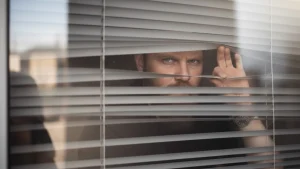
Voyeurism crime includes specific actions that invade another person’s privacy without consent in places where privacy is expected.
This can involve secretly watching someone undress, bathe, or engage in intimate activity inside a home, bathroom, dressing room, or similar private space.
It also includes using cameras, mobile phones, or hidden recording devices to capture images or videos without the person’s knowledge.
- Installing hidden cameras in bedrooms or restrooms clearly falls within criminal conduct under many state laws.
- Looking through windows with the intent to secretly observe private acts may also qualify as voyeurism in the eyes of the law.
- Upskirting is the act of secretly recording or photographing a person’s intimate areas beneath their clothing, often in public spaces like subway stations, escalators, or crowds.
- Flying a drone over private property to record someone in their backyard, bedroom, or pool area can constitute a criminal offense.
At least 15 states, including Florida and California, have passed laws specifically covering drone-based voyeurism.
Mississippi classifies drone-based spying as a felony. Indiana specifically criminalizes “remote aerial voyeurism” as a Class A misdemeanor, escalating to a Level 6 felony if the images are distributed.
Unlike a licensed investigator working within legal limits, using drones to surveil private individuals without consent can constitute criminal conduct. Understanding this distinction is essential when evaluating what qualifies as lawful vs unlawful surveillance under state law.
Casual observation in public areas such as parks, malls, or streets does not meet this legal standard. In those places, people generally do not have a reasonable expectation of privacy.
Key Legal Elements of Voyeurism Crime
Courts do not label conduct as voyeurism based on suspicion alone. Prosecutors must prove specific legal elements beyond a reasonable doubt before a conviction is possible.
1. Lack of Consent
Consent is a central issue in voyeurism prosecutions. In criminal law, consent must be explicit, informed, and voluntary.
Explicit consent means the person clearly agrees, either verbally or through unmistakable actions.
Informed consent requires that the individual understands what they are agreeing to, including the nature of any observation or recording.
Voluntary consent must be given freely, without coercion, manipulation, threats, or deception. Silence or lack of resistance does not automatically equal permission.
2. Expectation of Privacy
Expectation of privacy refers to when a reasonable person would believe they are safe from observation in a particular setting.
Courts apply an objective standard called the “reasonable person test” to evaluate this factor.
Private residences, bathrooms, hotel rooms, fitting rooms, and locker rooms typically qualify as protected spaces.
In these areas, individuals are legally entitled to bodily privacy and personal security. Without this element, prosecutors may struggle to establish criminal wrongdoing under applicable state law.
3. Intent Requirement
Criminal intent, also called mens rea, is another essential element. Prosecutors must usually prove that the accused acted knowingly and purposefully.
However, many laws also treat it as a crime when someone observes or records another person for exploitation, harassment, or unauthorized sharing, even without clear sexual intent.
Accidental or unintentional viewing without a privacy-violating purpose typically does not qualify as an offense.
Evidence such as hidden equipment placement, stored recordings, or prior conduct may be used to establish intent. Without proof, a voyeurism charge may not result in a conviction.
In my experience handling these cases in Florida courts, establishing intent is often the central battleground.
Prosecutors rely heavily on circumstantial evidence, such as the placement of a device, the angle of a camera, and search history on a phone, to build an intent argument.
4. Video Voyeurism
The use of electronic devices often increases the seriousness of the offense.
Many states have specific statutes addressing video voyeurism, which involves cameras, smartphones, hidden recording tools, or digital surveillance equipment.
Installing concealed cameras or using remote monitoring systems can elevate a charge from a misdemeanor to a felony.
Digital evidence, metadata, and forensic analysis frequently play a role in prosecution. Technology expands the scope of harm, which is why legislatures impose stricter penalties.
Florida Voyeurism Laws
According to the official Florida statute on voyeurism, Florida Statutes §810.14 makes it a crime to secretly observe or record another person in a place with a reasonable expectation of privacy.
The lewd, lascivious, or indecent intent element is one of the most litigated issues in Florida voyeurism cases. I’ve seen cases where the prosecution struggled to prove intent beyond a reasonable doubt.
It’s also worth noting: Florida law restricts the definition of “intimate area” to body parts normally covered by clothing. Watching someone in a swimsuit through a window, for example, would likely not qualify.
- Intimate Area: Intimate area means parts of the body or undergarments covered by clothing and intended to be kept from public view.
- First-Offense Penalty: A first violation is a first-degree misdemeanor, which can include jail time, fines up to $1,000, or probation.
- Repeat Offense Penalty: Two or more prior convictions elevate the crime to a third-degree felony with substantially severe punishment.
- Criminal Intent Requirement: The prosecutor must show lewd, indecent, or lascivious intent at the time of the act to meet the statutory definition.
- Video Voyeurism Against a Minor: Classified as a second-degree felony with a Level 6 severity ranking, carrying mandatory sex offender registration, up to 15 years in prison or probation, fines up to $10,000, and no eligibility for record sealing.
Washington Voyeurism Laws
Washington State Legislature defines voyeurism under the Revised Code of Washington § 9A.44.115, which outlines when secret observation or recording becomes a criminal offense.
- First Degree Voyeurism: Viewing, photographing, or filming another person without consent; this offense is a Class C felony in Washington.
- Second Degree Voyeurism: Intentionally photographing or filming someone’s intimate areas with the intent to distribute the images, classified as a gross misdemeanor.
- Privacy Expectation: The law applies only where a reasonable person would expect privacy, such as in a home, bathroom, or changing area.
- Felony Consequences: A first-degree conviction can lead to significant prison time and fines under Washington sentencing laws.
- Corrections Security Exception: Recording by corrections or jail staff for legitimate security or misconduct investigation purposes is not covered by the voyeurism statute.
Potential Penalties and Legal Consequences Nationwide

Voyeurism penalties across the United States vary by state, but every jurisdiction treats the offense as a serious invasion of privacy.
A first-time conviction is commonly charged as a misdemeanor, often punishable by up to 1 year in county jail and fines, depending on the statute.
Felony voyeurism convictions in many states carry potential prison sentences ranging from 5 to 15 years, along with substantially higher fines.
Courts may also impose probation, mandatory counseling, and restrictions on the internet.
In numerous jurisdictions, a conviction can trigger mandatory sex offender registration requirements that affect housing eligibility and employment opportunities.
Victims may also file civil lawsuits seeking monetary damages for invasion of privacy and emotional distress.
Voyeurism charges are not open-ended. Depending on the state and how the offense is classified, prosecutors typically have 2 to 3 years from the date of the offense to file charges.
However, when minors are victims, many states extend the statute of limitations significantly, sometimes until the victim turns 18 or beyond.
If you are a victim who discovered the violation years after it occurred, speak with an attorney about whether charges can still be filed in your jurisdiction.
What to Do If You Are a Victim of Voyeurism?
Immediate action is critical after discovering a voyeurism incident.
- Preserve all available evidence, including photographs, recordings, messages, devices, and surveillance footage, without altering digital files or metadata.
- Report the incident promptly to local law enforcement so an official police report can be created and an investigation initiated under applicable state statutes.
- Request a copy of the report number for legal and insurance purposes.
- Seek medical or psychological support if emotional distress or trauma symptoms develop.
- Victims may also consider consulting a licensed attorney to discuss criminal proceedings and potential civil claims for invasion of privacy.
When law enforcement responds, knowing the difference between being detained and arrested can help you better understand your rights and obligations during any interaction with officers at the scene.
A common concern in these cases is whether unintentional viewing or recording can still lead to charges.
In most states, accidental situations, like briefly seeing someone while hiking or a camera activating without intent, do not meet the legal standard for voyeurism.
The key factor is intent. However, that argument becomes difficult to defend if evidence suggests otherwise. Stored footage, repeated recordings, or a device placed in a deliberate position can point toward intent.
Even details like camera angle or placement may be used by a jury to infer purpose. In such situations, claiming it was accidental is rarely sufficient without strong legal representation.
Confidential assistance and crisis support services are available through the National Center for Victims of Crime, which provides guidance for individuals experiencing privacy violations.
Real Case Studies Related to Voyeurism Crime
Real case studies provide a clearer understanding of how voyeurism laws are applied in real situations. These examples also highlight how courts interpret concepts such as reasonable expectation of privacy and how laws continue to evolve with technology.
1. Hidden Camera in Cruise Ship Passenger Stateroom
Arvin Joseph Mirasol, a cruise ship employee, placed a hidden camera under the sink in a passenger bathroom on the Royal Caribbean Symphony of the Seas.
He secretly recorded children undressing and using the bathroom. He pleaded guilty to producing child pornography through these secret recordings.
This illustrates video voyeurism with hidden devices in a space where victims had a reasonable expectation of privacy (private stateroom bathroom), plus the serious escalation when minors are involved.
2. Upskirting in Public Mall
Sean T. Glas was caught using a camera to photograph under women’s skirts (upskirting) at a public shopping mall in Union Gap, Washington.
He took multiple images without the victims’ knowledge or consent.
The case went to the Washington Supreme Court, which analyzed whether upskirting in public qualifies under the voyeurism statute (RCW 9A.44.115).
It highlights the debate over “reasonable expectation of privacy” for intimate areas even in semi-public spaces.
Common Defenses to Voyeurism Charges
Voyeurism charges require prosecutors to prove every legal element beyond a reasonable doubt. If the prosecution fails to establish the required statutory elements, charges may be reduced.
- Consent Defense: The accused argues that clear, voluntary, and informed consent was given before any observation or recording occurred.
- No Reasonable Expectation of Privacy: The defense claims the alleged conduct occurred in a public or non-private setting.
- Lack of Criminal Intent: Evidence shows the absence of sexual intent or deliberate purpose required under the statute.
- Mistaken Identity: The accused challenges identification, questioning the reliability of witnesses or digital forensic evidence.
- Unlawful Search or Seizure: Defense asserts evidence was obtained in violation of Fourth Amendment constitutional protections.
Conclusion
Understanding voyeurism laws begins with answering a basic question many readers ask: what is voyeurism crime under different jurisdictions?
Voyeurism crime meaning is not simply inappropriate behavior; it is a criminal offense when someone secretly observes or records another person without consent in a private setting.
And as technology evolves, from miniaturized cameras to drones to cloud-based storage, what constitutes a voyeurism crime continues to expand under both state and federal law.
State laws such as those in Florida and Washington clearly define prohibited conduct and impose penalties that may include jail time, fines, and sex offender registration.
These consequences show how seriously courts treat violations of personal privacy.
Anyone dealing with a voyeurism issue, as a victim or someone facing charges, should seek guidance from a qualified attorney for advice based on state law.
Do you think current voyeurism penalties are strict enough? Share your opinion in the comments.
Frequently Asked Questions
What is Exhibitionism Crime?
Exhibitionism is a crime that involves intentionally exposing one’s private parts in public to shock or arouse others. It is typically treated as a criminal offense and may lead to fines, jail time, or registration.
What Happens If Recorded Images Or Videos Are Shared Online?
Sharing recorded images or videos often escalates charges. Laws may treat this as digital voyeurism, adding penalties like fines, jail time, and possible civil lawsuits for emotional distress or harassment.
Are There Civil Remedies For Voyeurism Victims Beyond Criminal Charges?
Yes, victims can pursue civil action for invasion of privacy or emotional distress. Compensation may include therapy costs, lost income, and damages, depending on state laws and the severity of harm.