

Kathleen Peterson’s death is the kind of case that makes you slow down before accepting the easiest explanation.
A woman is found at the bottom of a staircase. Her husband says it was a fall. Prosecutors say the scene tells a different story.
As a legal case, what matters is not the shock of the allegation.
It is the evidence: the blood on the walls, the scalp wounds, the missing weapon, the expert testimony, and the details that later came under serious doubt.
That is why the Kathleen Peterson case still holds attention more than two decades later.
It is not just about what happened inside that Durham home. It is about how far forensic evidence can take a case, and what happens when that evidence starts to break under scrutiny.
Who Was Kathleen Peterson?
Kathleen Peterson was born on February 21, 1953, in Greensboro, North Carolina.
She was the first woman admitted to Duke University’s engineering program in 1971 and went on to earn degrees in both civil and mechanical engineering.
After divorcing her first husband, Fred Atwater, with whom she had a daughter named Caitlin, Kathleen moved to Durham and rose to vice president at Nortel Networks.
She met novelist and columnist Michael Peterson there.
He had four children, including adopted daughters Martha and Margaret Ratliff. They married and built what appeared to be a stable blended family life in Durham’s Forest Hills neighborhood.
By late 2001, Nortel was in financial trouble, and Kathleen faced the possibility of losing her job. The couple was also carrying over $100,000 in credit card debt.
She held a $1.8 million life insurance policy and was the sole owner of their 14-room Forest Hills mansion.
Kathleen Peterson’s Cause of Death: What the Autopsy Found

Image source: Amazon Prime Video
The autopsy was performed on December 9, 2001, by Dr. Deborah Radisch. The official manner of death was ruled homicide.
Radisch found seven scalp lacerations along with bruises and abrasions on Kathleen’s head, neck, arms, wrists, and hands, plus a fracture in the left thyroid cartilage, an injury prosecutors linked to possible throat trauma.
Court records establish that Kathleen died from blood loss approximately 90 minutes to two hours after her injuries.
Toxicology showed a blood alcohol content of 0.07 percent and Valium in her system.
Michael Peterson’s position was that she likely fell down the stairs after drinking wine.
The defense disputed the homicide ruling, pointing to the absence of a skull fracture, brain swelling, or subdural hematoma.
Defense expert Dr. Werner Spitz argued that “injuries were more consistent with a fall than repeated blows.”
The Evidence that Challenged the Staircase Fall
Peterson said he had been by the pool before finding Kathleen at the bottom of the staircase.
He called 911 at about 2:40 in the early morning and said she may have fallen after drinking wine while wearing flip-flops.
Investigators found evidence that challenged a simple fall theory.
Blood appeared beyond the staircase, including drops on the outdoor walkway, a bloody handprint on the exterior door frame, and stains in other areas that did not clearly match an indoor fall.
Kathleen also had hair clutched in both hands with root balls attached, along with small twigs and microscopic material.
For prosecutors, the key question was simple: if she fell inside, why was there blood outside the house and evidence suggesting movement beyond the stairwell?
The Blood Evidence that Shaped the Trial
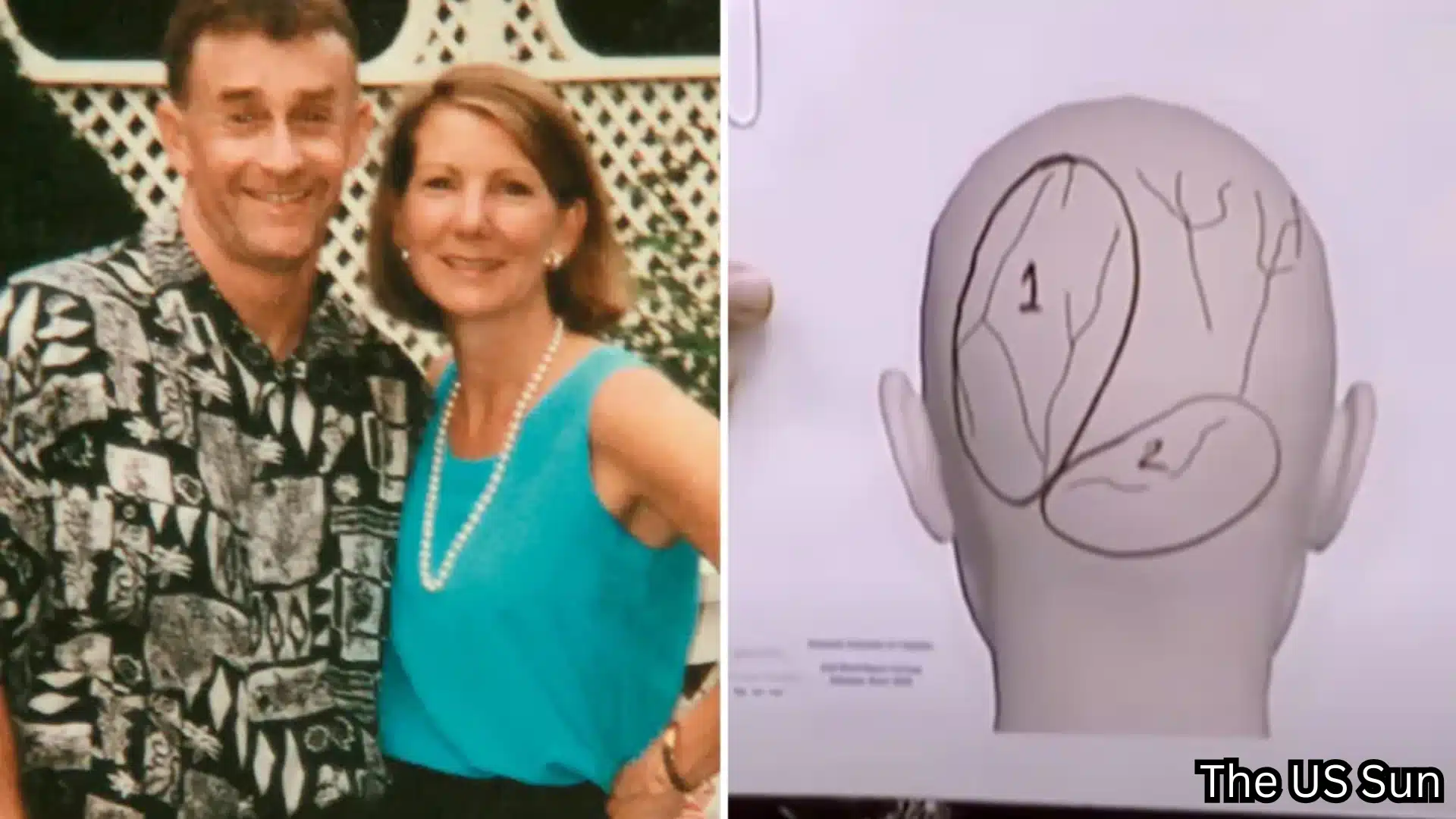
Image source: The US Sun
Blood spatter testimony was the prosecution’s strongest argument at trial.
Investigators found extensive blood on the staircase, including wall spatter and droplets reaching nearly nine feet high.
SBI analyst Duane Deaver testified that the patterns were consistent with a beating rather than a fall.
The defense countered with forensic expert Henry Lee, who argued the spatter could have resulted from Kathleen coughing blood from her scalp wounds.
He demonstrated the theory in court using ketchup. Years later, Deaver’s testimony came under serious scrutiny.
In December 2011, a judge vacated Peterson’s conviction after finding Deaver had made “materially misleading” and “deliberately false” statements
Statements about bloodstain evidence in the Peterson case and others.
The conviction’s collapse on that ground became one of the clearest recent examples of
Michael Peterson’s Trial, Conviction, and Alford Plea
Michael Peterson was indicted for first-degree murder on December 20, 2001. His 2003 trial became one of the longest murder trials in North Carolina history.
Prosecutors argued he had a personal and financial motive, citing Kathleen’s life insurance and his private messages with a male escort.
Peterson’s defense said Kathleen knew about his sexuality, and no witness claimed she was upset by it.
Jurors also heard about the 1985 death of Elizabeth Ratliff, who was found at the bottom of a staircase in Germany.
Prosecutors used that case to suggest Peterson had staged a similar accident before.
Peterson was convicted on October 10, 2003, and sentenced to life without parole. His conviction was vacated in 2011 after Duane Deaver’s bloodstain testimony was discredited.
In February 2017, Peterson entered an Alford plea to voluntary manslaughter.
The Elizabeth Ratliff Connection


The Staircase: From Documentary to TV Series

Source: Prime Video
The Kathleen Peterson case became the subject of one of the most influential true crime documentaries ever made.
In 2004, French filmmaker Jean-Xavier de Lestrade released Soupçons (“Suspicions”), an eight-part documentary series that followed Michael Peterson’s trial in real time.
The series gave viewers an unusually close look at how a murder case is built, challenged, and argued before a jury.
In 2022, HBO Max adapted the story into a scripted miniseries also called The Staircase, starring Colin Firth as Michael Peterson and Toni Collette as Kathleen.
The series shifted its focus to Kathleen’s perspective and the broader family fallout, drawing on Peterson’s self-published memoirs as source material.
Peterson later told Variety the series contained “egregious fabrications.” The HBO series was added to Netflix in December 2025, bringing renewed search interest to the case.
The Staircase Owl Theory Explained
In 2009, Durham attorney Larry Pollard suggested that Kathleen Peterson may have been attacked by a barred owl outside her home before collapsing on the staircase.
He based the theory on the shape of her scalp wounds and microscopic material found in the hair she was clutching when she died.
Supporters point to a later review that reportedly found tiny feathers and a wood fragment tangled in Kathleen’s hair.
A 2017 Audubon Society investigation said at least two scalp wounds matched a barred owl’s talon pattern, while small facial injuries were consistent with a bird’s beak.
They also cite blood drops on the outdoor walkway and a bloody handprint on the exterior door frame as signs she may have been injured before entering the house.
Why the Owl Theory Never Changed the Case
The owl theory remains disputed because key details were never fully proven or tested in court. Dr. Deborah Radisch testified that an owl could not have caused wounds as deep as Kathleen Peterson’s scalp lacerations.
The feather evidence was microscopic and was never DNA-tested to confirm it came from a barred owl. No bird was identified, captured, or confirmed near the Peterson home that night.
The theory was also never presented at Michael Peterson’s original trial, so it was never tested through full cross-examination or evaluated by a jury.
Because of that, it remains an alternative explanation rather than a legal finding.
Kathleen’s daughter, Caitlin Atwater, also filed a wrongful death lawsuit in 2002, which settled for $25 million in 2008.
Where is Michael Peterson Now?
After his release in 2017, Peterson remained in Durham for several years, writing two self-published memoirs about his relationship with Kathleen and his time in prison.
He sold the Forest Hills mansion where Kathleen died, and the house was listed at $1.9 million.
He later moved into a ground-floor apartment in Durham, a living arrangement his defense attorney David Rudolf described publicly as “a really important accommodation” given the circumstances of the case.
In April 2024, Peterson announced on Facebook that he had left Durham and moved to Reno, Nevada.
He described the move as “exhilarating and uplifting” and said he had written three additional books. He continues to maintain his innocence in Kathleen’s death.
Conclusion
The Kathleen Peterson case ended in 2017 without a definitive answer.
The official record reflects Michael Peterson’s Alford plea to voluntary manslaughter, while he continues to deny involvement.
The owl theory remains disputed, and the full truth has never been settled in court.
What remains clear is that Kathleen Peterson, a civil engineer, vice president, mother, and accomplished woman, died at 48 in a case that still raises questions.
Have thoughts on the case or the owl theory? Share your take in the comments and tell us which explanation you find most convincing.
Frequently Asked Questions
What is an Alford Plea, and How Does It Differ from a Guilty Plea?
An Alford plea lets a defendant accept a conviction and sentence without admitting guilt. Michael Peterson entered a plea in 2017 for voluntary manslaughter, ending the case while still maintaining innocence.
Did Michael Peterson Profit from the Documentary About Kathleen’s Death?
Michael Peterson cooperated with the French team behind The Staircase, which later gained wider attention on Netflix. He reportedly received some compensation and, in 2019, published Behind the Staircase.
Are Barred Owls Dangerous to Humans in North Carolina?
Barred owls are common in North Carolina, and attacks on humans are rare but documented. When attacks happen, they often involve the head or face, especially during territorial or nesting periods.
What Happened to Kathleen Peterson’s Daughter, Caitlin?
Caitlin Atwater first supported Michael Peterson but later changed her position after reviewing autopsy evidence. She filed a wrongful death lawsuit that settled for $25 million in 2008 and now lives in northern Virginia.