
A news alert says someone was charged with murder, and the story moves on without saying which kind.
That gap matters more than it seems, because the exact charge decides whether a defendant is looking at a few years or a life sentence.
Degrees of murder exist because not every killing carries the same level of planning, intent, or danger to others, and the law sorts that out before punishment is decided.
Reading a headline correctly starts with understanding how that sorting works, beginning with what separates one degree from the next.
What are Degrees of Murder?
Murder degrees are a legal classification system that ties the severity of a charge to the level of intent and premeditation behind a killing, and how that system works depends on which state you’re in.
Not every killing is treated the same under the law.
Murder is a specific category of homicide, and the degree attached to a murder charge tells you how much planning and intent the prosecution believes was involved.
Most states use a first- and second-degree structure. A handful recognize a third degree. Federal law uses only two.
Some states skip degree labels entirely and use their own naming system.
What is First-Degree Murder?

First-degree murder is defined by premeditation, and it has two legally distinct paths to that charge, both carrying the most serious penalties the law allows.
Most people picture one version: someone plans a killing and carries it out. But a person can also face first-degree murder without ever intending to kill anyone.
1. Premeditated Murder
Premeditation doesn’t require days of planning. It requires that the intent to kill existed before the act, even briefly.
Courts look for evidence that the defendant made a decision and then acted on it. Killing by poison qualifies. So does lying in wait.
Both are treated as proof of prior intent under federal law and most state statutes, because the method itself shows the killing wasn’t spontaneous.
Deliberation matters too. The defendant had to have weighed the decision, however quickly. That’s what separates premeditated murder from an impulsive killing.
2. Aggravating Factors That Can Increase a Charge
Some states move a killing into first-degree territory even without an obvious plan, based on how it happened or who was involved. Common examples include:
- Multiple victims: Killing more than one person in a single episode
- A vulnerable victim: The victim was very young, elderly, or otherwise defenseless
- Killing a public servant: Victims such as police officers or corrections staff often trigger automatic escalation
- Extreme methods: Torture or unusually cruel conduct beyond what the underlying act required
These factors vary sharply by state, so the same facts can lead to very different charges depending on where the killing happened.
3. The Felony Murder Rule
This is where first-degree murder gets counterintuitive.
In the Felony Murder Rule, someone dies during the commission of certain dangerous felonies robbery, arson, kidnapping, rape, burglary– and the person committing that felony can be charged with first-degree murder.
The law’s reasoning is deliberate.
When you choose to commit a felony that carries a serious risk of death, you’ve already made a choice that the law treats as lethal.
The death that follows is treated as a consequence of that choice, not an accident.
So a getaway driver who never entered the building can face the same murder charge as the person who pulled the trigger inside. That’s how far the felony murder rule reaches.
What is Second-Degree Murder?
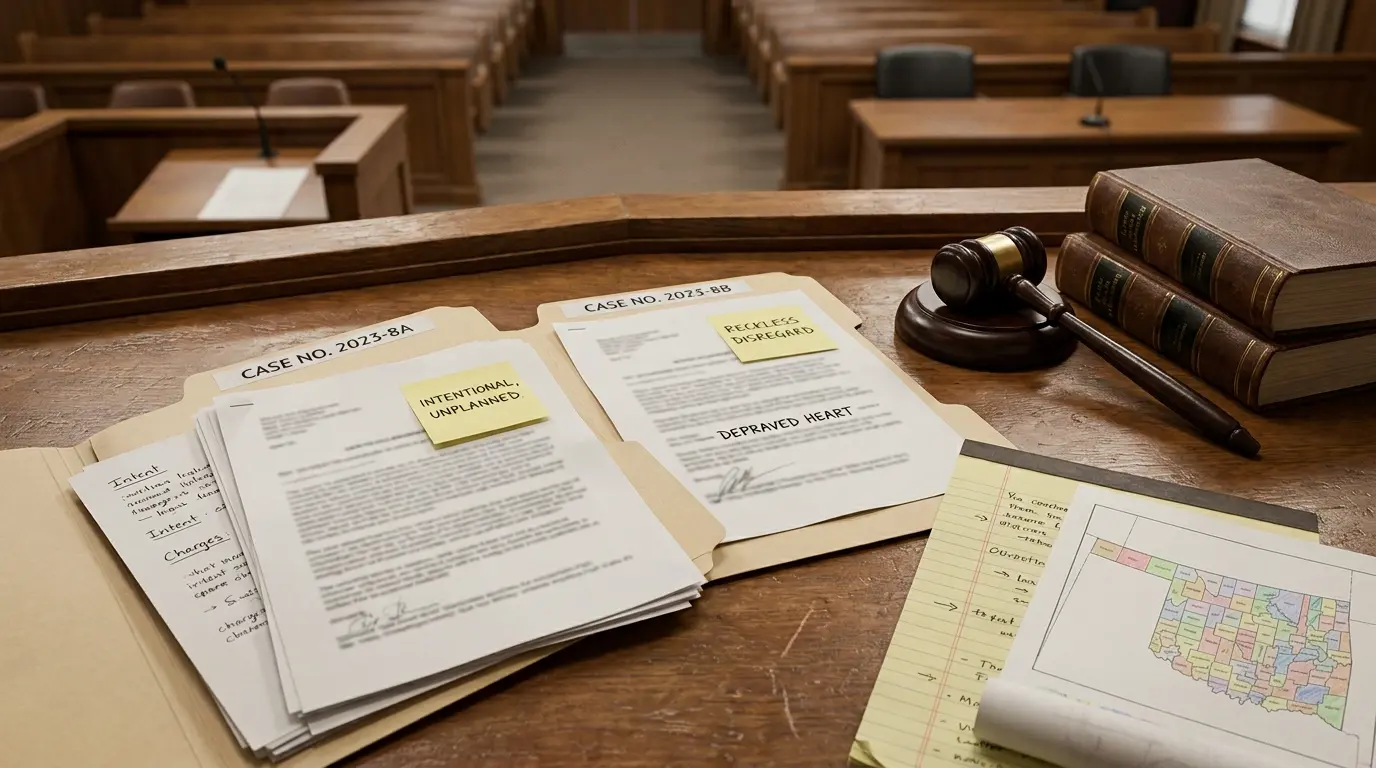
Second-degree murder is an intentional killing without premeditation; the decision to kill is formed in the moment, not before it. It also covers conduct so recklessly dangerous that intent to kill doesn’t matter.
That second path is where most people get lost.
Intentional but Unplanned
The difference between first and second degree often comes down to timing, specifically, when the intent formed.
First-degree requires that intent existed before the act. Second-degree means it arose in the moment. The killing was deliberate, but there was no prior decision to kill.
That distinction sounds narrow. In court, it’s the difference between decades and life.
Depraved Heart Murder
It’s also the part of second-degree murder that surprises people most.
A person can be convicted of second-degree murder without any intent to kill if their conduct showed a complete disregard for human life. The law calls this “depraved heart” or “depraved indifference” murder.
Firing a gun into a crowded street is the clearest example. No specific target. No intent to kill anyone. But the act itself is so dangerous that the law treats it as murder.
The logic is the same as felony murder, but the trigger is different. It’s not about what crime you were committing. It’s about how little you valued the lives around you.
Does Third-Degree Murder Exist?
Third-degree murder is not a nationwide charge. Only some states, including Minnesota, Florida, and Pennsylvania, use it, and each state defines it differently.
Similar cases are usually handled through second-degree murder or manslaughter charges.
- Florida: Covers certain unintentional killings that happen during nonviolent felonies. The felony itself triggers the charge.
- Minnesota: Applies when a person’s actions show a depraved mind or extreme disregard for human life.
- Pennsylvania: Covers murders involving malice that do not meet first- or second-degree murder standards
If you see third-degree murder in the news, check the state first. The meaning depends on the law where the case happened.
What is Manslaughter and How Does It Differ from Murder?
Manslaughter sits between murder and accidental death, and the difference between murder and manslaughter often comes down to intent, circumstances, and how reckless the conduct was.
| Type | What It Means | Key Difference From Murder |
|---|---|---|
| Voluntary Manslaughter | Intentional killing after serious provocation or heat of passion. | Reduced from murder because the law recognizes the circumstances. |
| Involuntary Manslaughter | Death caused by criminal negligence or reckless actions without intent to kill. | Recklessness is serious but does not reach murder-level disregard. |
| Vehicular Manslaughter | Fatal crash caused by reckless driving or negligence, often involving DUI. | Usually involves negligence rather than intent or extreme recklessness. |
The key difference is not just whether someone died, but why the law views the person’s actions as less or more blameworthy.
What Can Change or Reduce a Murder Charge?
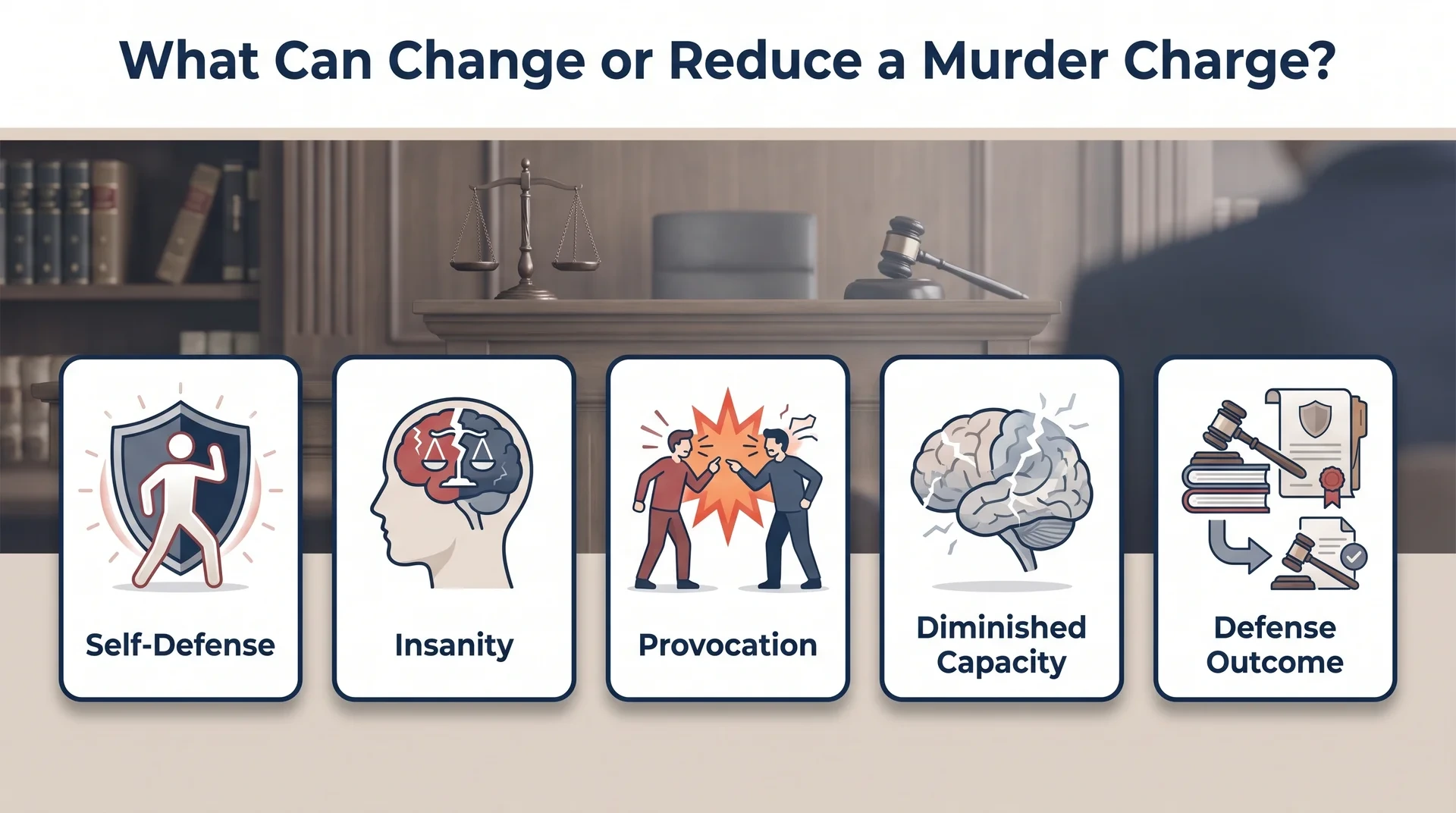
A murder charge does not always stay the same throughout a case. Legal defenses and circumstances can change how prosecutors, judges, and juries view the charge.
- Self-defense or defense of others: A murder charge can be defeated if the jury finds the response was reasonable under the circumstances.
- Insanity defense: If a defendant could not understand the nature of their actions, the charge may be affected, though the standard varies by state.
- Provocation: Adequate provocation can reduce murder to voluntary manslaughter by showing the killing happened in the heat of passion.
- Diminished capacity: In some states, impaired mental functioning short of insanity can reduce a higher murder charge to a lower degree.
- The outcome depends on the defense available: The same facts can lead to different charges depending on which legal arguments the defense can prove.
These factors show why the final outcome depends on more than the original accusation. The details behind the case can completely change the legal result.
How Does Jurisdiction Change the Charge?
There is no single national murder degree system. States define charges, while federal law operates as a separate framework.
This is what makes homicide headlines difficult to interpret. The location of the crime affects which laws apply and what charge prosecutors can file.
Every degree of murder is still charged as a felony rather than a lesser offense, unlike many felony versus misdemeanor distinctions that separate more minor crimes.
Key differences include:
- Federal law: Recognizes two degrees of murder under 18 U.S.C. § 1111.
- State laws: Most states use similar structures, but each state sets its own categories, requirements, and penalties.
- Different labels: Some states do not use degree terms at all. Texas, for example, uses categories like capital murder, murder, manslaughter, and criminally negligent homicide.
Location is not just background detail in a homicide case. It helps determine what the charge actually means.
What Penalties Attach to Each Degree?
The degree isn’t just a label; it sets the ceiling on what someone actually faces. Here is how the maximum penalty compares across federal law and the three states that recognize a formal third degree:
| Jurisdiction | Charge | Maximum Sentence |
|---|---|---|
| Federal (18 U.S.C. § 1111) | First-degree murder | Death or life imprisonment, with no lesser range available |
| Federal (18 U.S.C. § 1111) | Second-degree murder | Any term of years up to life |
| Minnesota | Third-degree murder | Up to 25 years |
| Florida | Third-degree murder (a second-degree felony) | Up to 15 years |
| Pennsylvania | Third-degree murder | Up to 40 years |
Conclusion
Understanding degrees of murder helps you read a charge with more care.
A headline may say murder, but the legal meaning depends on intent, planning, reckless conduct, state law, and the facts behind the case.
First degree usually points to premeditation or a serious felony. Second degree often covers unplanned intent or extreme disregard for life.
Third degree exists only in some states, and manslaughter can apply when the law sees the conduct differently.
That is why the same act can lead to very different penalties depending on where it happened and what prosecutors can prove.
Following a case or comparing charges? Start with the degree, then check the state law behind it.
Frequently Asked Questions
What is the Difference Between Murder and Homicide?
Homicide is the broad legal category covering any killing of a human being by another person. Murder is a subset of homicide that requires unlawful intent, expressed through malice aforethought.
What Does “Malice Aforethought” Mean?
Malice aforethought is the mental state required for a murder conviction. It does not require hatred or planning; ng it means the defendant acted with intent to kill, intent to cause serious bodily harm, depraved indifference to human life, or intent to commit a dangerous felony.
Can a Murder Charge Be Reduced to Manslaughter?
Yes. A charge can be reduced if the defendant can show that adequate provocation caused a heat-of-passion response, eliminating the malice aforethought required for murder. This argument is called a “heat of passion ” or ” provocation ” defense.
What is Felony Murder and Does It Apply in Every State?
Felony murder holds a person responsible for murder if a death results during the commission of a qualifying felony, regardless of intent to kill. Most states recognize the felony murder rule, but the qualifying felonies and degree of the resulting charge vary significantly.