
Legal terms can sound confusing until they suddenly appear in a news headline, police report, or courtroom discussion that grabs attention.
Many people stop and wonder what ” absconded ” means when they hear that a suspect “absconded” after bail or failed to appear in court.
The phrase often sounds serious, but its actual meaning is not always clear to everyday readers.
The same confusion happens with what absconding means, especially because the term is commonly used in criminal cases, immigration matters, and probation violations.
One word can completely change how a legal situation is understood.
Knowing what the law means by absconding can make legal stories, court documents, and public cases much easier to follow without feeling lost.
What Does Absconded Mean in Law?
In law, the term “absconded” means a person has intentionally hidden, escaped, or left a place to avoid legal action, arrest, court hearings, or other responsibilities required by law.
Absconding means deliberately leaving, hiding, or disappearing to avoid legal responsibility or official action.
The Nebraska Supreme Court put it plainly in Smith v. Johnson, defining the act as going “in a clandestine manner out of the jurisdiction of the courts, or to be concealed in order to avoid their process.”
That definition has held up across jurisdictions for well over a century.
The word is commonly used in criminal cases when someone disappears after being accused of a crime or after getting bail.
Courts and police usually use this term when there is proof that the person purposely avoided contact or tried to escape legal proceedings.
Absconding can lead to serious consequences such as arrest warrants, cancellation of bail, fines, or additional criminal charges.
The term may also appear in immigration, probation, or fraud-related cases where someone avoids official obligations or investigation.
Key Situations Where Absconding Applies
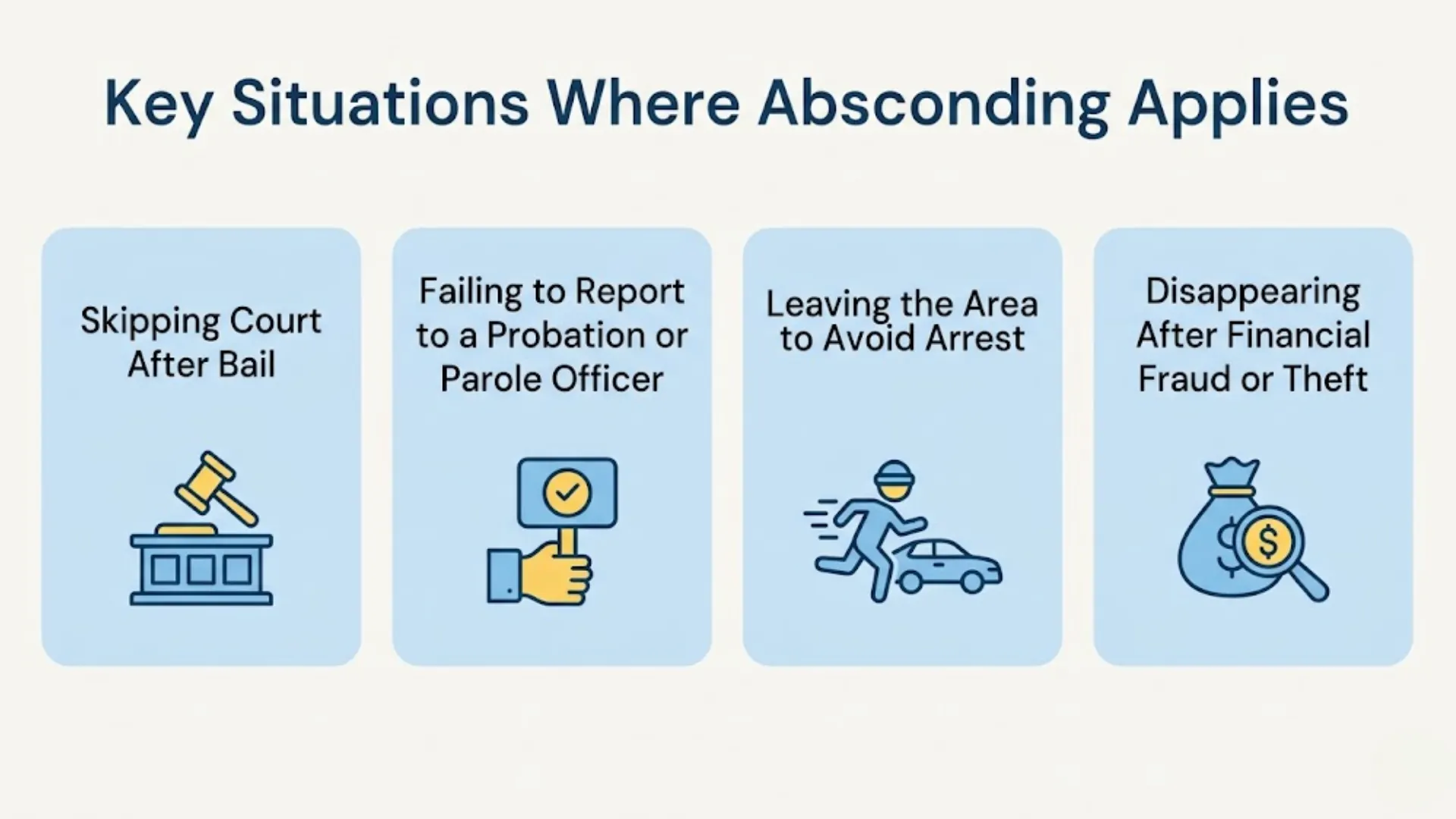
Courts usually look for signs that the person purposely disappeared or avoided contact to escape legal action. Understanding these situations helps explain why absconding is treated seriously by law enforcement and the justice system.
1. Skipping Court After Bail
One of the most common situations I have seen involves absconding, which happens when a person skips a scheduled court appearance after being released on bail.
When someone receives bail, they agree to follow certain legal conditions, including attending hearings on time.
If the person suddenly disappears or cannot be reached, the court may treat the act as absconding. This often leads to a bench warrant, bail cancellation, and additional charges.
Courts view this behavior seriously because it disrupts legal proceedings and shows an attempt to avoid facing the case or possible punishment connected to the crime.
2. Failing to Report to a Probation or Parole Officer
People placed on probation or parole must regularly report to assigned officers and follow strict rules ordered by the court.
Absconding may apply when a person stops reporting, changes location without permission, or completely cuts off communication with supervising authorities.
After handling cases involving probation violations, the pattern that I see most often is not dramatic flight; it is gradual disappearance.
In many states, probation officers first try to contact the individual before declaring them absconding.
This situation often results in probation or parole violations, which can lead to jail time or stricter supervision conditions after the person is found.
3. Leaving the Area to Avoid Arrest
Absconding also applies when a person leaves a city, state, or country to avoid being arrested or investigated for a crime.
This usually happens after police begin searching for a suspect or after criminal charges are filed.
Authorities may consider actions such as changing addresses secretly, using fake names, or avoiding known locations as evidence of absconding.
In serious cases, law enforcement agencies may work across states or internationally to locate the person.
Understanding the difference between being detained and arrested matters here, because once a warrant is issued for an absconder, any contact with law enforcement can result in immediate custody regardless of the original charge.
4. Disappearing After Financial Fraud or Theft
In fraud and theft cases, absconding may occur when a person disappears after taking money, property, or business funds illegally.
This situation is common in financial scams, workplace theft, or investment fraud cases where the accused suddenly leaves without notice.
Victims often report that the person stopped answering calls, closed accounts, or left the area unexpectedly. Investigators may treat these actions as signs of intentional evasion.
Once authorities determine the person fled to avoid responsibility, courts may issue warrants and begin legal procedures to recover losses and bring the accused back for criminal prosecution.
How Does Law Enforcement Handle Absconding Cases?
Law enforcement treats absconding as a serious violation.
Officers first issue a bench warrant or violation report. They then search using databases, phone tracking, financial records, family contacts, and tips from the public.
Local police, sheriffs, probation officers, and the U.S. Marshals Service often team up through fugitive task forces to track and arrest the person.
In California, the Parole Apprehension Team focuses on high-risk parole absconders. Texas issues warrants quickly and uses local sheriff teams for pickup.
Florida runs dedicated units and bars absconders from lighter supervision programs.
New York and North Carolina use online absconder lists and coordinate with out-of-state agencies when needed.
The goal is always the same: locate the person fast, arrest them, and bring them back to face the original charges plus new penalties for jumping.
Legal Consequences of Absconding
Absconding can lead to serious legal penalties across the United States, especially when a person skips court, violates probation, or avoids law enforcement.
In most states, courts immediately issue a bench warrant for arrest, cancel bail, and may file additional criminal charges.
Under federal law, failing to appear can result in separate penalties, including fines and prison time, depending on the original offense.
In Texas, bail jumping is treated as a Class A misdemeanor or a third-degree felony if the original case involved a felony charge.
In California, probation absconding can lead to probation revocation and jail or prison sentences under Penal Code §1203.2.
Washington law also treats bail jumping as a criminal offense with additional penalties and warrants.
In many states, absconding also reduces the chance of receiving bail or probation again in future cases.
Absconding in Different Areas of Law
Understanding how absconding applies in different legal areas makes it easier to understand court documents, police reports, and legal discussions.
- Criminal law: Absconding in criminal cases means a suspect has fled or hidden to avoid arrest, trial, or punishment. Courts respond with arrest warrants, bail cancellation, and new charges for the evasion itself.
- Probation and parole: A person under supervision is considered absconding when they stop reporting to officers, leave approved locations without permission, or go unreachable while subject to court-ordered monitoring.
- Immigration: In immigration proceedings, absconding refers to failing to appear at a scheduled hearing or disappearing after receiving a deportation or reporting order. It can result in removal proceedings being decided without the person present.
- Family law: A parent who secretly removes a child from the jurisdiction in violation of a custody order may be considered absconding. These cases often involve emergency legal intervention and law enforcement coordination across state lines.
- Financial fraud: When someone takes money or assets through fraud and then disappears to avoid investigation or repayment, courts treat the flight as evidence of guilt and move quickly on warrants and asset recovery.
- Employment disputes: Some employers use “absconding” informally when a worker leaves without notice and refuses all contact. This usage is generally not criminal unless it involves theft, fraud, or breach of a specific contractual obligation.
Absconding vs Similar Legal Terms
These terms are related to avoiding law enforcement or legal responsibility, but they have different meanings in criminal law. Understanding the differences helps make legal reports and court discussions easier to understand.
| Factor | Absconding | Fleeing | Bail Jumping |
|---|---|---|---|
| Meaning | Hiding or disappearing to avoid legal action | Running away from the police or danger | Missing a court date after release on bail |
| Legal Use | Criminal, probation, and immigration cases | Police chases and escape situations | Bail and court-related cases |
| Main Purpose | Avoiding the legal process | Escaping immediate arrest | Breaking bail conditions |
| Example | A suspect disappears after charges | A driver runs from the police | A defendant skips court |
| Common Consequences | Warrants and extra charges | Arrest and criminal penalties | Bail cancellation and new charges |
Conclusion
Understanding what absconded means helps make legal terms easier to follow in court reports, police cases, and everyday legal discussions.
The term is commonly used when someone avoids legal responsibilities by disappearing, hiding, or failing to appear before authorities.
Since absconding can lead to serious legal consequences, it is important to understand how the law uses the term in different situations.
From bail violations to probation cases, the word carries significant legal meaning across the United States.
Have you come across this term in news reports, court cases, or personal experiences? Feel free to share your thoughts in the comments below.
Frequently Asked Questions
Can Someone Return Voluntarily After Absconding?
Yes. Some individuals choose to surrender voluntarily to reduce further legal complications. Courts may consider voluntary return when reviewing warrants, bail requests, or sentencing decisions.
Does Absconding Affect Background Checks?
In many cases, active warrants or unresolved absconding records can appear during criminal background checks. This may affect employment opportunities, housing applications, or professional licensing.
Can Absconding Lead to Extradition Between States?
Yes. If a person absconds to another state, authorities may request extradition to bring them back and continue legal proceedings in the original jurisdiction.
Are Juveniles Treated Differently in Absconding Cases?
Juvenile absconding cases are often handled through family or juvenile courts. The focus is usually on supervision, rehabilitation, and returning the minor safely rather than strict criminal punishment.