

This is among the most searched legal questions online. It’s also one of the least clearly answered.
The honest answer: it depends. Not on the act itself, but on conditions most people don’t know exist until they’re already in the process.
Most expect a straightforward yes or no. What they get is a system built on starting points and escalation.
What drives that escalation, and when a misdemeanor can quietly become something far more serious, is exactly what I’ll cover today.
Is Domestic Violence a Felony or a Misdemeanor?
Domestic violence can be charged as either a misdemeanor or a felony. Which one applies depends on the specific circumstances of the incident and your prior record.
There’s no single domestic violence charge that automatically falls into a single category.
The same act, say, a physical altercation with a spouse, can result in a misdemeanor for one person and a felony for another.
The legal dividing line is straightforward. A misdemeanor means the offense carries a maximum sentence of up to one year in county jail.
A felony carries a sentence of more than one year of imprisonment, served in state prison.
A prosecutor looks at what happened, how serious the harm was, whether a weapon was involved, and whether you’ve been here before. Then they make a decision.
What Makes a Domestic Violence Charge a Felony?
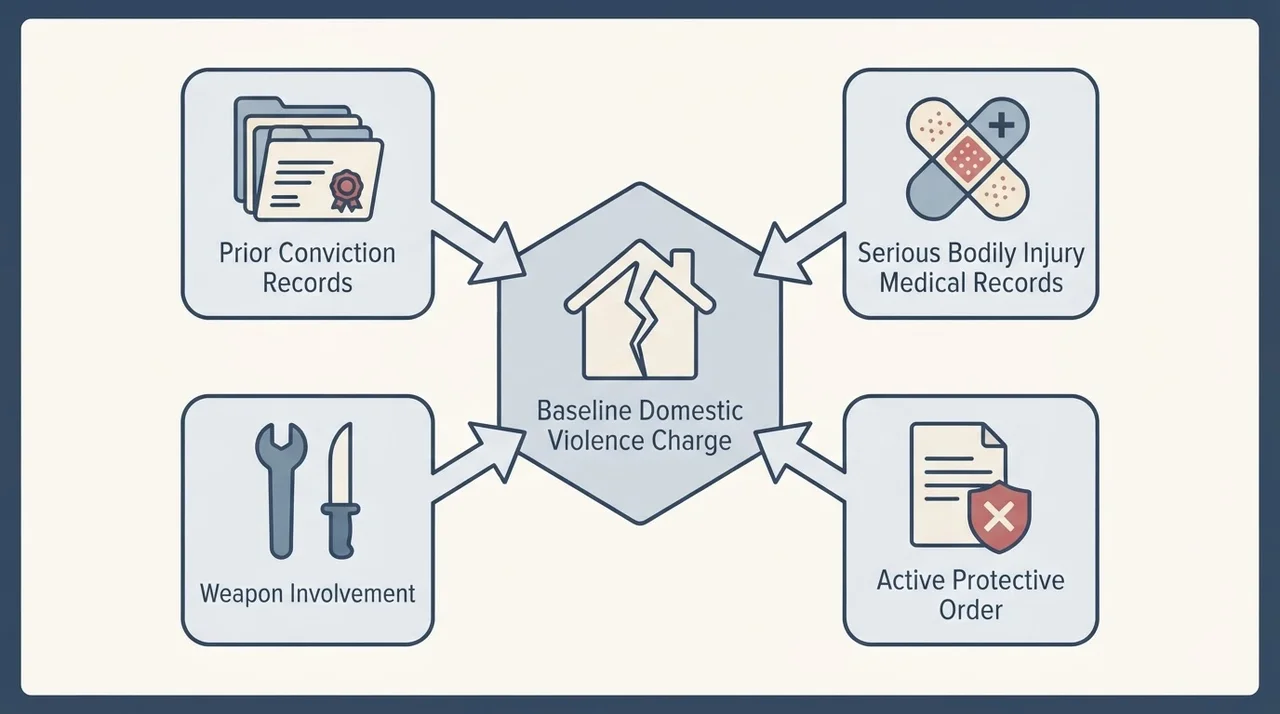
Felony classification results from specific aggravating factors stacking on top of the baseline charge, not from the act of domestic violence itself.
Those factors don’t work as a simple checklist. They interact with each other, and how much weight each one carries depends entirely on the state.
In some states, one factor is enough on its own. In others, the charge only escalates when two or more combine.
That’s why the same incident can result in different charges depending on where it happened.
Here’s where it gets important: a first-time offender isn’t automatically protected from felony charges. Certain circumstances override the usual progression entirely.
1. Prior Convictions
A prior domestic violence conviction is one of the most reliable felony triggers across the country.
In many states, a second offense is automatically a felony regardless of what happened in the current incident.
Ohio’s domestic violence statute follows this pattern, escalating to a felony once a person has one qualifying prior conviction, before anything else about the current incident is even considered.
Other states require two or more prior convictions before the felony threshold is reached. The number matters, and it varies.
2. Severity of Injury
Not all physical harm is treated equally under the law. There’s a clear legal line between simple assault and serious bodily injury.
The distinction plays out similarly in general assault charges, where the same injury threshold decides the classification.
Simple assault typically involves minor harm, bruising, pain, and non-permanent injury.
Serious bodily injury means broken bones, loss of consciousness, permanent disfigurement, or injuries requiring emergency care.
Cross that line, and the charge often escalates automatically. Prosecutors look at medical records closely for exactly this reason.
3. Weapon Use and Other Aggravating Circumstances
Using a weapon during an incident is a well-known felony trigger. Less discussed but equally weighted in most states are three others.
- Violating an active protective order: This carries the same weight as a weapon in most jurisdictions. A protective order violation during a domestic incident is treated as an aggravating fact on its own, separate from whatever physical harm occurred.
- The victim being a minor: This overrides the usual injury-based progression.
- The victim being pregnant: Courts and prosecutors treat this the same way as weapon use.
That means a first-time offender with no prior record can still face felony charges.
The nature of the circumstances overrides the baseline. Injury severity becomes secondary when any of these are present.
4. Strangulation
Strangulation is a fourth factor that deserves its own mention, since it rarely shows up in general explanations of this topic.
Federal law treats non-fatal strangulation of a spouse, partner, or family member as a serious offense in its own right, separate from ordinary bodily injury.
Federal sentencing guidelines add extra penalty levels for strangulation because these acts can cause serious harm without leaving a visible mark, which makes them easy to underestimate.
Many states have written strangulation into their own statutes as an independent felony trigger, rather than folding it into general injury categories.
The reasoning is simple: strangulation does not always show up on a medical exam the way a bruise or fracture does.
What Are the Penalties for Felony vs. Misdemeanor Domestic Violence?

Domestic violence charges carry very different penalties depending on which classification applies. The biggest difference between misdemeanor and felony domestic violence is the possible punishment.
Misdemeanors usually involve local jail, while felonies can lead to state prison time.
| Penalty | Misdemeanor Domestic Violence | Felony Domestic Violence |
|---|---|---|
| Jail or prison | Up to 1 year in county jail | 1 year or more in state prison |
| Fines | Often $1,000 to $6,000 | Often $6,000 or higher |
| Supervision | Probation with strict conditions | Longer probation or parole periods |
| Court requirements | Counseling programs, restraining orders | Counseling, supervision, and added restrictions |
| Additional penalties | Depends on state law | Enhancements may apply for injuries, weapons, or repeat offenses |
Aggravating factors can increase the sentence beyond the basic range. Serious injuries, weapon use, or prior convictions may add extra penalties.
First-time offenders may receive lighter sentences in some cases. Repeat convictions, especially involving the same victim, often lead to harsher consequences.
A conviction can also create long-term effects beyond jail or prison. These may include restrictions, financial impacts, and other legal consequences.
Learning how felonies and misdemeanors differ more broadly can help put these numbers in context.
Can a Domestic Violence Charge Be Upgraded from Misdemeanor to Felony?
Yes, a domestic violence charge can be upgraded from misdemeanor to felony; most commonly when new facts emerge during investigation or prior convictions surface before trial.
The initial charge at arrest is based on what police know in that moment. That picture can change.
Before formal filing, prosecutors review everything investigators gathered. Injury severity, weapon presence, prior convictions- any of these can shift the charge before it’s officially entered.
After filing, the window stays open. Medical records showing serious bodily injury. A prior conviction from another state that didn’t appear in the initial search. Either can prompt an amendment to a felony charge in most jurisdictions.
That window does close. Once jeopardy attaches, which typically happens at the start of trial, upgrading a charge becomes constitutionally restricted.
In practice, elevation almost always happens in the pre-trial phase. If a charge is going to change, it changes then.
Anyone with a pending misdemeanor charge should understand it isn’t necessarily final until trial begins.
Conclusion
Whether domestic violence is a felony or a misdemeanor in your case comes down to specific facts.
Your prior record, how serious the injury was, and whether a weapon, a protective order violation, or another aggravating factor was involved all play a part.
A first arrest does not guarantee a lighter charge, and the classification can still shift after the initial filing as new evidence surfaces.
If you are facing a domestic violence charge, do not assume the label attached at arrest is final or permanent.
Talk to a criminal defense attorney early, since domestic violence charges can still shift before medical records or prior history are fully reviewed in court.
Frequently Asked Questions
What is the Difference Between Domestic Violence and Domestic Assault?
Domestic assault refers specifically to the act of physical harm or the threat of it between people in a qualifying relationship. Domestic violence is a broader legal term that can include assault, battery, stalking, harassment, and in some states, property destruction, with the relationship between parties as the defining element.
Does a Domestic Violence Conviction, Even a Misdemeanor, Affect Gun Rights?
Yes. The federal Lautenberg Amendment permanently bars anyone convicted of a misdemeanor crime of domestic violence from buying or possessing firearms, with no expiration date. Felony domestic violence convictions already trigger the same firearm ban under separate federal law. Together, both conviction types can end a person’s legal ability to own a gun for life.
Can a Domestic Violence Felony Conviction Be Expunged?
In most states, felony convictions are either ineligible for expungement or face a waiting period of five to ten years with strict conditions. Misdemeanor domestic violence convictions are more frequently eligible, though the federal firearm prohibition under the Lautenberg Amendment is not removed by expungement.
Does Domestic Violence Carry Mandatory Jail Time?
Many states impose mandatory minimum sentences for domestic violence convictions, even at the misdemeanor level, typically 24 to 48 hours for a first offense. Felony convictions carry longer mandatory minimums, often one year or more, and repeat convictions can push that minimum even higher depending on the state.