
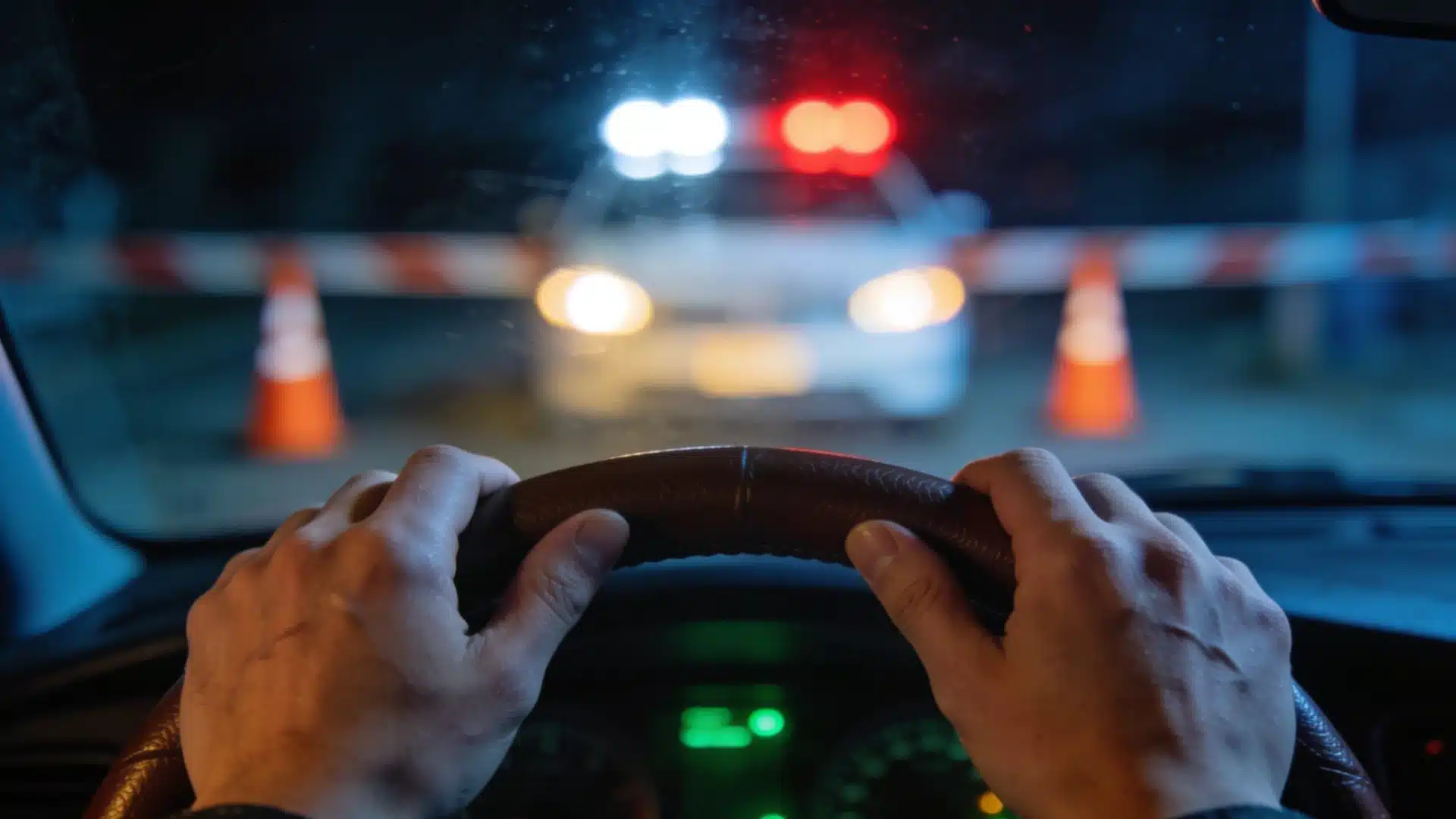
You’re driving home, and suddenly you see orange cones, patrol cars, and officers in uniform slowing traffic ahead.
You’re not sure if you’re required to stop, whether the checkpoint is even constitutional, or what you’re allowed to say once an officer approaches your window.
This confusion is more common than most drivers realize. DUI checkpoints sit at the intersection of public safety and constitutional rights, and the rules are not the same everywhere.
This blog covers the federal legal framework, which states permit or ban sobriety checkpoints, what makes a checkpoint legally valid, and exactly what rights you have if you’re stopped.
What are DUI Checkpoints?
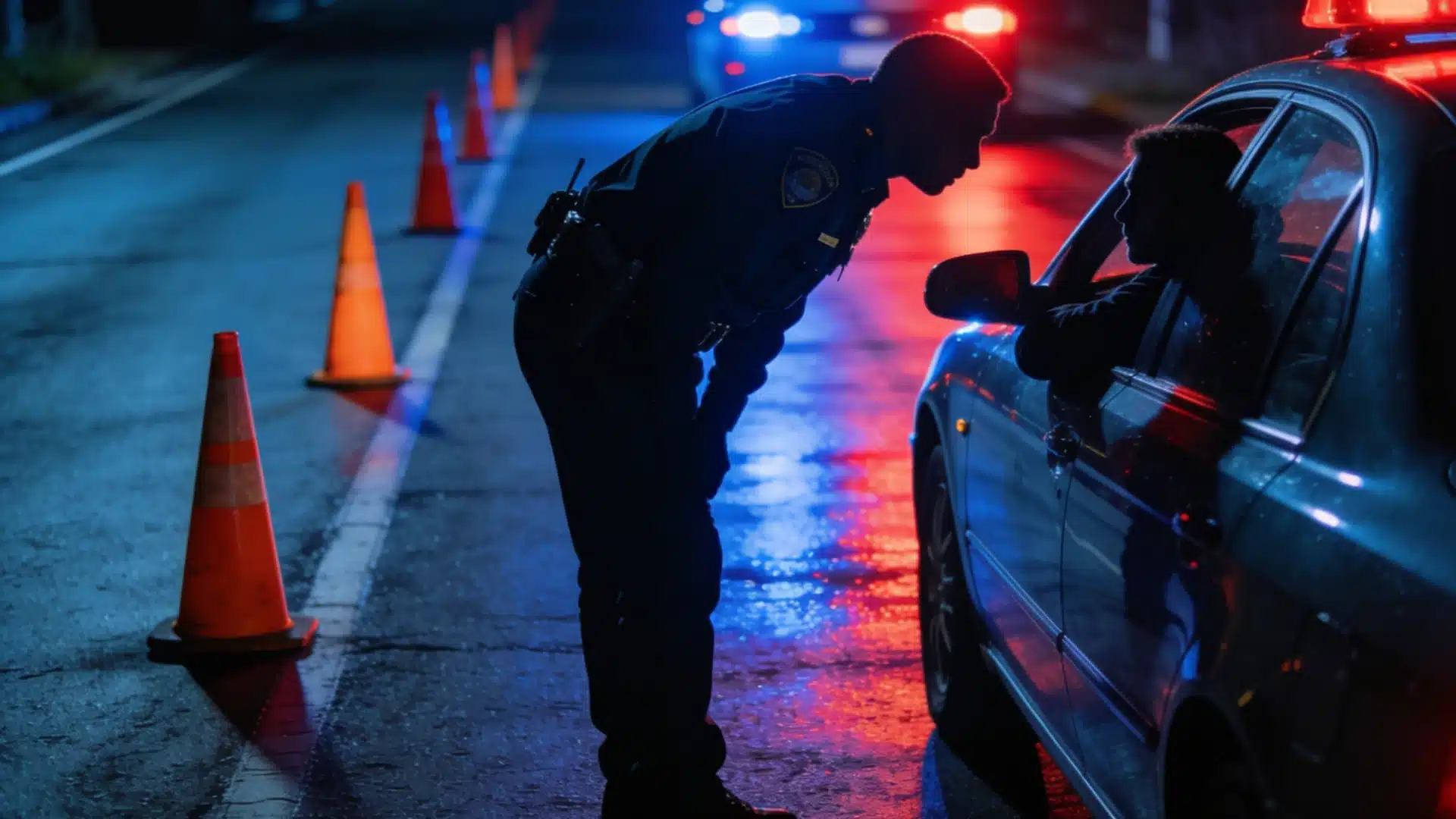
A DUI checkpoint, also known as a sobriety checkpoint, is a temporary roadblock where law enforcement systematically stops vehicles to screen drivers for alcohol or drug impairment.
Officers do not need individualized suspicion to stop you. Instead, vehicles are selected using a neutral formula, such as stopping every third or fourth car, to remove officer discretion from the process.
You may also see these called sobriety checkpoints, DWI checkpoints, or roadside safety checks. The terminology varies by state, but the legal framework is largely the same.
A typical stop lasts about 25 seconds for a sober driver. The officer asks a few brief questions, checks for visible signs of impairment, and waves you through. If something raises concern, the stop continues from there.
Colorado police also use “blitz” operations, a heightened patrol presence without a formal checkpoint to spot impaired drivers. Both are legal under state law.
Are DUI Checkpoints Legal Under Federal Law?
Yes. The Supreme Court settled the federal question in Michigan Department of State Police v. Sitz, 496 U.S. 444, a 1990 case that remains the controlling precedent today.
The Court ruled 6-3 that sobriety checkpoints are consistent with the Fourth Amendment’s protection against unreasonable searches and seizures.
The Fourth Amendment usually requires individualized suspicion, but the Court upheld DUI checkpoints, finding that the government’s interest in preventing drunk driving outweighed the minimal intrusion of brief stops.
It also treated checkpoints as administrative inspections rather than traditional investigatory stops. Four justices dissented, arguing that suspicionless stops violate the Fourth Amendment.
Understanding the legal alcohol limit is also relevant here, since officers at checkpoints are specifically watching for drivers who exceed the 0.08% BAC threshold that applies in most states.
Are Sobriety Checkpoints Legal in Every State?
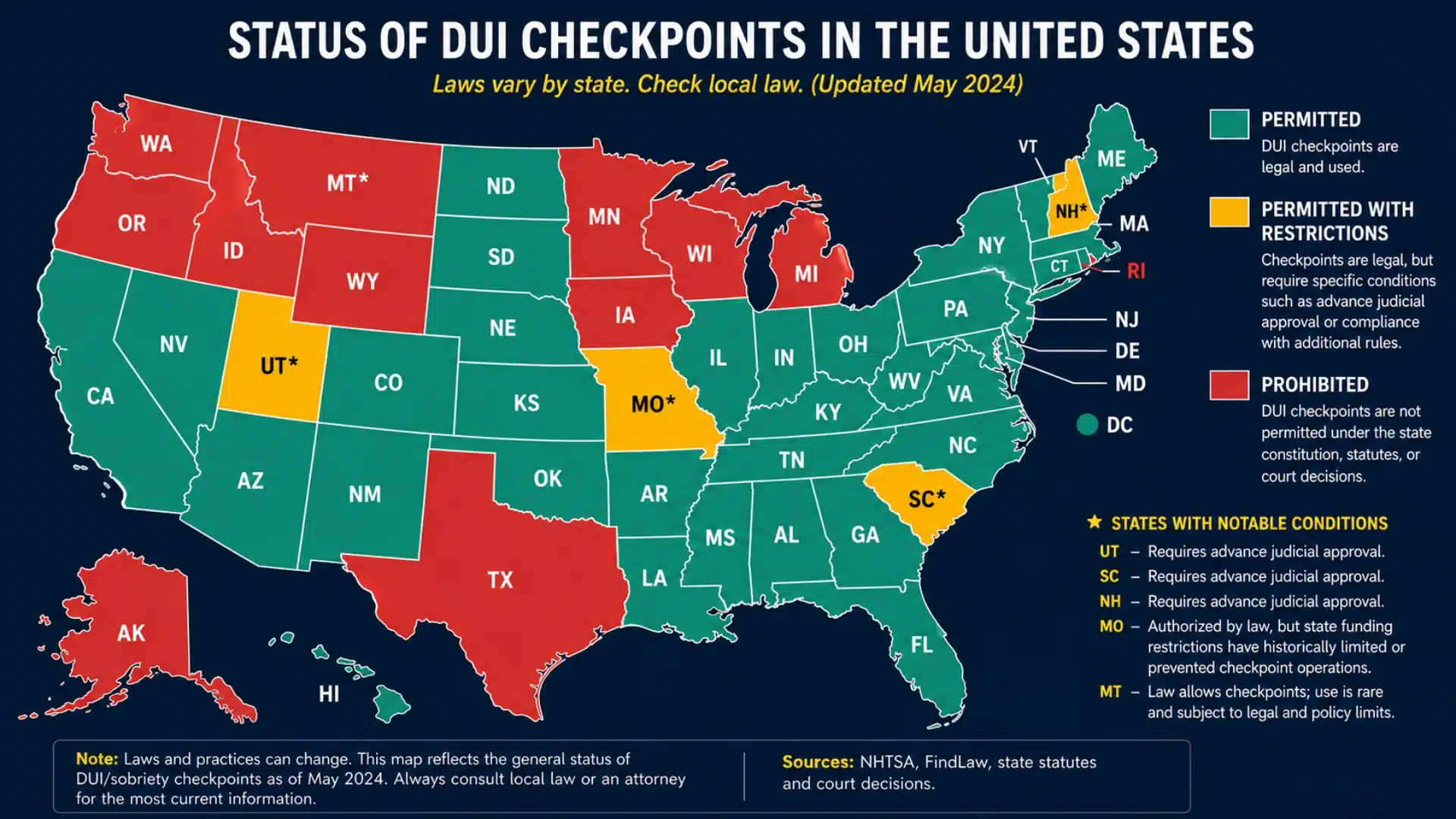
No. While the Supreme Court opened the door federally, it did not require states to use checkpoints.
It gave them the option. Thirty-eight states and Washington, D.C., allow sobriety checkpoints. Twelve states have banned them.
States where DUI checkpoints are prohibited:
| State | Basis for Prohibition |
|---|---|
| Colorado | Legal under both the U.S. Constitution and the Colorado Constitution. |
| Alaska | State constitutional protections interpreted to prohibit suspicionless stops |
| Idaho | Deemed unconstitutional under state law |
| Iowa | Banned through state constitutional interpretation |
| Michigan | Prohibited under the Michigan Constitution (despite being the state involved in Michigan Dept. of State Police v. Sitz) |
| Minnesota | State courts found that checkpoints violate state constitutional protections |
| Montana | Prohibited on state constitutional grounds |
| Oregon | Banned by the state Supreme Court in State v. Boyanovsky (1987) |
| Rhode Island | Requires statutory authority, which has not been granted |
| Texas | State courts interpret search-and-seizure protections more strictly; Article I, Section 9 of the Texas Constitution prohibits checkpoints |
| Washington | Prohibited absent specific legislative authorization |
| Wisconsin | State statute requires legislative authorization, which has not been enacted |
| Wyoming | Prohibited under state constitutional protections |
Three additional states sit in a middle category. New Hampshire, South Carolina, and Utah permit checkpoints, but only with judicial approval before the operation begins.
The Michigan situation is a notable case study. After the U.S. Supreme Court ruled in the state’s favor in 1990, Michigan’s own Supreme Court reviewed the same checkpoint program under the state constitution and concluded it was still prohibited.
Federal constitutional minimum and state constitutional protection are two different things.
What Makes a DUI Checkpoint Legally Valid?
Even in states that permit checkpoints, not every checkpoint is automatically legal. Courts evaluate both how a checkpoint was authorized and how it was actually conducted.
Federal guidelines from the Office of Justice Programs identify the core requirements that most courts apply. A legally valid checkpoint generally must meet all of the following:
- Supervisory authorization: A supervising law enforcement official, not individual officers, must authorize the checkpoint. A group of officers cannot decide on their own to block a road and screen drivers.
- Advance public notice: The checkpoint must be announced in advance. Law enforcement agencies typically notify the public through local media or official channels.
- Neutral vehicle selection: Officers must stop vehicles according to a predetermined, non-discriminatory formula. Stopping cars based on an officer’s judgment or the appearance of the driver is not permitted.
- Published location and timing: The public must have prior notice of when and approximately where the checkpoint will occur.
- Minimal detention: Stops must be brief. Extended detentions without reasonable suspicion of impairment are not allowed.
- Safety measures: The checkpoint must include adequate lighting, visible signage, marked police vehicles, and uniformed officers.
If any of these requirements were not met at a checkpoint where you were stopped, that procedural failure may be grounds to challenge evidence obtained during the stop.
What are Your Rights at a Sobriety Checkpoint?
You have more options at a checkpoint than most drivers realize. Understanding them before you encounter one is worth the few minutes it takes.
What you are required to do:
- Stop when directed by law enforcement
- Provide your driver’s license, vehicle registration, and proof of insurance
What you are not required to do:
- Answer questions about where you have been or whether you have been drinking. The Fifth Amendment right to remain silent protects you from incriminating yourself. You can politely decline to answer.
- Submit to a vehicle search. Without a warrant or probable cause, you can refuse consent to search your car.
- Perform field sobriety tests. In most states, these are voluntary for drivers over 21. Refusing them may raise suspicion, but it is generally not independently penalized.
The post-arrest chemical test is a different matter. Once you are lawfully arrested, most states’ implied consent laws require you to submit to a breath or blood test.
Refusing at that stage carries automatic penalties in most states, including license suspension, and the refusal itself can be used as evidence.
If you are detained or placed under arrest at a checkpoint, ask for an attorney immediately and do not answer further questions.
Can You Legally Avoid a DUI Checkpoint?
Yes, with important conditions. Avoiding a checkpoint is not illegal by itself. You can make a legal U-turn, take a legal exit, or turn onto a side street before reaching the checkpoint.
Police cannot legally stop you solely because you turned around before reaching the stop.
The critical word is “legal.” If you make an illegal U-turn, cross a double yellow line, or commit any traffic violation while maneuvering away, officers have grounds to pull you over on that basis independent of the checkpoint.
Many departments also position officers away from the checkpoint specifically to watch for avoidance maneuvers, so any evasive move must be completely within the rules of the road.
What Happens if a Checkpoint Was Conducted Illegally?

A checkpoint that failed to follow required procedures may not produce legally admissible evidence.
Courts apply what is commonly called the exclusionary rule: evidence obtained in violation of your constitutional rights cannot generally be used against you in court.
An attorney can challenge the checkpoint’s validity by examining the authorization documents, the notice given to the public, the selection method used, and the length of individual stops.
If the checkpoint did not meet legal requirements, a motion to suppress the evidence could result in charges being reduced or dismissed entirely.
This does not happen automatically. It requires someone to identify and raise the procedural issue, which is why legal representation after a checkpoint arrest matters.
Conclusion
So, are DUI checkpoints legal, and are sobriety checkpoints legal in Colorado? In most cases, yes, but that answer should never make drivers feel powerless.
A sobriety checkpoint must still follow legal limits, fair procedures, and basic rights. That is the point worth remembering.
These stops are meant to reduce impaired driving, not erase protections or excuse careless enforcement.
Knowing what officers can ask, what drivers must provide, and when a stop may be challenged brings clarity where fear often takes over. The road ahead should be safer, but it should also be fair.
Have you ever been stopped at a DUI checkpoint? Did the experience seem routine, or did something about it feel questionable? Share your experience in the comments.
Frequently Asked Questions
Do Police Have to Announce DUI Checkpoints in Advance?
Usually yes. Most states require advance public notice, and checkpoints without it may be challenged in court.
Can I Be Arrested Just for Avoiding a DUI Checkpoint?
No. Legally avoiding a checkpoint is not a crime, but police can stop you if you commit a traffic violation while doing so.
Do DUI Checkpoints Actually Reduce Drunk Driving?
Yes. Studies show that well-publicized checkpoints can reduce alcohol-related crashes by about 20% through deterrence.
Can a DUI Charge from a Checkpoint Be Dismissed?
Yes. If the checkpoint violated legal requirements, evidence may be suppressed, which can lead to reduced or dismissed charges.